The market Alisaproxy trades in has a wide honesty range. Some vendors publish every tier, some publish a starting rate that nobody reaches, and a few publish nothing at all. Knowing which kind you are looking at is half the decision.
Alisaproxy on the record
The company behind the name sits at alisaproxy.com.
What we do not hold is a current, sourced price for Alisaproxy. Rather than print a figure we cannot stand behind, this page leaves it out and tells you what to look for when you read their page yourself.
Look for the tier you would actually land in, not the one at the bottom of the table, and find the expiry and failed-request clauses before the rate impresses you.
What is on their front page
As of 9 September 2026 the tab reads "ProxyBG , Мобильные прокси в Болгарии, Быстро и надёжно". The blurb under their search result reads: "Премиальные мобильные прокси в Болгарии. Реальные IP-адреса операторов A1, Telenor, Vivacom. 99.9% uptime, безлимитный трафик, мгновенная активация."
Reading the same page for the things buyers actually ask about:
We found no separate pricing page linked from the homepage, which usually means the price arrives by quotation.
Every line above is a quotation from their marketing rather than a measurement by us. It is included because it is checkable, not because it is evidence of performance.
Longevity, on the public record
The domain was registered on 24 March 2022, through NameCheap, Inc, which makes it about 4 years old. Those dates come from a registry query on 9 September 2026. Their registration is booked through 24 March 2027.
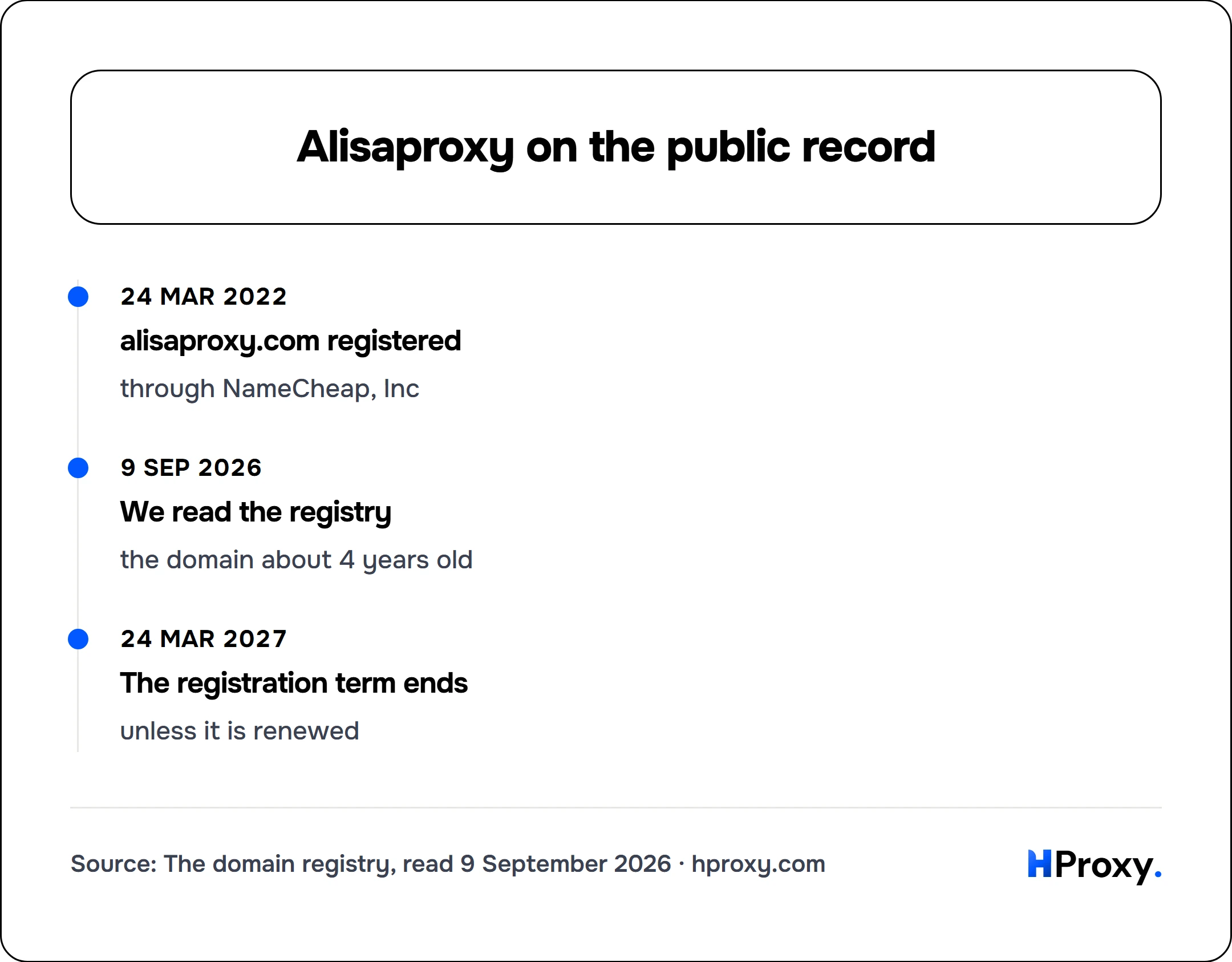
24 Mar 2022
alisaproxy.com registered
through NameCheap, Inc
9 Sep 2026
We read the registry
the domain about 4 years old
24 Mar 2027
The registration term ends
unless it is renewed
Read that as a floor rather than a recommendation. Longevity says somebody has kept paying the registrar, and in a market with this much churn that is worth ten seconds of your attention.
Where published figures stop being useful
Who else is using your address
A shared address arrives with a history you did not create and cannot see. For read-only work it rarely matters. For anything that keeps a session, it is the most common cause of unexplained failure.
The line item hidden in the success rate
Some vendors bill every request, some bill only successful ones, and the difference is the whole comparison once a target starts blocking. A cheap rate with a fifty percent success rate is twice its advertised price.
What actually caps your throughput
Rate limits are often enforced per account rather than per plan, which means buying more traffic does not raise them. Confirm how yours scales before you assume a bigger plan runs faster.
A comparison that admits what it cannot say
This is the shortest table that still decides the purchase:
| Question to ask | Alisaproxy | HProxy |
|---|---|---|
| Entry price | Not verified by us, read their page | From $0.44/GB, pay as you go |
| Does unused balance expire? | On their own terms page | Never |
| Minimum commitment | Read their current terms | None |
| Identity checks | Worth confirming in writing before you commit | Card orders are screened, and verification is sometimes requested |
| Targeting | Their terms page answers this | Country, city and ISP |
| Free way to evaluate | Check the current terms, this one moves | Free proxy list and proxy checker |
Nothing in that table settles the decision on its own. It narrows the field to two or three, and then measurement finishes the job.
How to settle it yourself in ten minutes
Run this before you commit any volume. It replaces every opinion on this page, including ours.
- Buy the minimum each side offers. Prefer a small paid batch over a trial, because trial traffic does not always ride the same pool.
- Send an identical workload through each: same target, same tooling, same time of day, same request mix.
- Measure what came back correctly and what it consumed, then divide the spend by the successes.
- Push a sample of exit addresses through an independent checker and confirm the country and connection type are what was advertised.
- Keep whichever pool won on your job. Re-run this whenever success rate drops or the bill moves.
Who else is in this bracket
The same treatment, applied to the providers most often weighed against this one:
- WonderProxy alternatives
- XenProxy alternatives
- Xiaoxiangdaili (小象代理) alternatives
- Xiaoxiongip (小熊代理) alternatives
- Xiongmaodaili alternatives
Our side of it
What we offer is one account holding residential, ISP, mobile and datacenter, priced from $0.44 per GB on residential, with no tier to climb and no allocation to lose at month end. Whether that suits you depends on how steady your volume is.