 Covered LuxSocks
In the carding scene, LuxSocks was a name you just knew. Carding is payment-card fraud, using stolen card numbers to buy things, and the people doing it needed one specific tool: a proxy that made a stolen card look like it was being used by its real owner, at home, in the right city. LuxSocks sold exactly that. It was a Russian marketplace for SOCKS5 proxies (SOCKS is a proxy protocol that forwards raw traffic, and version 5 adds authentication and remote name lookups), it took Bitcoin, it asked no questions, and for years it was one of the default answers when a fraudster needed a clean-looking exit.
Then, in January 2022, it went dark. No migration, no successor, just a dead marketplace where a busy one used to be. We run a residential proxy network and we study how this industry sources its IPs, so LuxSocks matters to us for the same reason VIP72 does: it is a clean example of why the words on a proxy listing tell you nothing, and the pool behind it tells you everything.
What LuxSocks actually was
LuxSocks was a storefront for SOCKS5 proxies, sold one at a time. You registered for a couple of dollars, funded a balance in Bitcoin, and rented individual proxies filtered by country, region, and city. At the end of its life it advertised a pool in the region of 25,000 SOCKS5 IPs. The pricing model was the tell: you were not buying bandwidth for a scraper, you were shopping for a specific IP in a specific place.
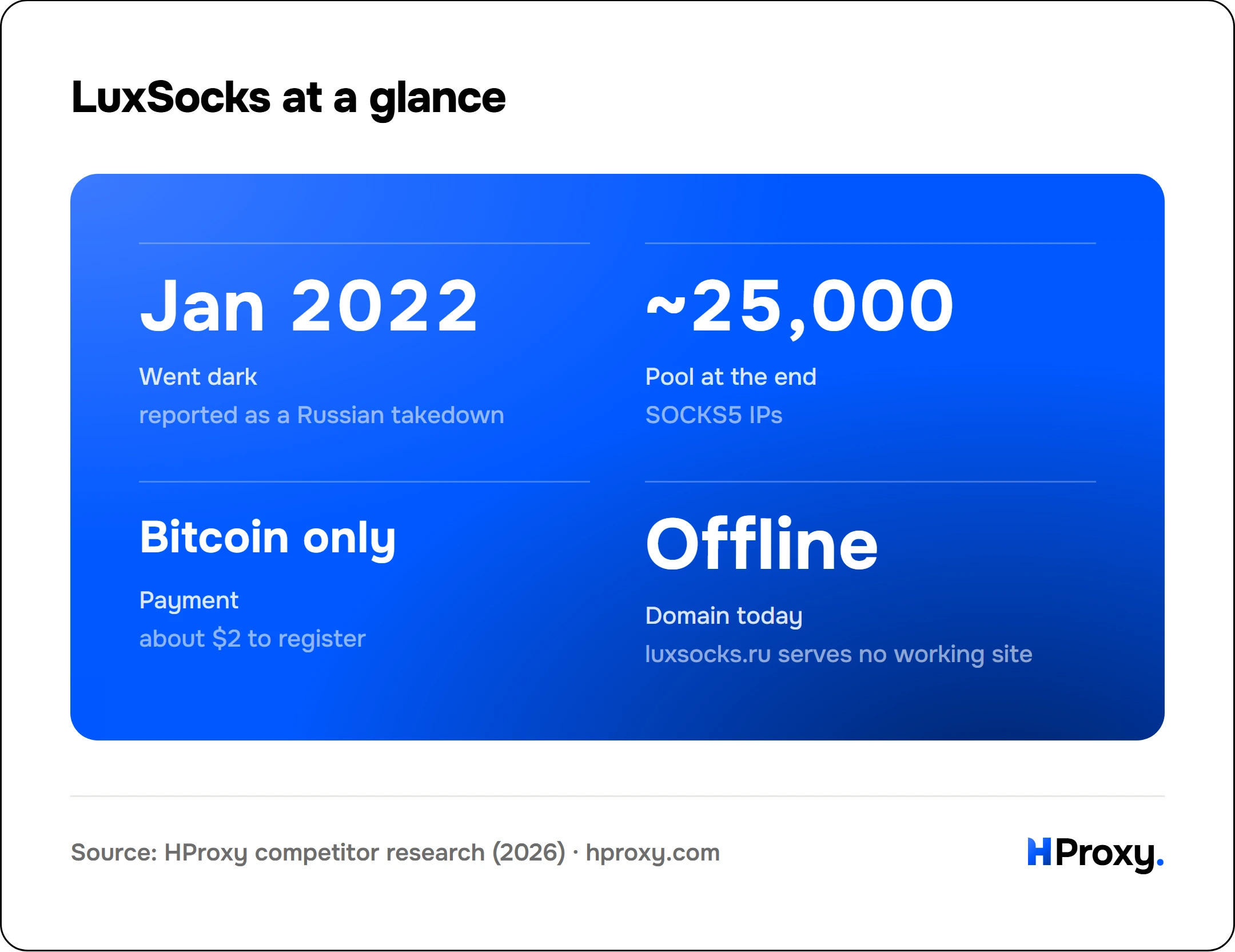
LuxSocks at a glance
- Jan 2022
- Went dark
- ~25,000
- Pool at the end
- Bitcoin only
- Payment
- Offline
- Domain today
reported as a Russian takedown
SOCKS5 IPs
about $2 to register
luxsocks.ru serves no working site
Source: HProxy competitor research (2026)
That "specific IP in a specific place" is the whole game, and it is worth understanding even if you never go near this world, because it explains why a certain kind of proxy exists at all.
Why carders wanted SOCKS in the first place
Banks and card processors fight fraud partly with geography. If a card that has only ever been used in Ohio suddenly buys electronics from an IP address in another country, that transaction gets flagged or declined. It is one of the oldest and most reliable signals in fraud detection.
A SOCKS proxy in the cardholder's own city defeats that signal. The fraudster routes the purchase through an IP that geolocates to the victim's home area, and to the bank the transaction looks local and ordinary. That is the entire reason a market like LuxSocks could charge for individual, geographically precise SOCKS5 proxies. It was not selling privacy or scraping capacity. It was selling the appearance of being somewhere you were not, aimed squarely at people committing fraud.
This is the same mechanic a legitimate residential proxy uses for legitimate reasons, which is exactly why sourcing, not the label, is what separates the two. The tool is neutral. The supply chain and the intent are not.
The night it went dark
In January 2022, LuxSocks stopped. In the fraud community it was reported as a takedown by the Russian government, and the timing lines up with a moment when Moscow was making a rare public show of arresting cybercriminals. We cannot point you to a Russian government press release naming LuxSocks, so treat the exact agency as community-reported rather than confirmed. What is not in doubt is the outcome and the date: the marketplace went dark in January 2022 and never came back, and the luxsocks.ru domain has since lapsed into a dead, non-resolving shell.
What makes the date meaningful is what it sat inside. LuxSocks did not die alone. It went down in the middle of a wave.
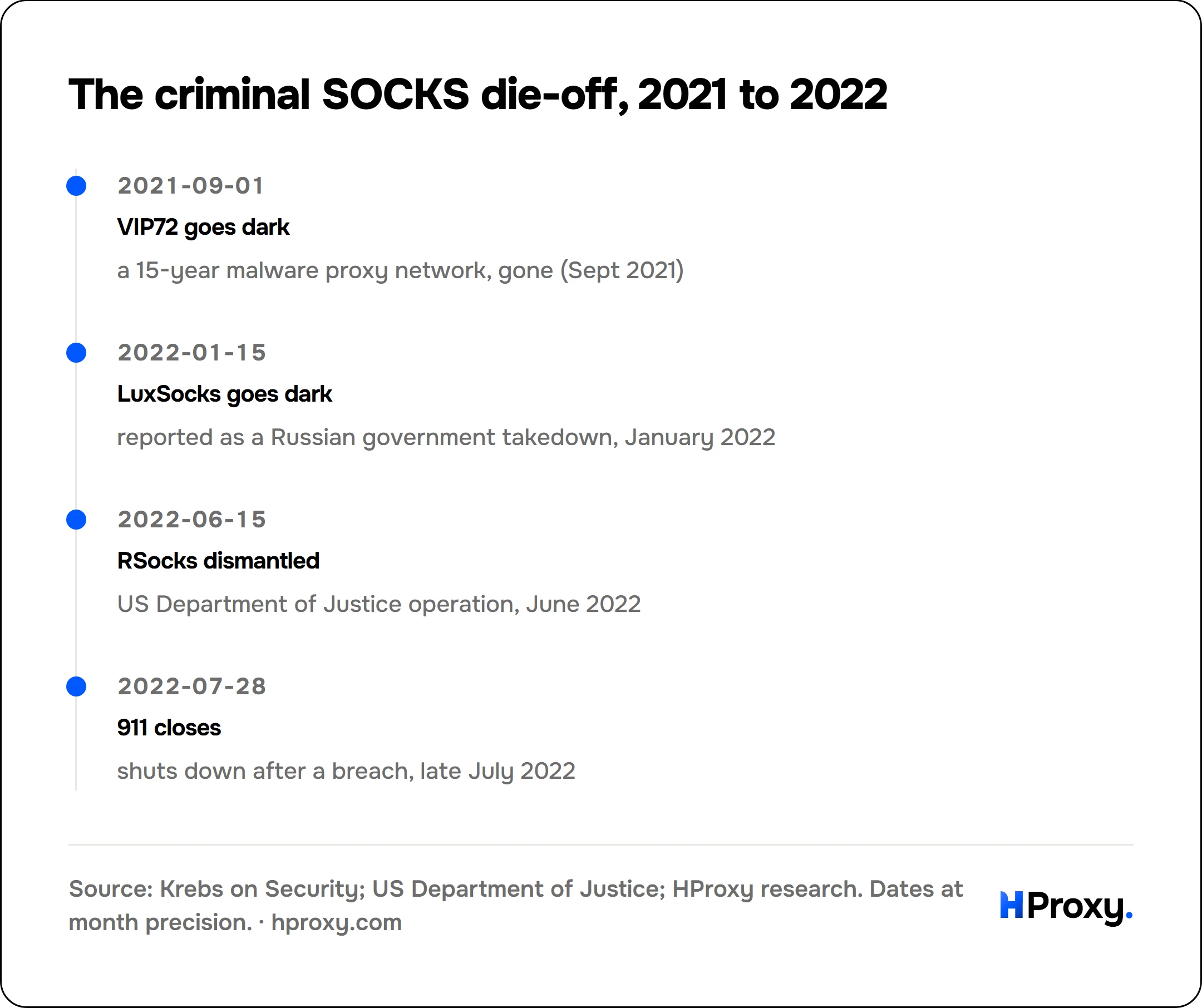
2021-09-01
VIP72 goes dark
a 15-year malware proxy network, gone (Sept 2021)
2022-01-15
LuxSocks goes dark
reported as a Russian government takedown, January 2022
2022-06-15
RSocks dismantled
US Department of Justice operation, June 2022
2022-07-28
911 closes
shuts down after a breach, late July 2022
LuxSocks was not alone: the 2021 to 2022 SOCKS die-off
Line the events up and a pattern jumps out. VIP72 went dark in September 2021. LuxSocks followed in January 2022. RSocks, another Russian SOCKS operation, was dismantled by the US Department of Justice in June 2022. 911, which advertised more than 200,000 IPs harvested from malware-infected machines, shut down after a breach in late July 2022.
Security journalist Brian Krebs wrote about this cluster directly, counting LuxSocks among the SOCKS proxy services that "closed or were shut down by authorities" in that stretch, and describing the net effect as a supply-chain crisis for cybercriminals. The services that hid criminal traffic were themselves getting hidden, seized, or breached, and the ones left standing, like SocksEscort with its roughly 14,000 hacked computers, were suddenly overwhelmed with demand. For once, the plumbing of online fraud was visibly under strain. LuxSocks was one of the pipes that burst.
What buyers actually inherited
Strip away the drama and LuxSocks is a lesson about what you are really buying when you buy a proxy. You are not buying an IP address. You are inheriting that IP's history.
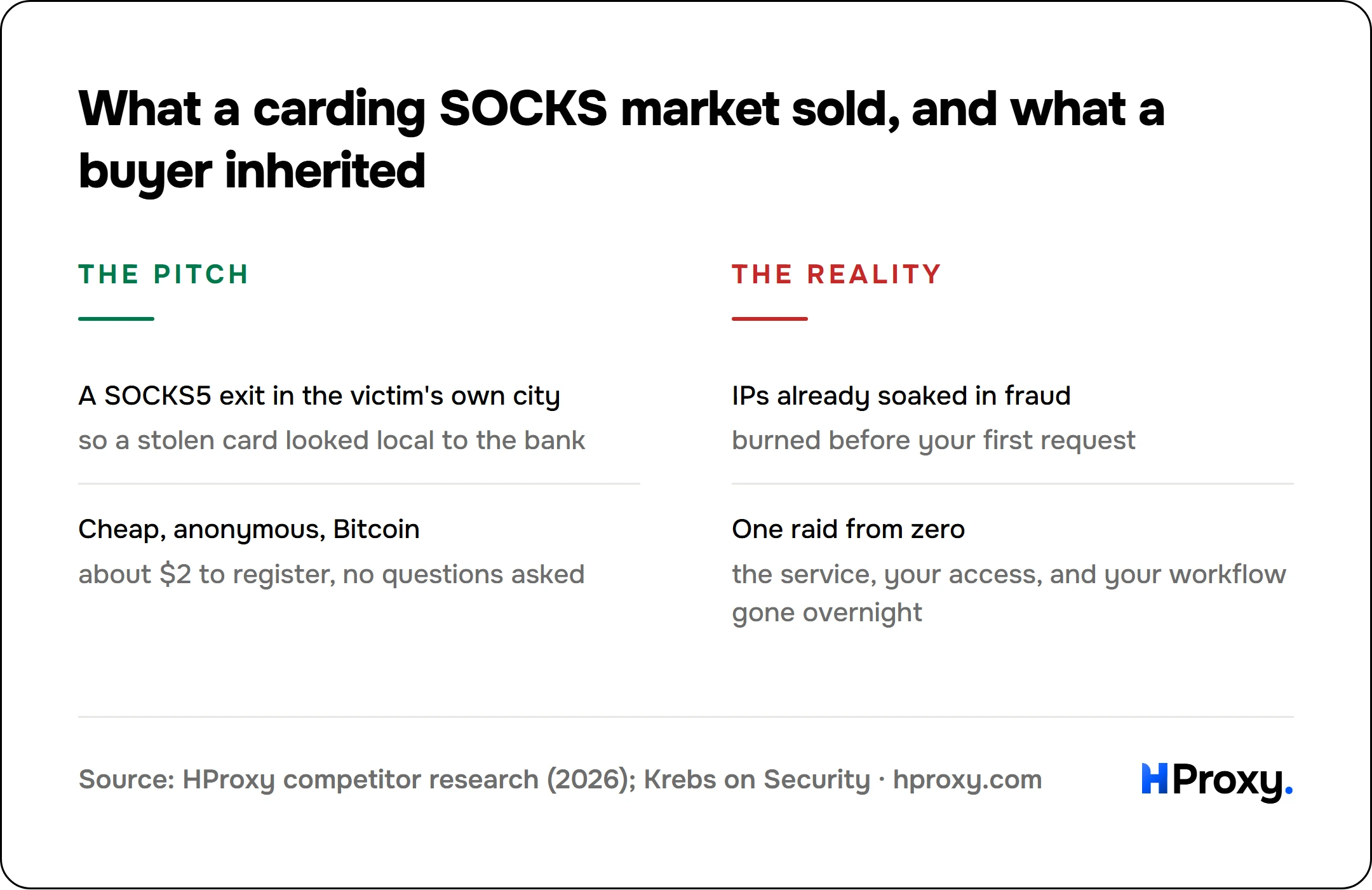
The pitch
A SOCKS5 exit in the victim's own city
so a stolen card looked local to the bank
Cheap, anonymous, Bitcoin
about $2 to register, no questions asked
The reality
IPs already soaked in fraud
burned before your first request
One raid from zero
the service, your access, and your workflow gone overnight
An IP that spent its working life carrying card fraud is not a clean IP. Every fraud-detection system worth anything keeps score on IP reputation, and a proxy pool built for carding is at the very bottom of that score. Route legitimate traffic through it and you look exactly like the crime it shares an address with. That is why how websites detect proxies starts with the reputation of the exit IP, long before it bothers with clever headers. A carding-sourced proxy fails that first test by definition.
And then there is the continuity problem, which LuxSocks demonstrated in a single night. A service built for crime is one law-enforcement action away from disappearing, and when it goes, it takes your balance, your access, and whatever you built on top of it. You cannot file a support ticket with a seized marketplace.
The sourcing lesson that outlives the brand
LuxSocks is gone, but the lesson is the same one the whole graveyard keeps teaching. A proxy's protocol, its price, and its marketing tell you almost nothing. Where the IPs came from tells you almost everything. A residential-looking SOCKS5 proxy can be a perfectly clean, consented IP or a burned criminal exit, and from the outside the listing looks identical. The difference is the supply chain.
You cannot audit a provider's entire supply chain from your desk, but you can do the two things that actually protect you:
- Ask how the pool is sourced, and treat vagueness as the answer. A provider using disclosed, opt-in supply can say so plainly. One that will not explain where its IPs come from is telling you something.
- Check what you are handed. Put any IP through our proxy checker before you trust it. It makes a real connection through the proxy and reports where it exits and what network it actually belongs to, so a burned or misrepresented IP shows itself before you rely on it. And know who owns your proxy provider, because a name you can trace is a start.
Where a network you can vouch for fits
We sell residential proxies because there are legitimate reasons to appear to be somewhere you are not: checking how a page renders in another country, verifying ads, testing localization, scraping public data at scale without one IP getting rate-limited. The difference between us and a LuxSocks is not the protocol. It is that we can tell you where the IPs come from and we are still here to answer for them.
If your job is low-stakes, our free proxy list says plainly that it is mostly short-lived datacenter IPs, re-checked every few minutes. When you need residential IPs that hold up, we sell them at $0.44/GB pay as you go, with no know-your-customer checks and a balance that never expires. The point of writing up a dead carding market is not to dance on its grave. It is that the thing which killed LuxSocks as a purchase, nobody being able to vouch for the pool, is the exact thing a serious provider should be able to answer for.
Sources
- Krebs on Security, "No SOCKS, No Shoes, No Malware Proxy Services!" (August 2022): LuxSocks counted among the SOCKS services shut down by authorities, the 2021 to 2022 die-off of 911, VIP72, RSocks and SocksEscort, and the resulting supply-chain crisis for cybercriminals.
- Krebs on Security, LuxSocks tag archive: ongoing coverage of LuxSocks in the malware and carding proxy ecosystem.
- HProxy internal competitor research (2026): LuxSocks as a Russian SOCKS5 marketplace, Bitcoin-only payment, roughly a $2 registration fee, a pool near 25,000 IPs, its January 2022 shutdown reported as a Russian government takedown, and the lapsed state of luxsocks.ru today.