If you bought residential proxies for a real company between roughly 2010 and 2020, you probably crossed paths with GeoSurf. It was one of the oldest names in the business, the proxy network you picked when you were an enterprise doing ad verification or brand protection and did not want to be anywhere near the fraud crowd. Then, on December 20, 2023, it shut down every proxy service it ran and told its customers to go to Bright Data, the very company that had spent years suing it.
We run a residential proxy network, so we pay attention to how these companies live and die. Most of the cautionary tales on this blog are botnet stories: 911 S5, VIP72, RSOCKS, services that rented out hacked machines and got taken down by law enforcement. GeoSurf is a different kind of death, and in some ways a more important one for a buyer. Nobody hacked anything. There was no seizure and no arrest. GeoSurf lost a patent war, and that was enough to end a network that had been around since 2009.
What GeoSurf actually was
GeoSurf launched in 2009 under BIScience, an Israeli data company. That makes it one of the genuine veterans of the residential proxy market, older than almost every brand you see advertised today. A residential proxy (a proxy whose exit IP belongs to a real consumer internet connection instead of a data center) was a niche enterprise tool back then, and GeoSurf built its whole identity around the respectable end of that niche.
At its height it advertised a pool in the millions of residential IPs, with coverage across more than 150 countries and over 1,700 cities, plus a browser extension and a toolkit aimed at marketing and ad-verification teams. The pitch was localization and legitimacy: see what your ads look like in Tokyo or São Paulo, check that a partner is not running your creative against fraudulent inventory, monitor pricing region by region. GeoSurf sold to businesses that wanted a proxy for boring, defensible reasons.
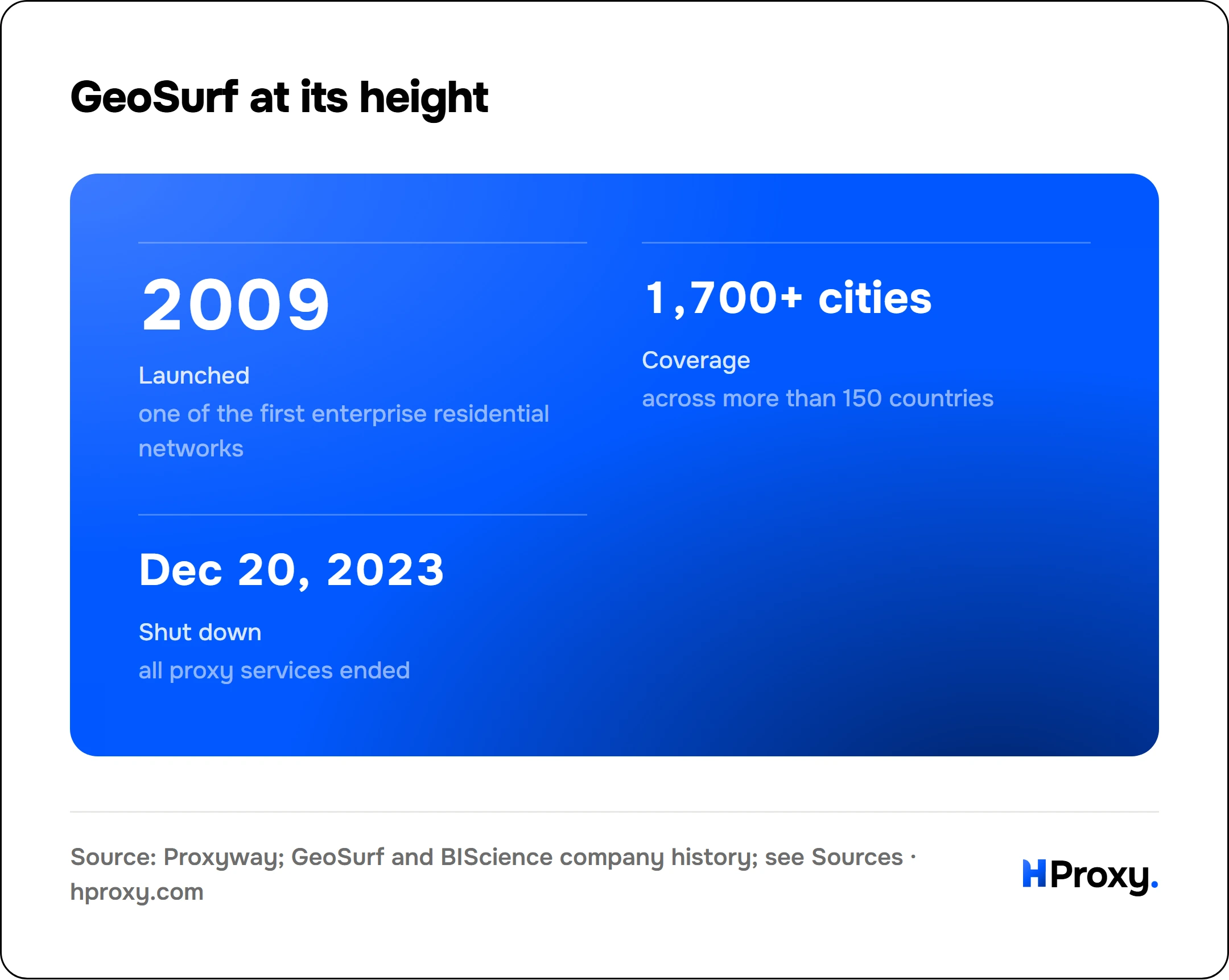
GeoSurf at its height
- 2009
- Launched
- 1,700+ cities
- Coverage
- Dec 20, 2023
- Shut down
one of the first enterprise residential networks
across more than 150 countries
all proxy services ended
Source: Proxyway; GeoSurf and BIScience company history; see Sources
That positioning matters for the rest of the story. GeoSurf was not a shady service that got caught. It was about as mainstream and enterprise-friendly as a residential proxy provider got. And it still did not survive.
The patent war that actually killed it
GeoSurf did not die of a scandal. It died in court.
In 2019, Luminati Networks sued BIScience. Luminati is the proxy company that spun out of Hola VPN, and in March 2021 it renamed itself Bright Data, the largest proxy and web-data company in the world. The suit accused BIScience of infringing Luminati's proxy-technology patents and misusing its trade secrets. This was part of a long campaign of patent litigation Luminati and Bright Data ran across the industry, the same machine that would later collide with Oxylabs in a multi-year patent fight.
The two sides reached a settlement in 2020. The terms were brutal for GeoSurf: it agreed to stop selling proxy services and to refer its customers to Bright Data, which kept the right to accept or reject those customers. BIScience appealed, trying to change the outcome, and the appeal failed. GeoSurf kept the lights on for a while longer, then in early December 2023 it emailed customers that it was closing, and on December 20, 2023 it shut down all proxy services for good.
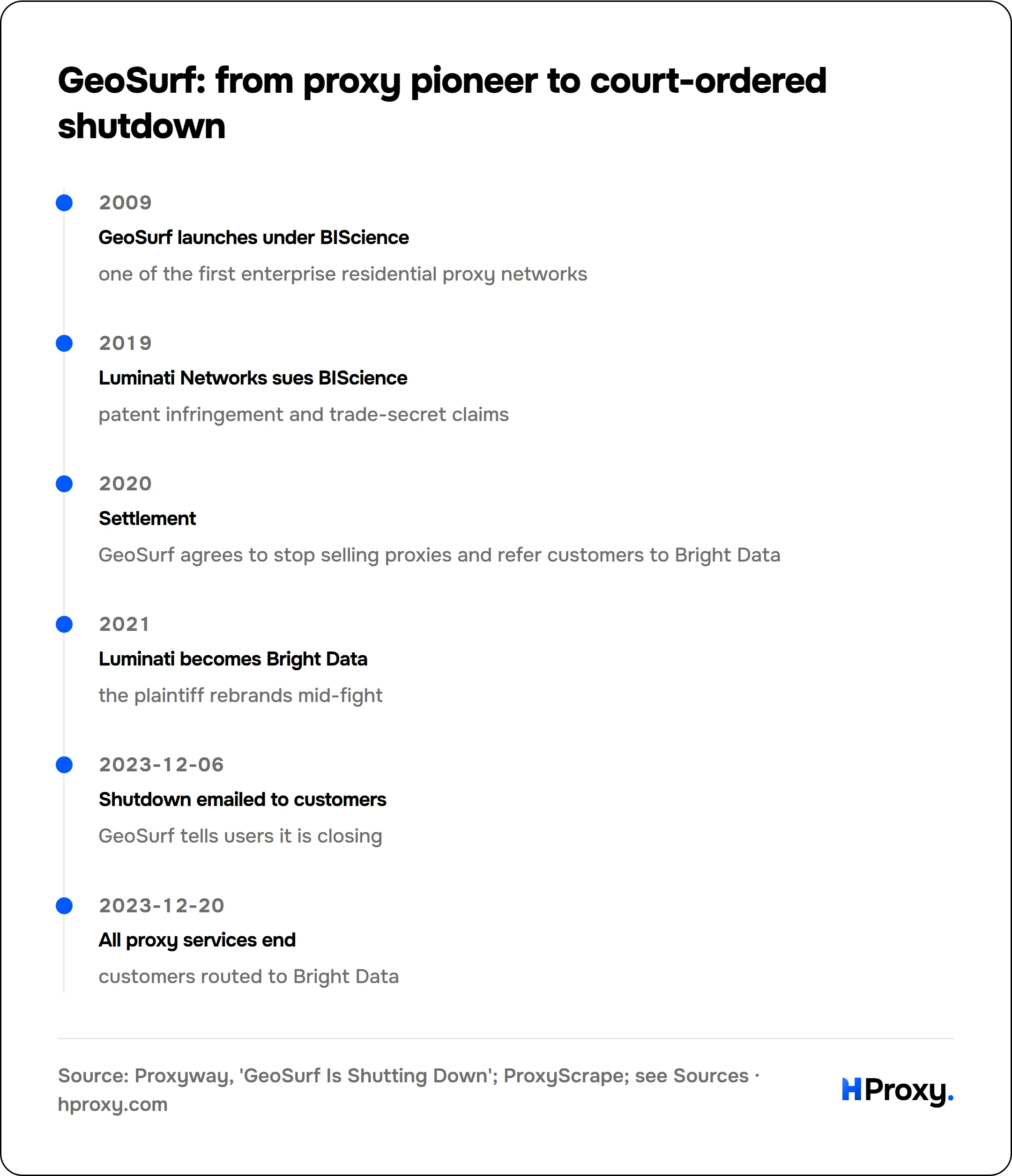
2009
GeoSurf launches under BIScience
one of the first enterprise residential proxy networks
2019
Luminati Networks sues BIScience
patent infringement and trade-secret claims
2020
Settlement
GeoSurf agrees to stop selling proxies and refer customers to Bright Data
2021
Luminati becomes Bright Data
the plaintiff rebrands mid-fight
2023-12-06
Shutdown emailed to customers
GeoSurf tells users it is closing
2023-12-20
All proxy services end
customers routed to Bright Data
Bright Data, for its part, rolled out a "welcome GeoSurf customers" landing page, offering to onboard the orphaned accounts, help with the technical migration, and honor existing pricing for six months. If you were a GeoSurf customer, the company you had been buying from for a decade was gone, and the exit door led straight into the arms of the competitor that had sued it out of the market.
The irony: killed by a company built on free-VPN bandwidth
Bright Data, the winner of this fight, did not start life as a clean-room enterprise vendor either. It began as Luminati, the commercial arm of Hola VPN, and Luminati's original residential pool came from reselling the bandwidth of people using the free Hola VPN. Those users were the exit nodes. That is the foundation the company was built on before EMK Capital bought roughly three-quarters of it in 2017 and it rebranded to Bright Data in 2021.
So the network that got to absorb GeoSurf's customers is the one that grew out of monetizing free-VPN users. The one that lost is the one that positioned itself as the buttoned-up enterprise option. The market did not reward the more careful sourcing story. It rewarded the bigger patent portfolio and the deeper pockets. We map more of these relationships in who owns your proxy provider and in how Google erased 13 proxy brands, because once you see the ownership graph, most of the "independent" brands on a review site turn out to be a handful of parents.
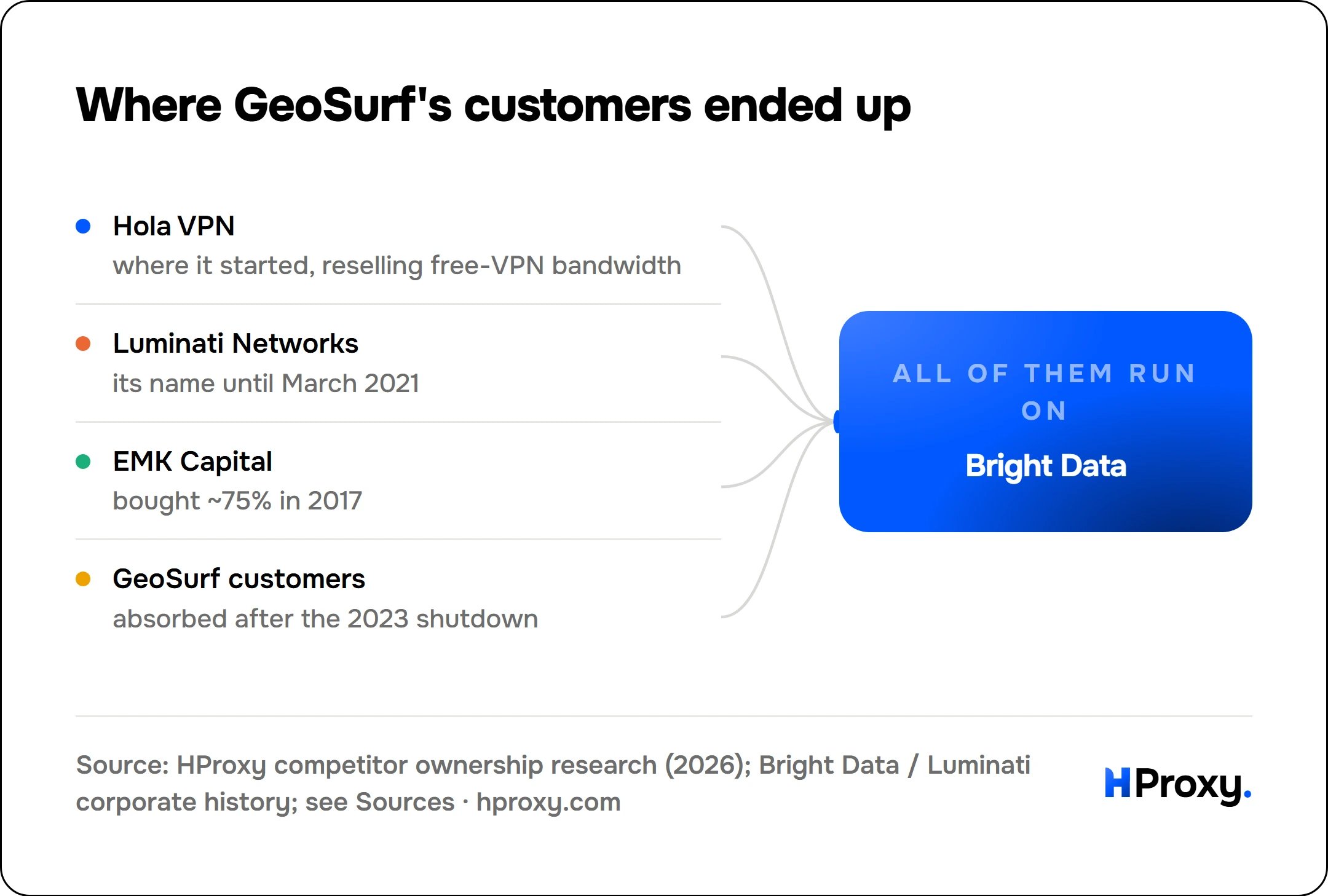
- Hola VPNwhere it started, reselling free-VPN bandwidth
- Luminati Networksits name until March 2021
- EMK Capitalbought ~75% in 2017
- GeoSurf customersabsorbed after the 2023 shutdown
all of them run on
Bright Data
The sourcing machinery underneath the enterprise label
GeoSurf never faced a botnet allegation, and we are not making one. But its parent company is a useful lesson in where "residential" data actually comes from, even at the respectable end of the market.
BIScience's other business is data collection. In January 2025, the security researcher Wladimir Palant published a detailed analysis showing BIScience gathering browsing data two ways: through its own browser extensions under the Urban brand (Urban VPN, 1ClickVPN, and others), and through a software development kit it handed to third-party extension developers, who bundled it into their own extensions. Palant found extensions adding "bogus features" like fake safe-browsing or ad-blocking tools mainly to justify collecting users' full browsing history, with raw URLs shipped back to BIScience whether or not the extension needed them.
That is a finding about clickstream data, not proof of where GeoSurf's specific proxy IPs came from, and we want to be precise about the difference. But it shows the machinery the whole industry runs on: real people's browsers and devices, enrolled through free apps, VPNs, and extensions, often in exchange for a feature they did not need. The enterprise label on the front of the storefront does not tell you what is happening at the back of it. That is the same lesson we draw from the NetNut botnet takedown, where a NASDAQ-listed parent company still ended up entangled with a botnet allegation.
What GeoSurf's death teaches a buyer
The practical takeaway is not about crime. It is about concentration risk.
GeoSurf ran for fourteen years and still disappeared, not because it did anything wrong technically, but because a bigger company owned the patents and won the case. If your business depended on GeoSurf's IPs in 2023, you got a few weeks of notice and a referral to whoever was left standing. That is a real operational risk that no review site scores: your provider can be litigated, acquired, rebranded, or wound down, and you inherit the disruption.
A few things protect you from it:
- Know who really owns your provider. A brand that is quietly a reseller of a larger network can vanish the moment that relationship ends. Trace the parent before you build a pipeline on top of it.
- Avoid lock-in you cannot exit. If switching providers means rewriting everything, a shutdown like GeoSurf's turns into an emergency. Standard endpoints and simple credential-based access make you portable.
- Do not pay for capacity you have to commit to up front. GeoSurf and its peers sold big enterprise plans. When the service ends, prepaid commitments are the thing that hurts. Pay-as-you-go with a balance that does not expire means a provider's death costs you nothing stranded.
- Check what you are actually getting. Our free proxy checker makes a real connection through a proxy and reports its exit location, anonymity grade, and the network the IP belongs to, so you are trusting a measurement instead of a marketing page.
Where a network you can verify fits
GeoSurf is proof that a proxy service does not need to be a botnet to disappear. It can be a fourteen-year-old enterprise brand that simply loses a lawsuit and hands you to the company that beat it. The technology was fine. The problem was that the whole market had quietly consolidated into a few giants who could decide, in court, who got to keep selling.
We would rather compete on being legible: you can see who runs the network, how it is priced, and what an IP really is before you route through it. If you just need to test tooling or run something low-stakes, our free proxy list makes no secret of what it is: mostly short-lived datacenter IPs, re-checked every few minutes. When you need residential IPs that hold up, we sell them at $0.44/GB pay as you go with a balance that never expires, so there is no plan to strand and no commitment to regret if you ever decide to leave.
Sources
- Proxyway, "GeoSurf Is Shutting Down": the December 20, 2023 shutdown date, the 2019 lawsuit, the 2020 settlement and failed appeal, and the Bright Data customer-transition program.
- ProxyScrape, "Geosurf shutting down over lost battle with Bright Data": second-outlet corroboration of the patent-litigation cause at the time. That article has since been taken offline and no archive of it survives, a small illustration of how quickly this industry's paper trail evaporates.
- Bright Data, "Welcome GeoSurf Customers" at brightdata.com/welcome-geosurf-customers: Bright Data's own onboarding offer for GeoSurf's orphaned accounts.
- Wladimir Palant, Almost Secure, "BIScience: Collecting browsing history under false pretenses" (January 13, 2025): BIScience's data collection through its own extensions and a third-party SDK.
- HProxy internal competitor-ownership research (2026): Bright Data's origin as Luminati and Hola VPN, the EMK Capital acquisition, and the March 2021 rebrand.