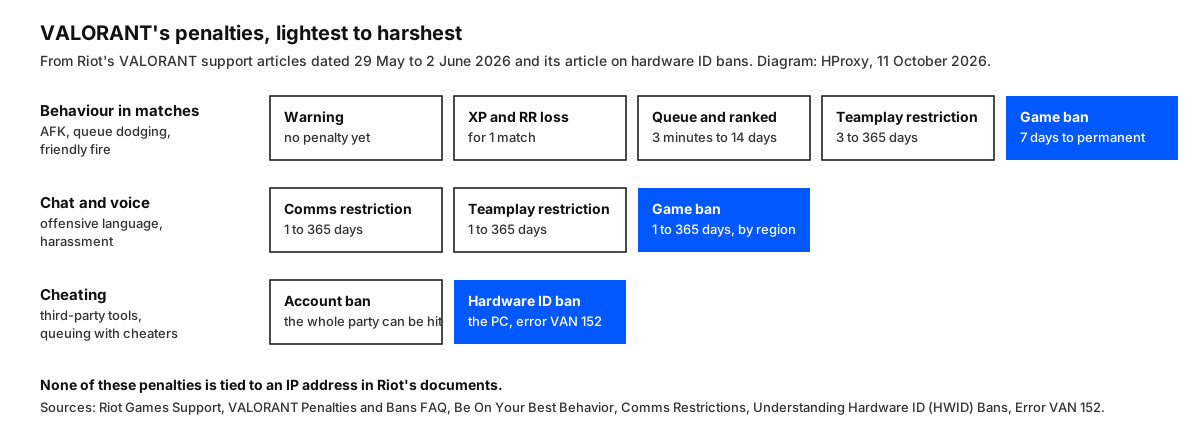
Nothing Riot publishes describes an IP ban in VALORANT. We read the 12 Riot documents behind its penalties on 11 October 2026, and none of them mentions an IP address. VALORANT's penalties sit on your account: warnings, timers, restrictions and game bans from 7 days to permanent. Cheating brings a hardware ban on the PC itself, which shows as error VAN 152. A new IP address, a VPN or a proxy changes none of these.
So the useful questions are which penalty you have, how long it lasts and how to get it reviewed. Riot's own tables answer the first two.
Which VALORANT penalty do you have?
| Penalty | What it blocks | How long |
|---|---|---|
| Warning | Nothing yet; further violations bring harsher penalties | None |
| XP denial | The XP from that match | 1 match |
| Rank Rating deduction | 6 to 24 RR, after an AFK or a dodge in a competitive match | 1 match |
| Queue timer | Joining any game other than a custom one | 3 to 240 minutes |
| Ranked restriction | Ranked matches | 7 to 14 days |
| Teamplay restriction | Team games; solo deathmatch and custom games stay open | 3 to 365 days |
| Comms restriction | Voice and text chat | 1 to 365 days |
| Game ban | VALORANT itself, until the date and time shown | 7 days to permanent |
| Hardware ID ban | The PC, for every account on it (error VAN 152) | As long as the ban lasts |
The game shows both. Riot says that "if your account already has a penalty, you'll also get to see its details and duration". Riot weighs your whole record, not one match. In its words, "Penalties are less about singular violations and more about the sum of your history as an Agent". Game bans "are reserved for repeat offenders who have ignored prior warnings and penalties". For chat, a game ban comes only after a chat restriction, when the offensive language continues.
Does Riot ban IP addresses in VALORANT?
Not according to anything it publishes. Riot's Terms of Service list its measures: "temporary bans, account suspension or termination and deletion, hardware bans". Chat limits and queue bans follow. IP addresses are not on that list.
We also counted what the rest of Riot's documents say. That covered the four VALORANT penalty articles, the hardware ban and Vanguard pages and the PC connection guide, about 18,300 words with the Terms.
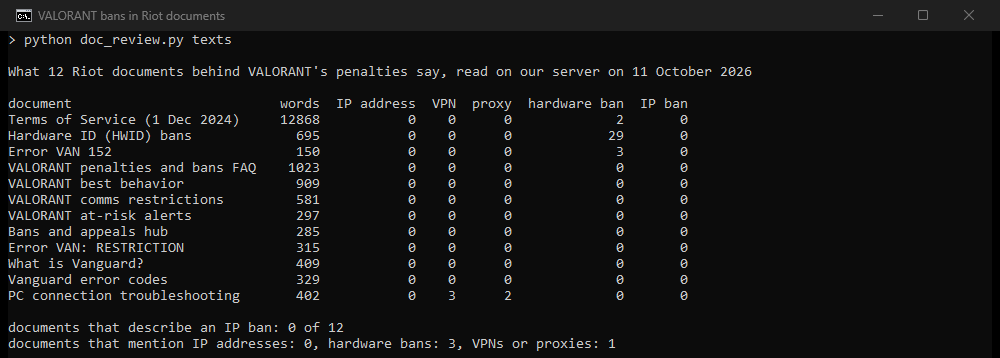
None of the 12 describes an IP ban, and none mentions an IP address at all. Hardware bans appear in three. VPNs and proxies appear in one, the PC connection guide, which tells players to switch them off. The pages that promise to get you around a VALORANT IP ban are answering a ban that Riot never describes.
Why does cheating end in a hardware ban?
Because Riot's anti-cheat looks at the PC, not at the network. Riot Vanguard is Riot's own security software. "It consists of a client that runs while our games are active along with a kernel mode driver". When it flags a player "for using third-party tools (scripting or cheating)", Riot can issue a hardware ID ban.
That ban covers the whole machine. Every login on it ends with error VAN 152. The message says a review found that an account playing on this device broke Riot's rules. Riot's page on the error lists what does not help: "reinstalling Riot Vanguard, reinstalling your game, changing your connection, or restarting your PC". A different account on that PC is blocked there and banned for a set period. Riot treats it as an attempt to get around the first ban.
Cheating can also take your friends down with you. Riot is direct about it: queuing up with cheaters, which players call bussing, "can get you banned". Boosting, where someone else plays on your account, is bannable too, and sharing your login is against Riot's Terms.
Can a bad connection or a VPN get you banned?
A bad connection is not a ban reason by itself. Riot says "our systems are implemented to prevent occasional tech and connection issues from being severely punished, if at all". When a server problem on Riot's side caused the drop, it forgives "any AFK or queue dodge penalties incurred while the issue was live".
Repeated drops are another matter, because VALORANT's penalties count AFKs and dodges over time. Riot asks players with "consistent connection issues" to submit a ticket "so we can help prevent your next AFK". It adds that "you may want to sit out until your connection stabilizes".
A VPN or a proxy makes that worse, not better. Riot's guide for its PC games says "Disable any VPNs or Proxy". They "can cause a number of connection issues that are impossible to resolve". Our page on proxies for VALORANT covers what Riot allows and why a proxy does not lower ping.
Does a ban in another Riot game follow you into VALORANT?
It can. Riot's Terms say that misconduct in one game "can result in account-wide penalties or escalated penalties in another game". Riot's example is repeated hate speech in one game leading to longer bans in another.
League of Legends players face the same Riot account rules and the same hardware bans. We cover that side in League of Legends IP ban explained.
How do you get a VALORANT ban reviewed?
Work through these in order.
- Check the penalty in the game. It shows the details and the duration.
- Let a timer run out. XP denial, Rank Rating loss, queue timers and most restrictions end on their own.
- If the penalty came from a connection problem, submit a ticket to Player Support, as Riot asks above.
- If you believe a game ban is wrong, submit a ticket to Player Support through Riot's support site and explain why.
- For a hardware ban, ask for a review through a player support request, with one ticket per affected account. Lifting it is "possible (but never guaranteed)".
- Do not try to get around it. Riot's Terms forbid "otherwise circumventing any technological measure" that controls access, and a new account on a banned PC is banned as well.
An at-risk alert is the moment to change course. Riot says it "means the account is dangerously close to getting penalized, which could include a temporary or permanent suspension".
What this page could not check
- We did not play VALORANT, take a penalty or test Vanguard. What we say about detection comes from Riot's own documents.
- We read Riot's English pages only.
- Search engines refused our server on 11 October 2026, so we could not check which pages rank for this search.
- Riot does not say whether it ever blocks addresses at the network level, for example during an attack. This page says only that none of its penalty documents mentions IP addresses.
- Riot's penalty tables differ slightly between articles and change with patches. We will read the 12 documents again by 11 January 2027.
Sources
- Riot Games, Terms of Service, last modified 1 December 2024, sections 7 and 7.3, read 11 October 2026: Riot Games.
- Riot Games Support, VALORANT Penalties and Bans FAQ, 2 June 2026: Riot support.
- Riot Games Support, VALORANT Be On Your Best Behavior, 29 May 2026: Riot support.
- Riot Games Support, VALORANT Comms Restrictions and Audio Retention, 31 May 2026: Riot support.
- Riot Games Support, VALORANT At-Risk Alerts, 26 May 2026: Riot support.
- Riot Games Support, Understanding Hardware ID (HWID) Bans, 31 May 2026: Riot support.
- Riot Games Support, Error VAN 152, 16 July 2026: Riot support.
- Riot Games Support, What is Vanguard?, 2 June 2026: Riot support.
- Riot Games Support, Troubleshoot PC Connection, 16 May 2026: Riot support.
- Our own review of 12 Riot documents, fetched on our server on 11 October 2026.