"Rate limit exceeded" means your X account, or an app acting for it, has used up a limit X counts over time. X's help center says these limits cover actions from all devices: web, mobile, phone and the API. They are counted for the account, so a new internet address does not reset them. Time-based limits end on their own, and X says you can try again once the time limit has passed. In the developer API, X counts per user token or per app, usually over 15 minutes or 24 hours.
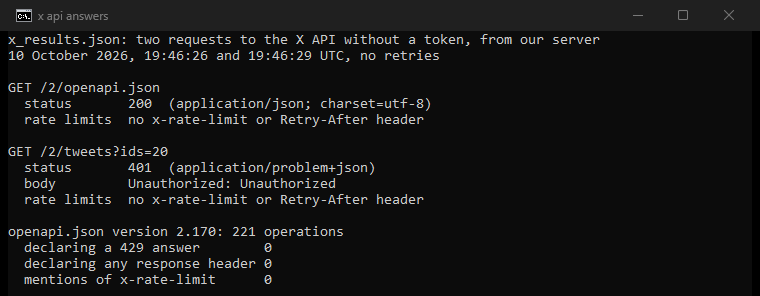
We read X's help page on limits and its API documentation on 10 October 2026. We also sent the X API two requests without a token from our own server. Then we counted what X's own API description file says about rate limits.
Where does the message appear?
| Where you see it | The words on screen | What it means | What to do |
|---|---|---|---|
| X site or app, while posting, following or sending messages | An error that names the limit you hit, which X says it shows | One of X's account limits, such as 2,400 updates a day | Wait until the time limit passes |
| X site, while reading replies, lists or search | "Sorry, you are rate limited. Please wait a few moments then try again.", as users report it | A limit X does not publish | Wait a few minutes and scroll more slowly |
| A third-party app connected to your account | A rate limit error inside the app | The app shares your account's hourly API limit | Disconnect apps you do not use |
| X API v2 | HTTP 429 Too Many Requests | A rate limit window, or a usage cap | Check the error type and x-rate-limit-reset |
| X API, older body | {"errors":[{"code":88,"message":"Rate limit exceeded"}]} | A rate limit window | Wait until x-rate-limit-reset |
The message reads the same for very different causes. The sections below separate them.
Which limits does X publish?
X's help page lists these account limits. We read it through the Internet Archive copy of 26 September 2026, because X's help site refused our requests.
| Action | X's published limit |
|---|---|
| Direct Messages | 500 sent per day |
| Posts, unverified accounts | 50 original posts and 200 replies per day |
| All updates | 2,400 per day, split into semi-hourly parts |
| Follows | 400 per day, with account-specific ratios past 5,000 followed accounts |
| Changes to account email | 4 per hour |
X adds that these limits may be temporarily reduced during periods of heavy site usage. When that happens, it says it posts an update on the X status site. The page lists no limit on reading posts.
Why does X say rate limit exceeded?
You did one thing too often
Posting, replying, following and messaging each have their own count. The daily update limit is split into semi-hourly parts, so a burst can trip it long before the daily total. X says its error message names the limit you hit.
An app is using your account
X's help page says API requests from all third-party apps count against the account's hourly API limit. People who connect several apps reach that limit sooner. The app shows the error, but the count belongs to your account.
You were reading, not posting
People report the message while opening replies, lists and search results. One user wrote in April 2024 that viewing the replies of a post was "Typically met with" it. X publishes no reading limit, so neither the threshold nor the wait is known.
Your app hit an API window or a usage cap
In the API, one status code covers two causes. X's error reference says a 429 means "Rate limit or usage cap exceeded", with the error types rate-limit-exceeded and usage-capped. A rate limit window is usually 15 minutes or 24 hours, counted per user token or per app. A usage cap is the plan's allowance: X tracks use per app, and pay-per-usage plans may read 3 million posts a month. Waiting a few minutes clears the first and does nothing for the second.
How long does rate limit exceeded last?
For time-based limits, X says you can try again after the time limit has passed. After the daily post limit, it suggests trying again in a few hours. In the API, X's docs tell you to read the x-rate-limit-reset header and wait until that time. A usage-capped 429 lasts until the monthly allowance renews, or until the plan changes.
What did X's API tell our server?
We asked the X API two questions without a token on 10 October 2026. Its description file answered 200, and a request for a post answered 401 Unauthorized. Neither answer carried an x-rate-limit header, although X's error reference says every response includes rate limit information. That fits X's own model, which counts per user token or per app.
The description file was the bigger surprise. Version 2.170 lists 221 operations, and none of them declares a 429 answer or any rate-limit header. A client generated from that file learns nothing about rate limits, so the 429 handling has to be written by hand.
How do I fix rate limit exceeded on X?
Work through these in order. The first one fixes most cases that X documents.
- Stop and wait. Leave the action alone until the time limit passes. After the daily post limit, X suggests a few hours.
- Check the X status site if many people see the message at once. X says it posts an update there when it lowers limits during heavy use.
- Disconnect third-party apps you do not use. Their requests count against your account's hourly API limit.
- Spread your actions out. The daily update limit is split into semi-hourly parts, so steady activity hits it later than bursts do.
- For an API app, read the error type. For rate-limit-exceeded, wait until x-rate-limit-reset and back off between retries. For usage-capped, check the app's usage in the Developer Console, because waiting will not clear it.
- Handle 429 in your own code. X's description file does not declare it, so a generated client will not handle it for you.
Does a VPN or a proxy help?
No. X counts these limits for the account, and in the API for the user token or the app. A new internet address keeps the same account and the same token, so it meets the same count. X's help page says the limits cover every device, including the API. The HTTP standard for 429 allows exactly this: a server may identify the user by credentials or a cookie, not by address.
That is why this page recommends no proxy. Our guide to proxies for Twitter covers the separate cases where an address matters on X. For limits that do follow an address, see your IP has been temporarily blocked.
What this page could not check
We used no X account, so we saw neither the site's message nor a real 429 ourselves. X's help site answered our server and this computer with 403. Its limits here come from the Internet Archive copy of 26 September 2026. X publishes no reading limit. The reading figures in circulation since July 2023 could not be checked against an original source, so this page gives none. Our test was two requests without a token on one day. X changes its limits and its API without notice, so we will read every source here again by 10 January 2027.
Sources
- X Help Center, "About X limits", read through the Internet Archive copy of 26 September 2026: help.x.com.
- X Developer Platform, "Rate Limits", read 10 October 2026: docs.x.com.
- X Developer Platform, "Response Codes and Errors", read 10 October 2026: docs.x.com.
- X Developer Platform, "Usage and Billing", read 10 October 2026: docs.x.com.
- X API v2 description file, openapi.json, version 2.170, fetched 10 October 2026: api.x.com.
- RFC 6585, Additional HTTP Status Codes, section 4 (429), April 2012: rfc-editor.org/rfc/rfc6585.
- What people reported: a gallery-dl discussion on GitHub of 1 April 2024, and thread titles on the X Developer Community.
- Our own measurement: two requests to the X API from our server, 10 October 2026, logged in the research folder for this page.