No-KYC means you can buy without sending identity documents: an email and a payment method are the whole gate. We read the identity rules of nine residential proxy companies, ours included, on October 22, 2026. Four put a KYC step before residential use, four ask for ID only when something triggers it, and one says it never asks. The biggest change of the year came from Bright Data. Since July 7, 2026, it sells residential access only to companies that pass its KYC review. No-KYC never means anonymity: the company still holds your email, your payment trail and your traffic logs. We sell residential proxies with no KYC for standard use, so weigh our view with that in mind.
What does no-KYC mean?
Know Your Customer is a term from banking, where checking identity is a legal duty. Selling proxy access carries no such general duty, so a proxy company's KYC is a policy it wrote for itself. No-KYC means that policy lets you open an account and buy without documents. Caproxy's definition is a good one: the company "does not force you through that process upfront". It may still ask later, when something about an order looks wrong.
Those policies sit at very different heights:
Email only
account, top up, send traffic; minutes
Payment verified
card checks or a confirmed crypto payment
Use-case questions
a form about what you plan to do
Documents
government ID, selfie, company papers
Contract and sales cycle
no self-serve path at all
The first two rungs are close to universal. From the third rung up, companies diverge, and a buyer either gets to test today or does not.
Who asks for ID, and when?
We sorted nine companies by what happens before a first residential purchase, from their own pages:
| Company | Before buying | ID is asked when |
|---|---|---|
| Bright Data | KYC review | Always, companies only |
| Oxylabs | KYC form | For every customer |
| Decodo | Approval step | Activity looks suspicious |
| Rayobyte | KYC procedure | On residential |
| SOAX | Nothing | Crypto, restricted sites |
| Webshare | Nothing | To unblock some sites |
| Databay | Nothing | A review is required |
| HProxy | Nothing | Fraud flags, large crypto refunds |
| Fastproxy | Nothing | Never, by its FAQ |
In the companies' own words:
- Bright Data writes that "For new Residential zones created after July 7, 2026, KYC approval is required for every proxy type." Accounts on Gmail or Outlook "are not eligible for Residential access". Its ISP and datacenter proxies need no KYC. In June 2022 it had gone the other way, with a "no-KYC mode" for a list of vetted websites.
- Oxylabs says "Every customer that wants to use Oxylabs services has to fill out our KYC form". The form asks about the business model and the planned use case.
- Decodo runs "an automatic internal check during registration", then a KYC process, and only then lets customers buy. ID verification follows if "suspicious activity" is detected.
- Rayobyte published a whitepaper in 2024 saying its residential network needs "a KYC procedure and a blacklist".
- SOAX says identity verification "is only needed if you: Choose to pay with cryptocurrency, or Request access to restricted domains or ports".
- Webshare says certain targets "can be unblocked after completing a brief KYC procedure".
- Databay lets customers "register and purchase Services without submitting identity documents unless a review is required".
- Fastproxy answers its own question, "Do you require KYC? No."
Our head-to-head with Bright Data works through what its check buys an enterprise customer.
Why do companies ask?
The reasons are real, and fairness matters here because we run no ID gate ourselves.
- Chargebacks. Proxy access is instant and digital, which makes it attractive to buy with a stolen card. The company delivers, the real cardholder disputes the charge weeks later, and the company pays twice.
- Abuse. A proxy network can be pointed at fraud or credential stuffing. Trend Micro, a security company, wrote of one service with no KYC policy that "anyone can simply pay and use the network".
- Sanctions. Some buyers cannot legally be sold to. Databay's policy prohibits deals with entities blocked under the US "OFAC's 50 Percent Rule".
- Procurement. A large company buying infrastructure expects a counterparty it has identified, with a contract and an invoice.
Each reason is strongest for a company whose usual deal is large, contractual and slow. For a buyer who wants one gigabyte to see whether the IPs work, the same process is mostly delay.
What do you hand over?
Time is the obvious cost of a gate: a network you cannot test today loses to one you can. The less obvious cost is the documents themselves. A passport scan and a selfie now sit with the company, or with its verification vendor. SOAX uses Sumsub and says it sees only "the final status of the verification". Databay uses Persona and tells customers not to send documents to support email.
Who holds the documents matters more in this industry than in most. Our account of how Google erased thirteen proxy brands tied to one network shows how many storefronts can share an owner. Our page on whether your provider resells someone else's network covers storefronts that run no infrastructure at all. Before you send a passport scan, find out who you are sending it to.
What does no-KYC not mean?
Skipping this part is how the phrase earned its bad name.
Does no-KYC make you anonymous?
No. The company still holds your email, the IP address you signed up from, a payment trail and metadata about your traffic. Paying with crypto removes one of those links and leaves the rest. A company can be required to hand over what it holds, so any promise that you cannot be identified should end the evaluation.
Does no-KYC allow anything?
No. The acceptable-use policy binds you exactly as it would after a passport scan. A network that does not enforce its own policy soon has a pool full of burned IPs, and that becomes your problem too.
Does no-KYC mean no screening?
No. We screen every card payment for fraud before anything is delivered. What no-KYC changes is the default: verification becomes an exception triggered by a specific signal.
Does no-KYC say anything about quality?
No. Some poor networks ask for nothing, and one of the best-funded asks for everything. A gate tells you who a company sells to. Our vetting guide covers the checks that measure a pool.
Does checking buyers keep a network clean?
A check on the buyer and the source of the IPs are two separate systems. One asks who sends traffic. The other decides whose home connection carries it, and that second question is where this market's scandals happened. The 911 S5 network spread through malicious VPN apps. In May 2024 the US Justice Department tied it to devices "associated with more than 19 million unique IP addresses". RSOCKS sold access to hijacked devices as a residential pool. Google's threat team wrote in January 2026 that "A robust residential proxy network requires the control of millions of residential IP addresses".
No passport check on a buyer would have changed where those IPs came from. A company with an ID gate can have a pool nobody can account for, and a company without one can run a careful network. Judge the two separately, and ask first where the IPs come from.
Does HProxy ask for ID?
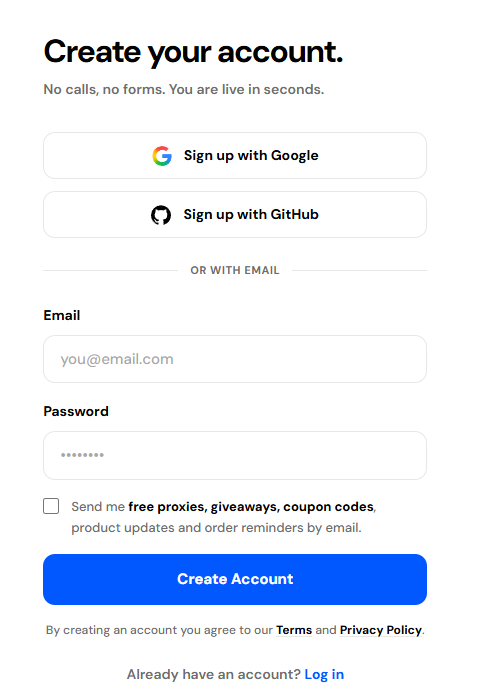
Not to open an account and not to buy: our checkout needs no KYC for standard use. Our compliance page states it in one line: "No documents at sign-up and none at an ordinary checkout". This is our sign-up form, captured on October 22, 2026:
We do ask for identification in set cases:
- A card payment trips fraud screening. Every card payment is screened before anything is delivered.
- A crypto refund above EUR 1,000. The German Anti-Money-Laundering Act requires an identity check before it clears.
- Rarer cases. We may ask on unusually large first orders, on partner and reseller accounts, or where an abuse report points at an account.
Documents go through the dashboard only, never by email or chat. Residential costs $0.50/GB for the first gigabyte on a balance that does not expire, down to $0.44/GB at 2,000 GB+. Card and crypto both work, including Bitcoin, Ethereum and USDT.
What if the company you need asks for documents?
Sometimes the network with the coverage you need is the one with a gate. That does not have to end the evaluation.
- Check who receives the documents. Find the legal entity, where it is registered and whether a verification vendor holds the files.
- Ask what triggers the check. At SOAX it is crypto payment or restricted sites, and at Webshare certain targets. A smaller test may pass without one.
- Ask about retention. How long the documents are kept, where, and whether you can have them deleted once the check clears.
- Separate testing from buying. Measure pool quality somewhere without a gate, decide on the evidence, then do the paperwork with the winner.
How do you check a company before you spend?
Four steps, ten minutes, and they work on any company, us included:
- Follow the pricing page to its end. A price and a button means self-serve. A form and a promise to be in touch means a gate.
- Read their own policy page. Their terms or KYC page say when they can ask for ID; quote that, not a comparison table.
- Buy the smallest unit. A one-gigabyte order tests billing, delivery and the gate in one move.
- Test the IPs. Run the exits through our proxy checker for the network, the anonymity grade and the country.
To look at a network before deciding anything, our free proxy list needs no account. When the job outgrows free, residential costs $0.50/GB for a single gigabyte, with no documents, no sales call and nothing that renews.
What we could not check
- No sign-ups. We opened no account and bought nowhere, so we saw no company's verification flow from inside.
- Secondhand sources. Rayobyte's KYC comes from a 2024 report of its whitepaper. The 911 S5 figure comes from the search index's copy of the Justice Department release, because justice.gov returned empty pages to our readers.
- Nine companies. Others publish no KYC rule we could read.
- Check by January 22, 2027. KYC rules change, as Bright Data's did on July 7, 2026.
Sources
- Bright Data, "Residential network access", documentation, read October 22, 2026; Proxyway, "Bright Data Introduces Residential Proxy No-KYC Mode", June 2, 2022.
- Oxylabs, "KYC and safety", read October 22, 2026.
- Decodo, "Ethical residential proxy sourcing and usage", read October 22, 2026.
- Proxyway, report on Rayobyte's abuse-prevention whitepaper, April 26, 2024.
- SOAX, "Identity verification with SOAX", help center, read October 22, 2026.
- Webshare, residential proxies page, read October 22, 2026.
- Databay, "Know Your Customer (KYC) Policy", read October 22, 2026.
- Fastproxy, pricing page, read October 22, 2026.
- Trend Micro, "A Closer Exploration of Residential Proxies and CAPTCHA-Breaking Services", undated, read October 22, 2026.
- US Department of Justice, "911 S5 Botnet Dismantled and Its Administrator Arrested", May 29, 2024.
- Google Threat Intelligence Group, "Disrupting the World's Largest Residential Proxy Network", January 28, 2026.
- Caproxy, "Top 12 Proxy Providers with Optional KYC in 2026", updated June 4, 2026.
- HProxy, "Compliance & identity verification" and sign-up page, read October 22, 2026.