Janitor AI is a front end: a chat site with characters and a free model of its own, JLLM. It also has a field for any other model, which it calls the "Proxy URL". Its alternatives come in the same two kinds. Other front ends let you bring a model. Hosted apps come with their own.
We checked both on 11 October 2026, along with the free model that Janitor's own guide tells you to use. That model no longer exists.
What does "proxy" mean on Janitor AI?
The address of a model. Janitor's help center says its built-in model, JLLM, "is the default model used in Janitor unless you've hooked up an external one via API". To hook one up, its guide has you fill in "Proxy URL: https://openrouter.ai/api/v1/chat/completions". That is the chat address of OpenRouter, with your own API key next to it.
That is not the proxy a network means. RFC 9110, the HTTP standard, defines a proxy as "a message-forwarding agent that is chosen by the client". It relays your traffic, so websites see its address instead of yours:
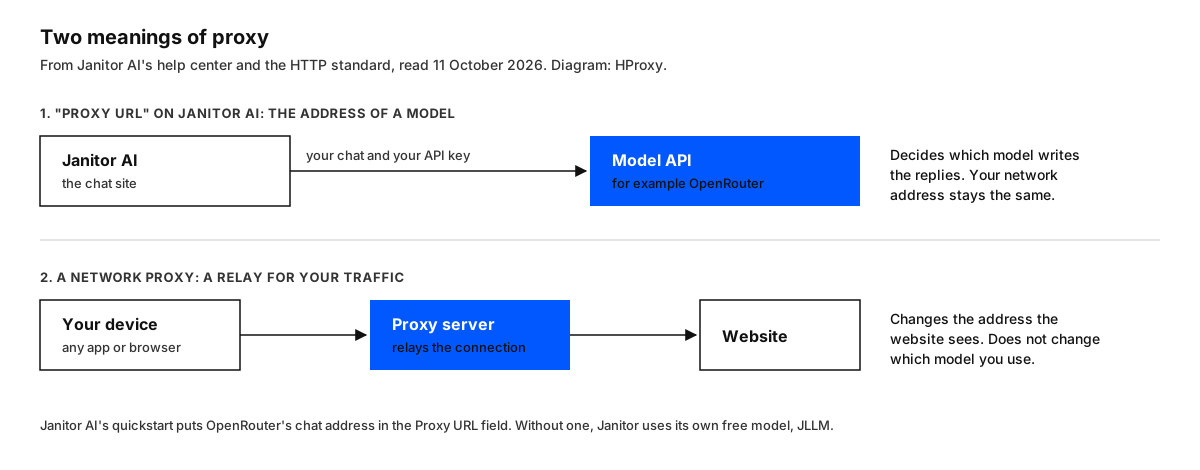
Some guides mix the two up and claim that this proxy field protects your identity. It does not. It only decides which model answers.
Is the free model in Janitor's guide still free?
No. The guide, last updated on 1 August 2025, says to paste "Model Name: deepseek/deepseek-chat-v3-0324:free (copy-paste exactly!)". We read the public model list of OpenRouter, which needs no key:
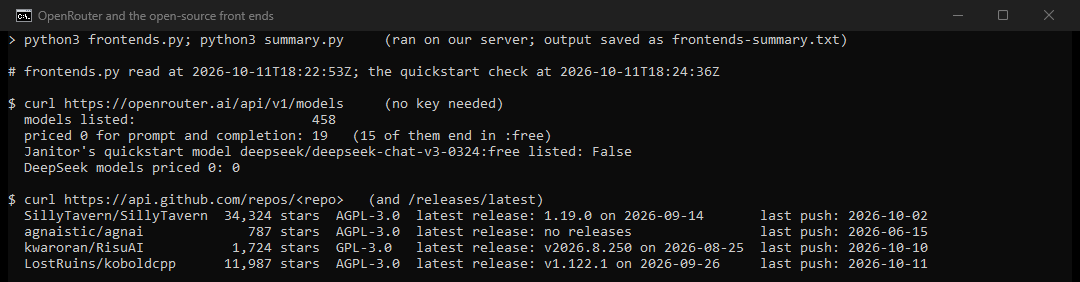
Of 458 models, 19 cost nothing for both prompt and completion. The model in the guide was not among the 458 at all, and none of the 19 came from DeepSeek. Anyone who copies that name today asks for a model the list no longer has.
Free models also have a ceiling. The docs set "FREE_MODEL_RATE_LIMIT_RPM = 20" and "FREE_MODEL_NO_CREDITS_RPD = 50": 20 requests a minute and 50 a day. An account that has bought at least 10 credits gets "FREE_MODEL_HAS_CREDITS_RPD = 1000", so 1,000 a day.
Front ends: bring your own model
These are programs you run, or sites you open, that talk to a model you choose. We read the four best-known open-source ones on GitHub:
| Front end | GitHub stars | Latest release | Licence |
|---|---|---|---|
| SillyTavern | 34,324 | 14 Sep 2026 | AGPL-3.0 |
| KoboldCpp | 11,987 | 26 Sep 2026 | AGPL-3.0 |
| RisuAI | 1,724 | 25 Aug 2026 | GPL-3.0 |
| Agnai | 787 | none | AGPL-3.0 |
SillyTavern is the largest by far. Its own line on GitHub reads: "LLM Frontend for Power Users." It runs on your computer, and it needs a model behind it, but not a key. Its docs: "You can use AI Horde for instant out-of-the-box chatting." It also takes an "OpenAI-compatible API, KoboldAI, Tabby, and many more".
KoboldCpp skips the outside model altogether. In its own words: "Run GGUF AI models locally with a KoboldAI UI. One File. Zero Install." No key and no provider: the model runs where you run it.
RisuAI calls itself "User-friendly software for LLM roleplaying". It released in August 2026 and was still changing in October. Agnai has no release on GitHub, and its last change there was on 15 June 2026. Our page on Agnai shows where it sends your requests.
Hosted apps with a model of their own
If setting up a model is the part you want to skip, the hosted apps do it for you. We looked them up in 60 App Store countries for our page on Character AI alternatives:
- Chai and Kindroid were listed in all 60, as was Janitor's own app.
- Character AI and Replika were listed in 59; China's store had neither.
- PolyBuzz was listed in 54, and Nomi in 51, missing from eight European Union storefronts.
Every one of them is rated 17+ in the US App Store. Their minimum ages, from their own terms, are on that page too.
Where does a network proxy fit?
Not in the model. A model you connect with your own key keeps the rules of its provider, including where you may use it. OpenAI warns that use outside its supported countries "may result in your account being blocked or suspended".
A network proxy is ordinary in one place: a front end on a company network that only lets traffic out through a proxy. Our pages on SillyTavern and OpenRouter show those settings.
What this page could not check
- We did not sign up for or chat with any service, so this page says nothing about writing quality, memory or filters.
- Janitor AI's site refused our server, so we read its help center but not its terms.
- GitHub stars measure attention, not quality.
- OpenRouter's free models change often, and one reading is a snapshot.
- We will read the model list and the four repositories again by 11 January 2027.
Sources
- Janitor AI help center: the proxy quickstart (updated 1 August 2025) and the JLLM article (updated 31 July 2025): help.janitorai.com.
- OpenRouter, limits documentation, read 11 October 2026: openrouter.ai. OpenRouter's public model list: openrouter.ai/api/v1/models.
- SillyTavern, documentation, read 11 October 2026: docs.sillytavern.app.
- GitHub, the repositories of SillyTavern, KoboldCpp, RisuAI and Agnai, read 11 October 2026.
- OpenAI, Supported countries and territories, read 11 October 2026: developers.openai.com.
- RFC 9110, HTTP Semantics, IETF, June 2022: rfc-editor.org.
- Our own tests on our server, 11 October 2026: OpenRouter's model list at 18:22 and 18:24 UTC, GitHub's API at 18:22 UTC, and Apple's lookup API for the hosted apps from 17:28 to 18:06 UTC.