A residential IP is an address that an internet provider gives to a home connection. No public record states that for certain. What you can check is everything around the address. Who announces it? What does that network call itself? What name did the operator give it? Does it sit in a cloud's published ranges?
We ran five such checks on 791 real addresses on 11 October 2026. This page shows how to run each one, and how often each one gave an answer.
Is my IP residential?
Open our proxy IP checker. It shows the address that websites see, with the ASN and the organisation behind it. A cable, DSL, fibre or mobile company points to a home or phone line. A hosting company or a cloud points to a server. For any other address, such as the exit of a proxy, use our IP lookup.
Both tools also label the network, as a datacenter or as a consumer provider. Treat any label like that as a first guess, from any checker. The five checks below tell you how far to trust it.
How often does each check answer?
We took the first 1,000 rows of our free proxy list, which mixes servers and home connections, and kept the 791 unique IPv4 addresses. For each one we read the ASN and organisation, the network's type in PeeringDB, the reverse DNS name and three clouds' published ranges.
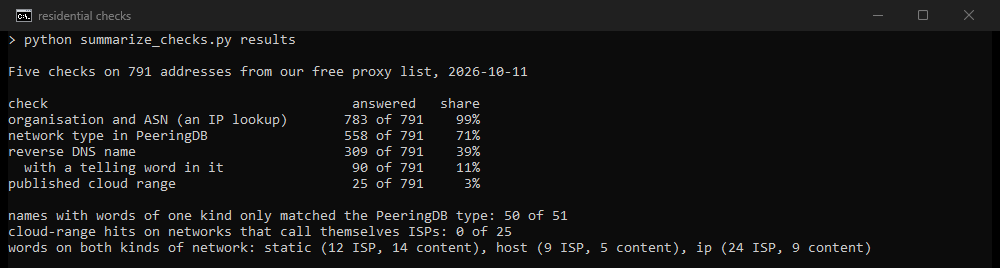
The organisation answered almost every time. The reverse DNS name carried a useful word for only about one address in nine. A cloud range matched just 25 addresses, but each of those answers was clear.
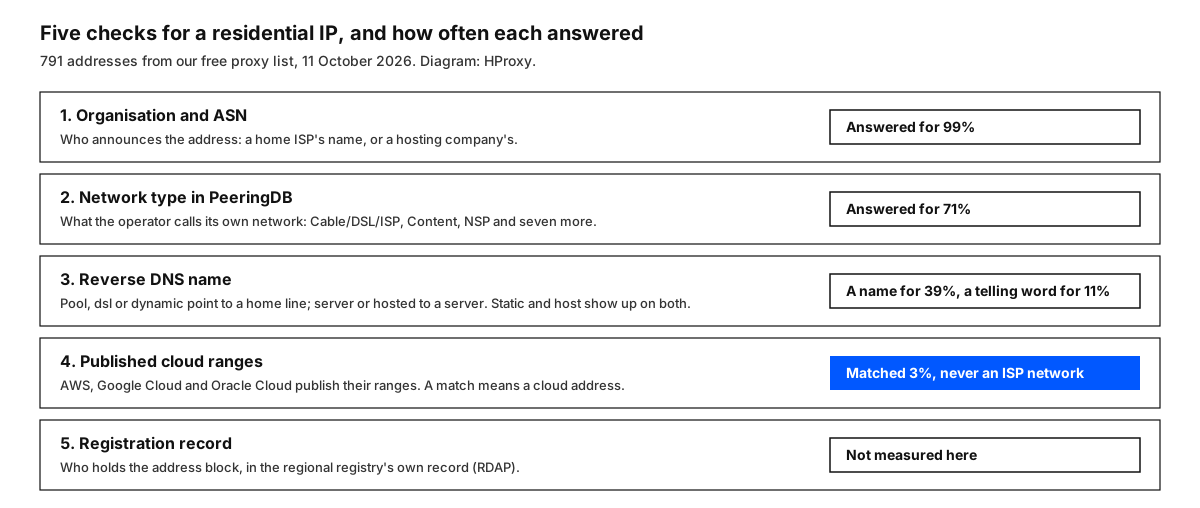
1. Read the organisation behind the ASN
Every public address belongs to an autonomous system. RFC 1930 defines one as "a connected group of one or more IP prefixes run by one or more network operators which has a SINGLE and CLEARLY DEFINED routing policy". Its number is the ASN, and a lookup shows the organisation that runs it. We explain the idea in more depth in what is an ASN.
Read that name yourself. Our lookup gave an ASN and organisation for 783 of the 791 addresses. Here is the answer for 8.8.8.8, Google's public DNS service:
curl https://hproxy.com/api/ip/8.8.8.8
{"asn":15169,"asn_org":"Google LLC","country":"US","country_name":"United States","ip":"8.8.8.8","is_datacenter":true,"isp":"Google LLC","latitude":37.751,"longitude":-97.822,"timezone":"America/Chicago"}
The organisation is Google, not a home provider. That fits a server.
2. Check the network type in PeeringDB
PeeringDB describes itself as "a freely available, user-maintained, database of networks". Operators fill in their own entry, and one field is the network type. It takes ten values, among them Cable/DSL/ISP, Content and NSP. Comcast, a US cable provider, calls itself Cable/DSL/ISP. Google calls itself Content.
curl "https://www.peeringdb.com/api/net?asn=15169"
Look for info_type in the answer. Two limits come with it. The type is the operator's own word. And many networks leave it out: 127 of our addresses sat on networks not listed at all, and 106 on networks with no type set. That left 558 of 791, or 71%, with an answer.
3. Look up the reverse DNS name
The reverse DNS name, or PTR record, is the name the operator gave the address. The DNS guidelines in RFC 1912 expect one: "For every IP address, there should be a matching PTR record in the in-addr.arpa domain." Yet 482 of our 791 addresses, or 61%, had no name at all.
dig -x 8.8.8.8 +short
That prints dns.google. On Windows, nslookup 8.8.8.8 shows the same name.
When a name exists, a few words in it tell you something, and others tell you nothing. We counted the names on networks that call themselves Cable/DSL/ISP only, and on networks that call themselves Content only:
| Words in the name | ISP networks | Content networks | What it suggests |
|---|---|---|---|
| Home words only, such as pool, dsl, dynamic, fiber or broadband | 25 | 1 | A home line |
| Server words only, such as server, hosted, vps, cloud or compute | 0 | 25 | A server |
| static | 12 | 14 | Nothing either way |
| host | 9 | 5 | Nothing either way |
| ip | 24 | 9 | Nothing either way |
So when a name speaks, it mostly agrees with the network. Words of one kind matched the network's own type in 50 of 51 cases. The exception was a cloud platform whose names contain the word customer. But only 90 of our 791 addresses, about one in nine, carried such a word at all.
4. Check the published cloud ranges
Big clouds publish their address ranges. AWS puts it plainly: "AWS publishes its current IP address ranges in JSON format. With this information, you can identify traffic from AWS." Google Cloud and Oracle Cloud do the same.
A few lines of Python test an address against such a list:
import ipaddress, json, urllib.request

ranges = json.load(urllib.request.urlopen("https://ip-ranges.amazonaws.com/ip-ranges.json"))
ip = ipaddress.ip_address("203.0.113.25")  # put the address you check here
print(any(ip in ipaddress.ip_network(p["ip_prefix"]) for p in ranges["prefixes"]))
A match means a cloud address. In our test, 25 of 791 addresses matched: 13 in Oracle Cloud's ranges, 6 in AWS's and 6 in Google Cloud's. None of them sat on a network that calls itself an ISP.
No match proves nothing, though. Many hosting companies publish no list at all. And you have to pick the right list. Google keeps two: goog.json for "Google-owned IP addresses", and cloud.json for ranges "available for customers' Google Cloud resources". 8.8.8.8 sits in goog.json, as part of 8.8.8.0/24, and not in cloud.json.
5. Read the registration record
The regional internet registries record who holds each address block. You read that record through RDAP, whose standard describes "JSON data structures representing registration information maintained by Regional Internet Registries". For North American addresses, ask ARIN:
curl https://rdap.arin.net/registry/ip/8.8.8.8
The answer names the block 8.8.8.0 to 8.8.8.255, a direct allocation registered to Google LLC. We did not run this check on the 791 addresses, so this page has no numbers for it.
What none of these checks can see
All five checks read data about an address: routing, the registries and the DNS. None of them sees the device that uses it. An ISP proxy shows how far apart the two can be. It is, in the words of our glossary, an address "registered to a consumer internet provider" and "running on hardware in a data centre". We explain the type in what is an ISP proxy.
So read the checks together. The organisation and the network type say what kind of network it is. A clear word in the reverse DNS name, or a cloud match, can settle the question. A single label, from any checker, cannot.
If you need home exits in a chosen country, our residential proxies let you pick it, and you can run every check above on each exit.
What this page could not check
- Every check reads data about an address, not the device behind it.
- Our 791 addresses came from our free proxy list on one morning. They mix servers and home connections, but they are not a random sample of the internet.
- The word lists for reverse DNS names are our own. Words we did not list may also carry meaning.
- We checked the ranges of three clouds. Azure and many smaller hosts were not part of the test.
- PeeringDB types are chosen by the operators themselves, and many networks have none.
- We did not run the registration record check on the sample.
- We did not grade any lookup's datacenter or residential label. We will run the checks again by 11 January 2027.
Sources
- RFC 1930, Guidelines for creation, selection, and registration of an Autonomous System, IETF, March 1996: rfc-editor.org.
- RFC 1912, Common DNS Operational and Configuration Errors, IETF, February 1996: rfc-editor.org.
- RFC 9083, JSON Responses for the Registration Data Access Protocol, IETF, June 2021: rfc-editor.org.
- PeeringDB, home page and API schema 2.83.0, read 11 October 2026: peeringdb.com.
- AWS, AWS IP address ranges, read 11 October 2026: docs.aws.amazon.com.
- Google Cloud, Compute Engine FAQ and Private Google Access, read 11 October 2026: cloud.google.com.
- Oracle Cloud Infrastructure, IP Address Ranges, read 11 October 2026: docs.oracle.com.
- ARIN, RDAP record for 8.8.8.8, read 11 October 2026: rdap.arin.net.
- HProxy, IP location and ASN API, read 11 October 2026: hproxy.com/docs/free/ip-lookup.
- Our own test: five checks on 791 addresses from our free proxy list, 11 October 2026, 06:45 to 06:47 UTC, and the five checks on 8.8.8.8 at about 06:58 UTC.