A proxy hostname is the name of the proxy server your device connects to: the host part of host:port. In premium.hproxy.com:10000, the hostname is premium.hproxy.com and the port is 10000. Your device looks the name up in DNS, connects to the address it gets back, and sends its traffic through that server. It is not the website you visit and not the name of your computer. If a settings screen asks for a proxy hostname and you use no proxy, leave the proxy off.
We tested the parts that other explanations only describe, on 10 October 2026. We measured how our own gateway's hostname resolves and what the name costs. We recorded what a proxy receives from a client. And we ran Android's own check on 16 entries, to show what its Proxy hostname field accepts.
What does a proxy hostname look like?
It is usually a domain name, sometimes a bare IP address. Providers hand it over in one of a few shapes:
| Where you see it | Example | The hostname in it |
|---|---|---|
| A provider's proxy line | premium.hproxy.com:10000:USER:PASS | premium.hproxy.com |
| A proxy URL | http://USER:PASS@premium.hproxy.com:10000 | premium.hproxy.com |
| A line with an IPv4 address | 203.0.113.10:8080 | 203.0.113.10 |
| A proxy URL with an IPv6 address | http://[2001:db8::10]:8080 | 2001:db8::10 |
| Android's grey hint text | proxy.example.com, port 8080 | proxy.example.com |
Our API documentation describes generated lines as host:port:username:password, so the hostname is always the first field. The curl manual writes a proxy as [protocol://]host[:port], and warns that without a port "it is assumed to be 1080". An IPv6 address goes in square brackets inside a URL. RFC 3986 (IETF, January 2005) reserves the brackets for exactly that.
A hostname follows the old rules for host names. RFC 952 (October 1985) allows letters, digits, the minus sign and the period, and "no blank or space characters". RFC 1123 (October 1989) lets the name start with a digit. RFC 1035 (November 1987) limits each label to 63 octets and the whole name to 255. An underscore is not on that list.
How does your device use the proxy hostname?
It asks DNS for the address behind the name, then opens a connection to that address and the port. We looked up our own gateway, premium.hproxy.com, through three public resolvers and its own name server on 10 October 2026. It had one IPv4 (A) record, no IPv6 (AAAA) record and no alias. A hostname can also stand for several addresses: hproxy.com returned two IPv4 and two IPv6 addresses that day.
The record carried a TTL of 300 seconds. RFC 1035 defines the TTL as "the time interval (in seconds) that the resource record may be cached before it should be discarded". So a client that uses the name learns about a moved gateway within about five minutes.
Which name goes where
The website's name does not go to your DNS. It goes to the proxy, inside the request. We showed this on our server with a 60-line logging proxy that answers by itself and relays nothing. Then we pointed curl 8.5.0 at it.
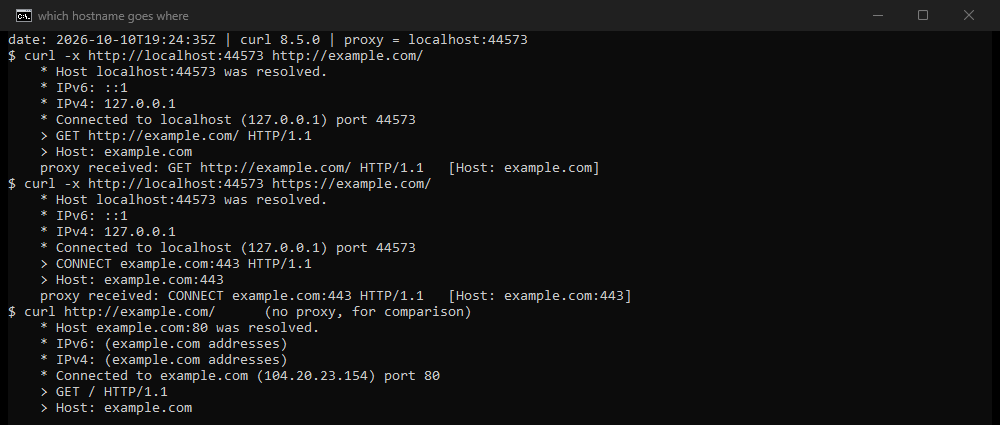
Through the proxy, curl resolved one name, localhost, which was the proxy hostname. It never looked up example.com. For the http address it sent GET http://example.com/ HTTP/1.1, and for the https address it sent CONNECT example.com:443 HTTP/1.1. Without the proxy, curl resolved example.com itself. RFC 9112 (IETF, June 2022) requires exactly this. A request to a proxy carries the full address in "absolute-form", and a CONNECT request carries "only the uri-host and port number of the tunnel destination".
Not every client does what curl does. A 2020 Stack Overflow question shows Java resolving the website itself and sending CONNECT with an IP address. For SOCKS proxies, the choice is explicit: our SOCKS4 vs SOCKS5 page tests who resolves the name with each setting.
Which three hostnames take part in a proxied request?
Three names are easy to mix up. Only the first one is the proxy hostname.
| Proxy hostname | Target hostname | Reverse name of the exit address | |
|---|---|---|---|
| What it names | The proxy server you connect to | The website you want | The address the website sees |
| Example | premium.hproxy.com | example.com | dns.google for 8.8.8.8 |
| Who types it | You, in the proxy settings | You, in the browser or the script | Nobody; whoever runs that network of addresses sets it |
| Who looks it up | Your device | The proxy, with HTTP proxies and socks5h | Anyone who asks DNS about the address |
| Where it travels | Your DNS query | Inside the proxy request | A PTR query for the address |
The third one answers a common search, "hostname of IP address". RFC 1035 describes a special domain, in-addr.arpa, "to support gateway location and Internet address to host mapping". We asked for three reverse names on 10 October 2026. 8.8.8.8 returned dns.google., 1.1.1.1 returned one.one.one.one., and 9.9.9.9 returned dns9.quad9.net.. The mapping is not one to one: dns.google points back to two addresses, 8.8.8.8 and 8.8.4.4.
What does Android's Proxy hostname field accept?
Android puts the proxy inside each Wi-Fi network's advanced options. The choices are None, Manual and Proxy Auto-Config. Manual shows three boxes: Proxy hostname, Proxy port and Bypass proxy for. The grey hints read proxy.example.com and 8080. These labels come from the Settings app in Android's open-source code.
The rule behind the hostname box is one line of code. Android's ProxyUtils matches the hostname against letters, digits, hyphens and dots, and requires a port from 1 to 65535. We copied that rule and ran it on 16 entries:
| What you type | Port | What Android does |
|---|---|---|
premium.hproxy.com | 10000 | Accepts it |
203.0.113.10 | 10000 | Accepts it |
http://premium.hproxy.com | 10000 | Rejects the hostname |
premium.hproxy.com:10000 | 10000 | Rejects the hostname |
USER:PASS@premium.hproxy.com | 10000 | Rejects the hostname |
2001:db8::10 (IPv6) | 10000 | Rejects the hostname |
my_proxy.example.com | 8080 | Rejects the hostname (underscore) |
premium.hproxy.com with a space before it, or a dot after it | 10000 | Rejects the hostname |
premium.hproxy.com | empty | Asks for the port |
premium.hproxy.com | 70000 or 0 | Rejects the port |
The bypass list follows the same alphabet plus *, separated by commas. example.com,*.local,localhost passed. The same list with a space after a comma failed.
On the Wi-Fi network screen, a failed check shows no message. Android's code simply keeps the Save button disabled. That matches what people report. A 2014 question on Android Stack Exchange describes a Save button that "grays out" the moment Proxy is set to Manual. Another asks why slashes are not allowed in the proxy setting. Android's Settings also carries a warning worth reading: "The HTTP proxy is used by the browser but may not be used by the other apps". Our Android proxy setup guide walks through the screens step by step.
Should you use the hostname or the IP address?
Use the hostname your provider gives you. We measured the price of the name on our server in three runs, going through our gateway by name and by its address. Every request was refused with a 407, so nothing was relayed. The name added one DNS lookup, with a median of 2.5 to 2.9 ms and a maximum of 47.1 ms. The connection setup to the gateway took a median of 165 to 188 ms either way.
| Hostname | IP address | |
|---|---|---|
| Extra step | One DNS lookup, a median of 2.5 to 2.9 ms in our test | None |
| When the provider moves the gateway | Follows the new address within the TTL, 300 seconds for our gateway | Stops working until you change it |
| Several servers behind one entry | Possible, as hproxy.com shows | One server per address |
| Typing it on Android | Allowed | Allowed for IPv4, refused for IPv6 |
Our documentation gives the same advice for code: "treat lines as opaque and use them verbatim". Windows shows how loose the labels are. Its box is called "Proxy IP address", yet Microsoft's help page says to "enter the proxy server name or IP address" there.
How do you find your proxy hostname?
If you pay for proxies, the hostname is in your provider's dashboard or in each line it generates. If your device already uses a proxy, the operating system shows it:
- Windows. Open Settings, Network & internet, Proxy. The manual setup box is called Proxy IP address, but a name works there too.
- Mac. Open System Settings, Network, your service, Details, Proxies. Each proxy type shows a server address and a port.
- iPhone. Open Settings, Wi-Fi, and tap the Info button next to the network. The proxy sits under HTTP Proxy, per network.
- Android. Open the Wi-Fi network's settings and its advanced options. With Proxy on Manual, the name is in Proxy hostname.
- curl. Look at the
-xoption or the proxy environment variables. The hostname is the host part of[protocol://]host[:port].
If none of these shows a proxy, you are not using one. On Android, leave Proxy set to None. A phone or a Wi-Fi network has no hostname of its own to put there.
What a proxy hostname is not
- Not encryption. It is only a name for an address. Our logging proxy read every request line and
Hostheader in plain text. One ranking page claims that the proxy hostname encrypts your traffic; it does not. - Not your exit address. The hostname names the gateway you reach. The address a website sees can be another one, and on a rotating network it changes while the hostname stays the same.
- Not a promise that every app uses it. Android's own warning says other apps may ignore the Wi-Fi proxy.
Where to go from here
To see the address and headers a website receives from your browser, use our proxy IP checker. For the basics of how a proxy works, read what is a proxy. On our network, Residential Premium lines carry the hostname premium.hproxy.com, from the residential proxies page.
What this page could not check
Android's rule is read from the open-source code on its main branch, and we ran it on a computer, not on a phone. Phone makers can change their Settings app, and older Android versions may differ. The DNS cost and the TTL were measured from one server in the US, on one day, against one gateway. Clients other than curl may resolve the website's name themselves, as the Java example shows, and we did not test them. Apple's iPhone guide names the path to the proxy but not the labels on the screen. The next review of these facts is due by 10 January 2027.
Sources
- RFC 1035, Domain Names: Implementation and Specification, IETF, November 1987.
- RFC 1123, Requirements for Internet Hosts: Application and Support, IETF, October 1989.
- RFC 952, DoD Internet Host Table Specification, IETF, October 1985.
- RFC 9112, HTTP/1.1, IETF, June 2022.
- RFC 3986, Uniform Resource Identifier: Generic Syntax, IETF, January 2005.
- Android Open Source Project, ProxyUtils.java, Connectivity module, main branch, read 10 October 2026.
- Android Open Source Project, Settings app: WifiConfigController2.java, with the app's strings and arrays, main branch, read 10 October 2026.
- Microsoft Support, Use a proxy server in Windows, June 2026.
- Apple, Change proxy settings on Mac, Mac User Guide, read 10 October 2026.
- Apple, Manage Wi-Fi settings on iPhone, iPhone User Guide, read 10 October 2026.
- curl manual, option -x, curl project, read 10 October 2026.
- HProxy documentation, plans and generated lines, read 10 October 2026.
- Questions people asked, cited as examples and not as evidence: Android Stack Exchange 68077 (March 2014) and 88018 (November 2014); Stack Overflow 62759078 (July 2020).
- Our own measurements, 10 October 2026: DNS records and lookup cost of our gateway hostname, reverse names of three public resolvers, the logging proxy test, and Android's rule run on 16 entries. The scripts and their output sit in this page's research folder.