 Covered ProxyBonanza
If you were buying datacenter proxies in the early 2010s, ProxyBonanza was on the shortlist. It was one of the brands you would see recommended for search-engine-optimization tools, rank checkers, and running a stack of social accounts: a clean storefront, proxies sorted into tiers, both shared and exclusive options, and a browser extension to manage them. For a while it was a normal, working part of the toolkit.
Open proxybonanza.com today and it loads a working storefront, selling shared, exclusive, and international proxy plans across roughly 107 locations, and taking card and PayPal payments under a "Copyright 2026" footer. That is worth stating plainly, because when we swept the domain in March 2026 it returned a blank, title-less page, and because the company that originally launched the brand has not legally existed since 2013. This is not the story of a botnet getting exposed or a service getting seized. It is the quieter, more common puzzle: a veteran brand that has outlived the company behind it, gone dark and come back, and now trades under an operator the paperwork cannot account for. That gap, between a live checkout and a dissolved company, is the whole reason it is worth a post.
What ProxyBonanza actually was
ProxyBonanza sold datacenter proxies. A datacenter proxy is an IP address that lives in a hosting facility rather than on a home internet connection, which makes it fast and cheap but easy for a target site to recognize as "not a real person." That was fine for most of what people used ProxyBonanza for: pulling search rankings, checking ads, light scraping, and managing accounts that did not need to look residential.
The product came in two shapes, and the difference still matters when you buy proxies from anyone today.
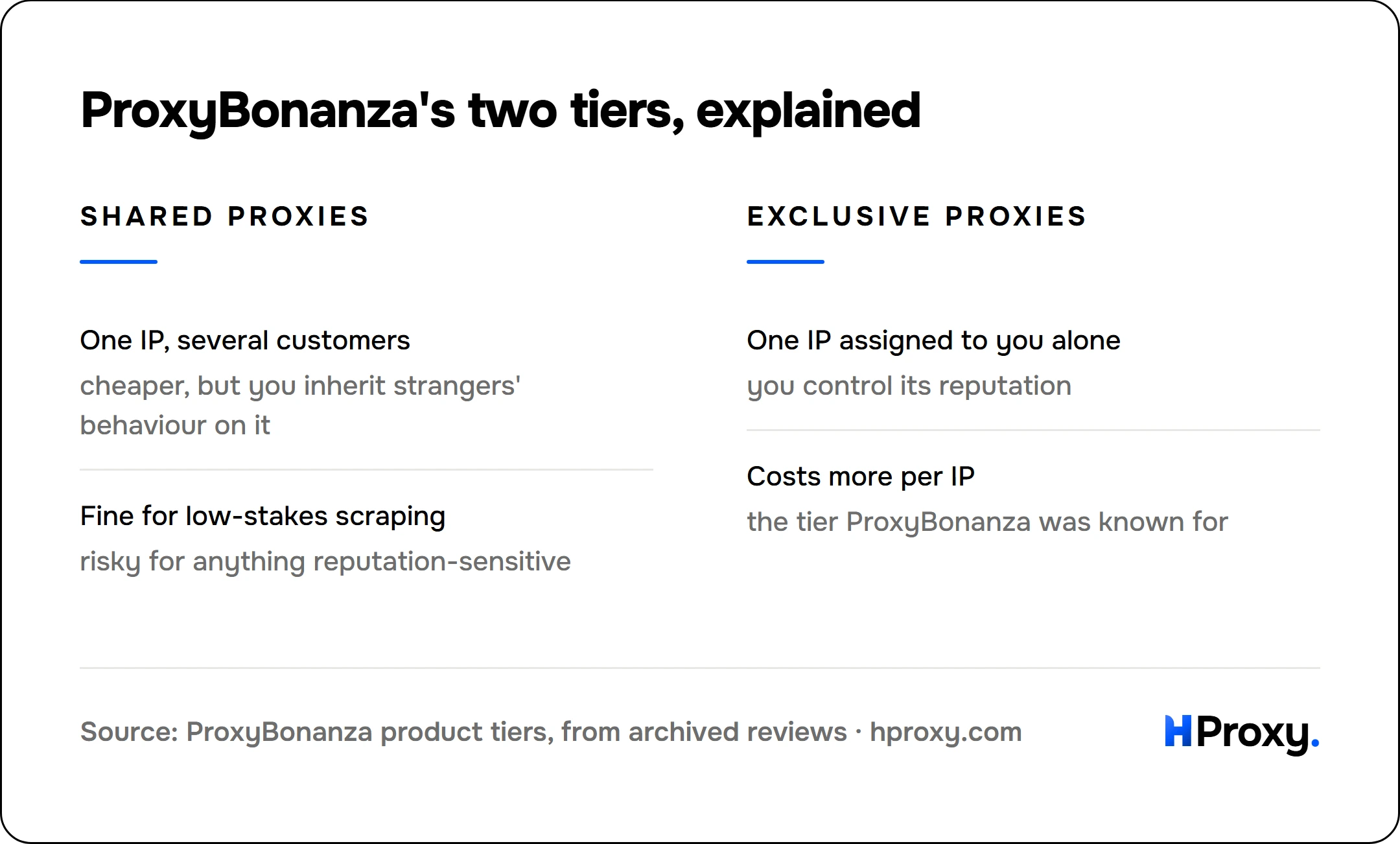
Shared proxies
One IP, several customers
cheaper, but you inherit strangers' behaviour on it
Fine for low-stakes scraping
risky for anything reputation-sensitive
Exclusive proxies
One IP assigned to you alone
you control its reputation
Costs more per IP
the tier ProxyBonanza was known for
Nothing here is exotic, and nothing here is criminal. ProxyBonanza was a straightforward reseller of hosting-based IP addresses. The reason it is interesting now is not what it sold. It is how it left.
The paper trail: a company that dissolved in 2013
Here is the detail that surprises people. The legal entity behind the brand, PROXYBONANZA.COM LTD, was a private limited company registered in London (company number 07489117). It was incorporated on January 11, 2011, and it was dissolved on April 30, 2013. On paper, the company that launched ProxyBonanza existed for barely two years.
The service did not die in 2013, though. That is the part you have to read carefully. A dissolved company does not mean a dead product. The brand kept trading for years after the UK entity was wound up, almost certainly under a different or undisclosed operator. The proxies still worked. The extension still shipped updates. The paperwork and the product were simply not the same timeline, which is its own quiet warning: the name you were buying from and the company legally standing behind it had already parted ways.
The slow fade
The clearest sign of when ProxyBonanza actually stopped caring is its own software. ProxyBonanza shipped a browser extension, the Proxybonanza Proxy Manager, to make switching between your proxies easier. Browser extensions need regular updates just to keep working as the browser changes underneath them. This one was rebuilt as a modern WebExtension in December 2017, got a couple of updates through early 2019, and then shipped its final version, 4.6, on May 30, 2019. After that, nothing. The tool its customers used every day was abandoned even as the storefront kept running, which is its own kind of warning: the parts of a business that need ongoing work can quietly stop while the checkout stays open.
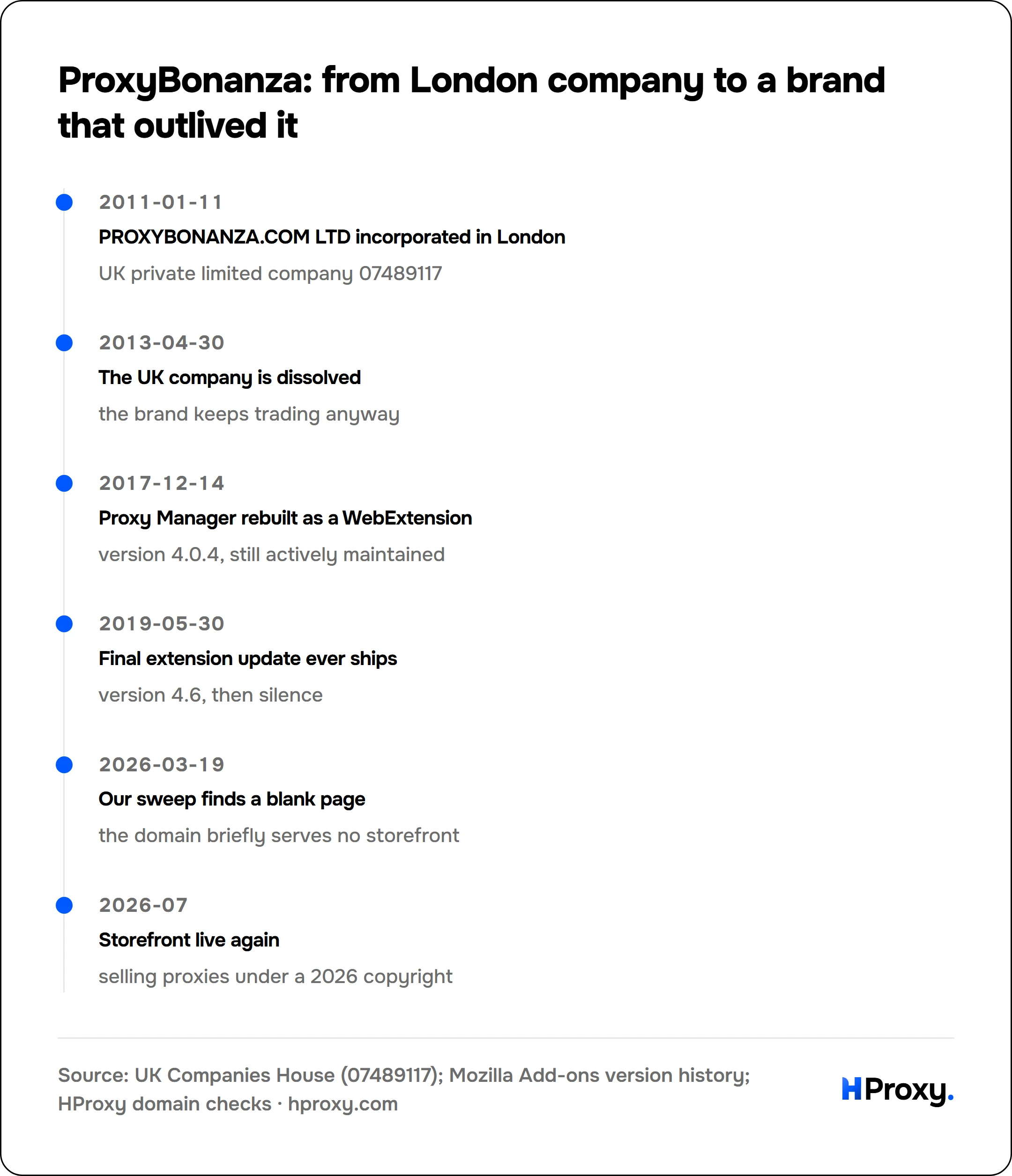
2011-01-11
PROXYBONANZA.COM LTD incorporated in London
UK private limited company 07489117
2013-04-30
The UK company is dissolved
the brand keeps trading anyway
2017-12-14
Proxy Manager rebuilt as a WebExtension
version 4.0.4, still actively maintained
2019-05-30
Final extension update ever ships
version 4.6, then silence
2026-03-19
Our sweep finds a blank page
the domain briefly serves no storefront
2026-07
Storefront live again
selling proxies under a 2026 copyright
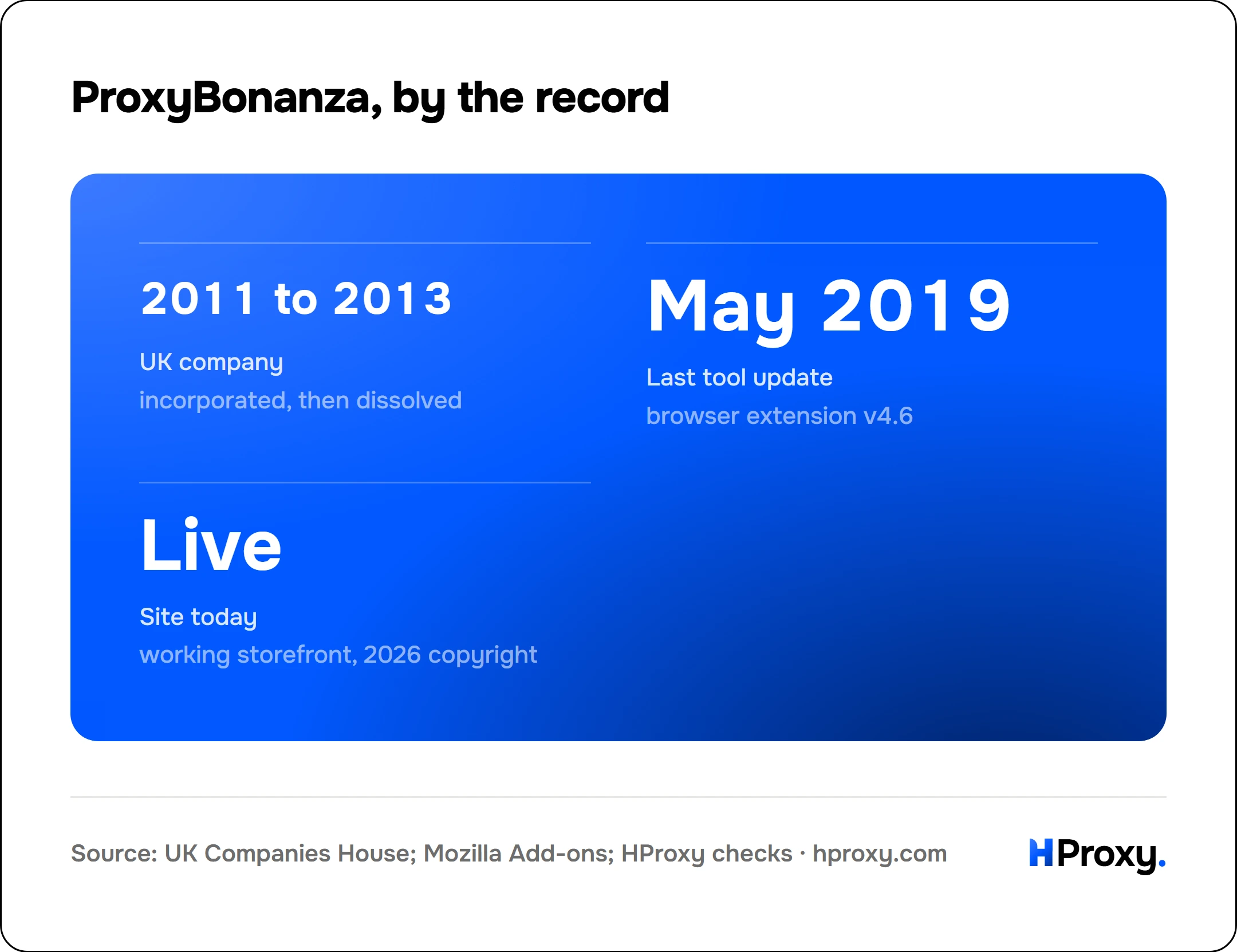
ProxyBonanza, by the record
- 2011 to 2013
- UK company
- May 2019
- Last tool update
- Live
- Site today
incorporated, then dissolved
browser extension v4.6
working storefront, 2026 copyright
Source: UK Companies House; Mozilla Add-ons; HProxy checks
Put those dates together and you get something stranger than an ordinary death. Incorporate in 2011. Lose the original company in 2013. Keep trading anyway. Abandon the tools in 2019. Go dark long enough for a sweep to find a blank page, then come back selling proxies again in 2026. Nobody ever announced any of it, which is exactly the problem: the brand changed hands, or shape, or operator, with no paper trail a buyer can follow.
Why a murky brand is its own kind of risk
The VIP72 and LuxSocks stories are dramatic: hacked machines, criminal marketplaces, law-enforcement takedowns. We wrote up what happened to VIP72, a 15-year malware proxy network, because the sourcing lesson is loud. ProxyBonanza teaches a quieter one, and it catches more people, because a legitimate-looking brand with a dissolved company behind it does not look dangerous. It looks fine right up until it does not.
The risk in a service like this is continuity and accountability, not somebody else's hacked PC carrying your traffic. When the company behind a brand dissolves but the storefront keeps selling:
- You do not know who you are actually paying. The legal entity that launched ProxyBonanza was wound up in 2013, and whoever runs the checkout today is not named in that paperwork.
- The tooling can be abandoned while the store stays open. The browser extension has not been touched since 2019, so anything built on it breaks on the next browser change with nobody to fix it.
- Support and refunds depend on an operator you cannot identify. If a proxy dies mid-job or a charge goes wrong, you are relying on a party the public record cannot place.
- A brand that has gone dark and come back can change hands quietly. The name on the door stays the same while the people, the sourcing, and the priorities behind it may not.
A proxy is an ongoing service, not a one-time download. You are not just buying an IP address, you are buying the promise that someone will keep that IP alive, clean, and supported next week. A brand whose operator you cannot even name is in a weak position to make that promise, no matter what the old reviews say.
How to tell if a proxy brand is still home
You do not need inside information to spot a ProxyBonanza in progress. The tells are all public:
- Load the actual site. A blank page, a parking page, a permanent "just a moment" challenge, or a homepage that has not changed in years is the loudest signal there is.
- Check the tooling. If the provider ships a browser extension or app, look at when it was last updated. A tool frozen for years means a team frozen for years.
- Look up the company. A quick registry search (Companies House in the UK, or the equivalent where they claim to be based) tells you whether the legal entity behind the brand still exists. A dissolved company selling a live product is a flag, not a footnote. We pulled the real corporate structure of the whole industry apart in who owns your proxy provider.
- Test before you trust. Whatever a brand claims, put an IP it gives you through a proxy checker and see if it actually connects and where it actually exits. A dead service often still lists proxies that no longer answer.
ProxyBonanza is not alone here. A whole cohort of 2010s brands has quietly gone dark or been erased, which we tracked in how Google erased 13 proxy brands. The pattern repeats because the datacenter proxy business got commoditized: margins thinned, attention wandered, and the brands that did not evolve just stopped.
Buy from something you can check
The lesson here is not "avoid datacenter proxies." Datacenter IPs are the right, cheap tool for plenty of jobs. The lesson is to buy from something that is demonstrably accountable: a live list, a working checker, current tooling, and someone you can identify answering when it breaks.
That is the boring thing we try to compete on. Our free proxy list is re-checked every few minutes, so what you copy was alive moments ago instead of in 2019. When you need paid IPs that hold up, we sell them at $0.44/GB pay as you go, with no know-your-customer checks and a balance that never expires, and the whole point of an article like this is that we would rather you be able to check we are still here than take our word for it.
ProxyBonanza was a normal, working service for years, and in a narrow sense it still is one: the storefront is live and taking orders. What it is not is accountable. The company that launched it dissolved in 2013, its tooling froze in 2019, it went dark and came back, and the old reviews still rank as if none of that happened. Before you trust any brand's reputation, make sure you can tell who is standing behind it today.
Sources
- UK Companies House, PROXYBONANZA.COM LTD (company 07489117): incorporation on January 11, 2011 and dissolution on April 30, 2013, registered in London.
- Mozilla Add-ons, Proxybonanza Proxy Manager version history: the extension's release dates, including the final version 4.6 on May 30, 2019.
- HProxy internal competitor research (2026): a blank page at the March 2026 sweep and a live, working storefront by mid-2026 selling shared, exclusive, and international proxy plans across roughly 107 locations, plus the shared-versus-exclusive product tiers drawn from archived reviews.