A proxy SLA is the part of a contract that turns an uptime figure into money. It defines when the service counts as down, measures that over a month, and pays a credit against future bills when the target is missed. The credit is small, often capped, and it is the only remedy you get. It covers the provider network, not whether the sites you reach will answer. Before you rely on one, read five things: the definition of downtime, the window, the credit, the claim deadline and the exclusions.
What an SLA is, and what a figure on a web page is not
NIST describes an SLA as "a commitment between a service provider and one or more customers". It covers the responsibilities of each side, the expected performance level, such as reliability and response times, and how problems are reported, resolved and ended. An uptime figure on a product page does none of that. It becomes a commitment only when a document says what happens if the figure is missed.
Many uptime figures in this market have no such document behind them. We read the business pages of seven proxy providers, and the documents those pages link to, on 26 and 27 September 2026. Six state an uptime figure, but only two publish an SLA that defines downtime and pays credits, and none of the 99.99 percent figures has a public SLA behind it. So the first question is always which document stands behind a figure.
Five SLAs, side by side
| SLA and target | What counts as down | What a missed month pays |
|---|---|---|
| SOAX, a proxy network: 99.9% a month on Premium | Its dashboard or its gateway stops working, per its own monitoring | 15%, 35% or 75% of the plan fee. Claim within 30 days of the month end. |
| Rayobyte, a proxy network: 99.9% a month | Every connection to a proxy fails for a whole minute | 10%, 20% or 30% of that proxy's charges, when the credit tops $5. Claim within 14 days, with logs. |
| HighProxies, dedicated proxies: 99.9% a month | Its nodes or control panel stop working | 5%, 15% or 25% of the monthly fee, capped at 50%. Claim within 7 days of the month end. |
| Google Cloud Secure Web Proxy: 99.99% a month | A 100% error rate, in whole minutes | 10%, 25% or 50% of the monthly bill. Claim within 30 days, with logs. |
| AWS RDS Proxy: 99.99% a month | Every connection fails for a whole minute | 10%, 25% or 100% of the month's charge. Claim by the end of the second billing cycle, with logs. |
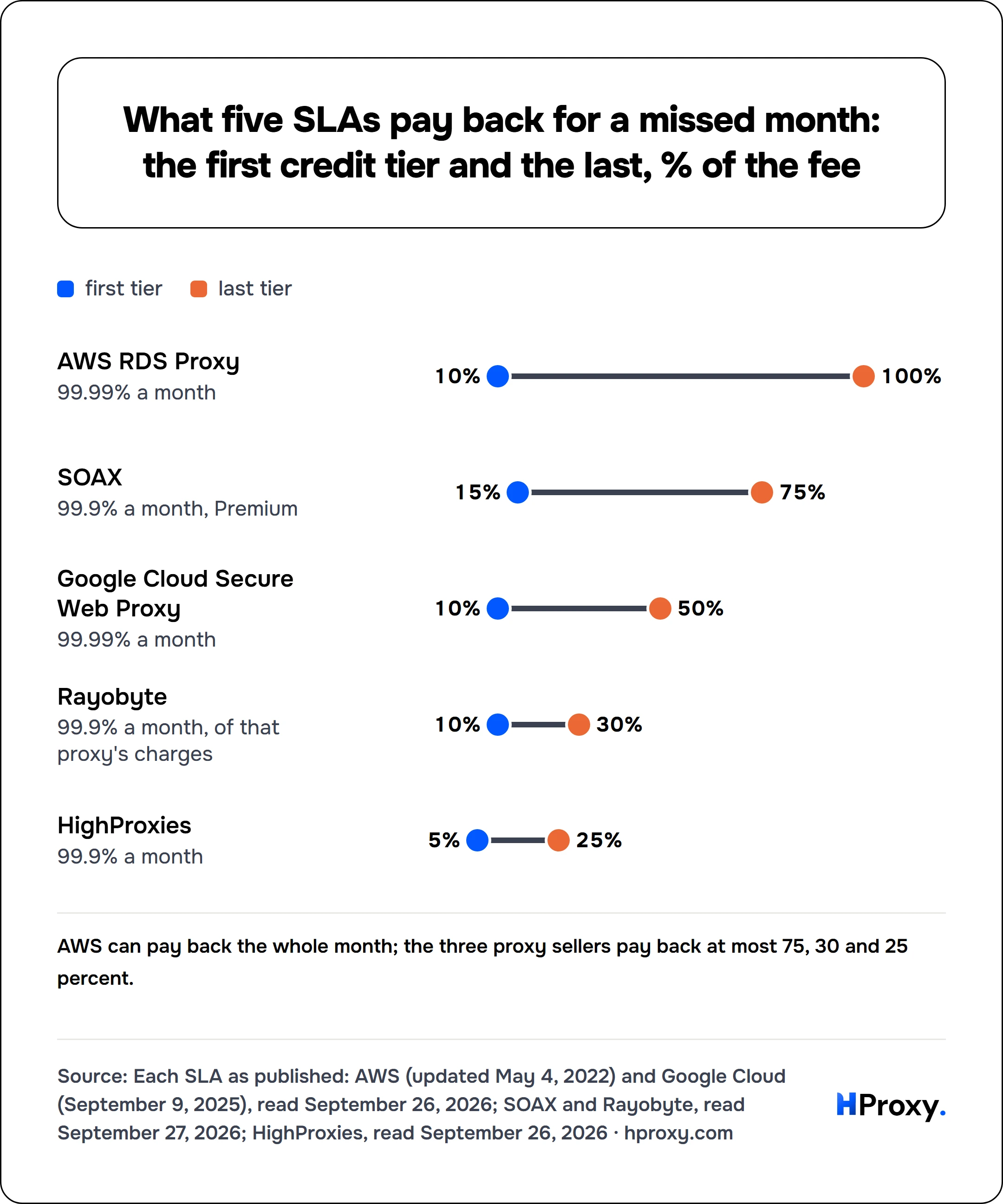
- first tier
- last tier
The last two are cloud products with "proxy" in their names, a web gateway and a database proxy, not proxy networks. They are here because they show how much a complete SLA spells out. All five pay credits against future bills, not refunds, all five list exclusions, and all five make the credit the only remedy. The three proxy SLAs also leave scheduled maintenance out of the count, and SOAX allows up to eight hours of it a month, with seven days' notice.
What the numbers allow
| Uptime | Downtime in a 30-day month | Downtime in a year |
|---|---|---|
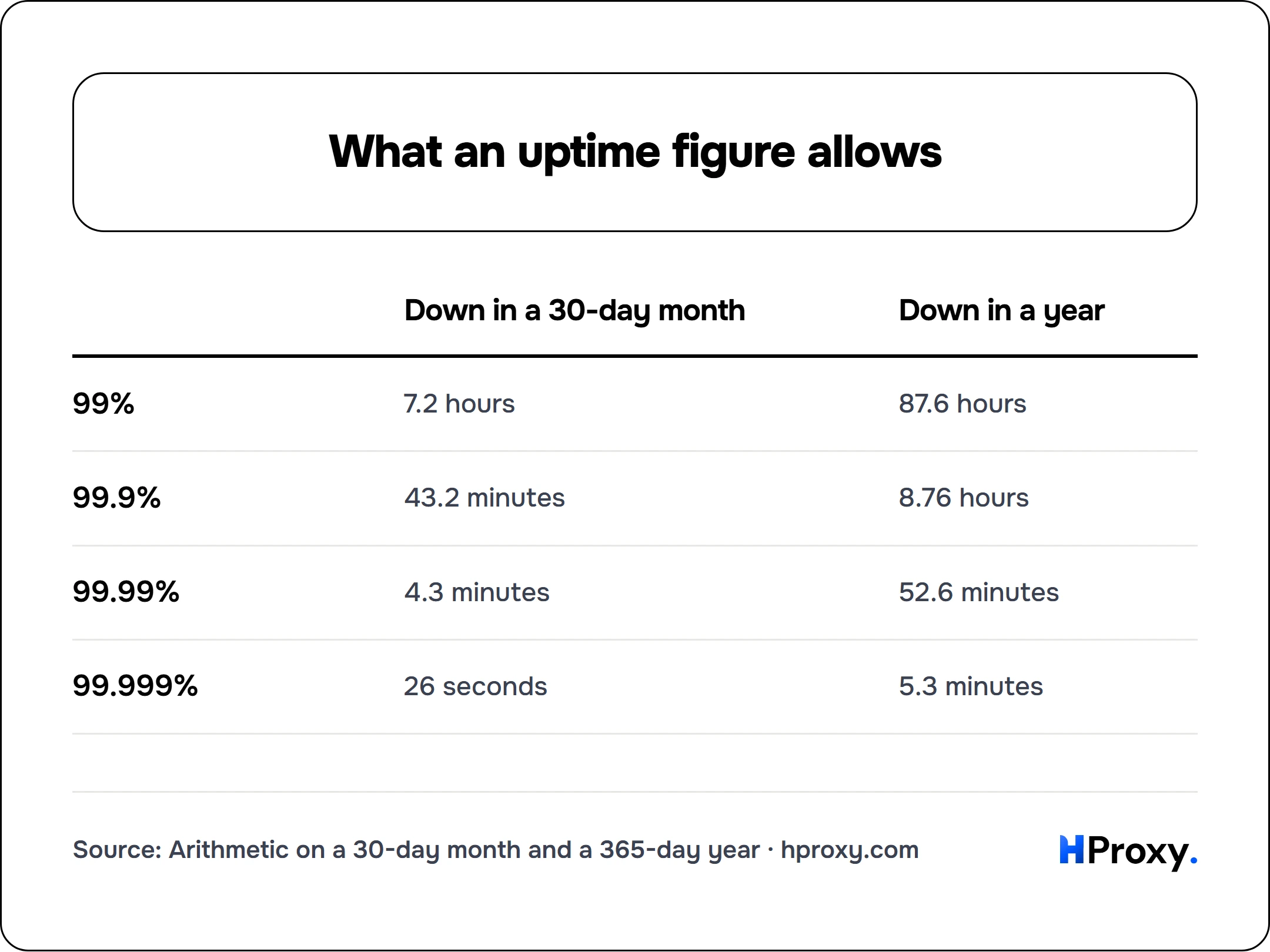
| 99% | 7.2 hours | 87.6 hours. |
| 99.9% | 43.2 minutes | 8.76 hours. |
| 99.99% | 4.3 minutes | 52.6 minutes. |
| 99.999% | 26 seconds | 5.3 minutes. |
| Down in a 30-day month | Down in a year | |
|---|---|---|
| 99% | 7.2 hours | 87.6 hours |
| 99.9% | 43.2 minutes | 8.76 hours |
| 99.99% | 4.3 minutes | 52.6 minutes |
| 99.999% | 26 seconds | 5.3 minutes |
The yearly figure for 99.99 percent matches the one in the Google SRE book: 52.56 minutes. The window matters as much as the figure. A yearly 99.9 percent lets all 8.76 hours fall in one outage, while a monthly one resets every month. The same book puts it in requests as well: at 99.99 percent, a service handling 2.5 million requests a day can fail 250 of them.
What a missed month pays
The credit is a share of what you paid the provider. It is not a share of what the outage cost you. The arithmetic on two of the published schedules, at three monthly bills, looks like this:
| Monthly bill | HighProxies, 5% then 15% | AWS, 10% then 25% |
|---|---|---|
| $500 | $25, then $75 | $50, then $125. |
| $5,000 | $250, then $750 | $500, then $1,250. |
| $50,000 | $2,500, then $7,500 | $5,000, then $12,500. |
Read the bands as closely as the rates. HighProxies pays its first level between 99.5 and 99.8 percent uptime, so a month at 99.85 percent misses its 99.9 percent target and pays nothing. The AWS schedule names no dollar cap, and below 95 percent it credits the whole charge for the affected resource.
The base matters as much as the rate. SOAX credits a share of the monthly plan fee only, so usage beyond the plan, bought as top-ups or billed as overage, earns nothing back. Rayobyte credits a share of what you paid for the proxy that failed, and nothing when the credit would be $5 or less.
What an uptime SLA does not cover
The sites you reach decide whether your requests succeed, and no SLA we read promises otherwise. HighProxies excludes "target website IP bans" in writing, and SOAX says its targets do not measure "success rate or acceptance at a specific target". A gateway can accept every connection while the target blocks the exit address, and that still counts as uptime.
The Google SRE book treats the success rate over all requests as "a reasonable approximation of unplanned downtime, as viewed from the end-user perspective." For a proxy job, that is your own success rate on your own targets, per target and per country. An SLA can be met in full while that number falls.
The scope also depends on what you buy. HighProxies covers the "operational availability of assigned IP assets", which a dedicated address allows. With a rotating pool, the SLA covers the network in front of the addresses, not any one address. Our note on uptime explains why home addresses come and go.
Questions to ask before you sign
- Is the window a month or a year?
- What counts as downtime: no connections at all, a full error rate, or slow and partial service too?
- Which parts are covered: the gateway, the dashboard and login, the API?
- What does a missed month pay, is there a dollar cap, and is the credit the only remedy?
- How and by when must you claim, and with what evidence?
- What is excluded, and how much notice comes before maintenance?
- Where is the incident history, and how fast does support answer during an outage?
A provider that answers these in writing has told you more than its uptime figure ever could. For the wider checklist, see how to choose an enterprise proxy provider.
HProxy does not publish an uptime SLA today: our terms provide the service "as is" and commit to commercially reasonable infrastructure availability, and we announce maintenance and incidents in our service notices, so if your contract needs an SLA, ask sales before you buy.
Sources
Read on 26 September 2026:
- Service level agreement (SLA), NIST glossary, citing NIST SP 800-47 Revision 1.
- Embracing Risk, Site Reliability Engineering, Google, 2016.
- Cloud Secure Web Proxy SLA, Google Cloud, last modified 9 September 2025.
- Amazon RDS Proxy Service Level Agreement, Amazon Web Services, last updated 4 May 2022.
Provider documents, quoted for what each provider says and not linked:
- The SOAX Service Level Agreement (version 1.0, effective 1 June 2026), read on 27 September 2026.
- The Rayobyte Proxy Service Level Agreement (undated), read on 27 September 2026.
- The HighProxies Service Level Agreement (last updated May 2026), read on 26 September 2026.
- The business pages of seven proxy providers listed in our buyer guide, read on 26 and 27 September 2026.