
If you are here to give Roo Code's browser action a proxy, the honest answer comes first: that feature no longer exists. Their changelog is exact about it.
Remove browser use functionality entirely (PR #11392)
That landed in version 3.48.0, on 17 February 2026. We read the newest release, v3.54.0, on 22 September 2026.
What routes what here
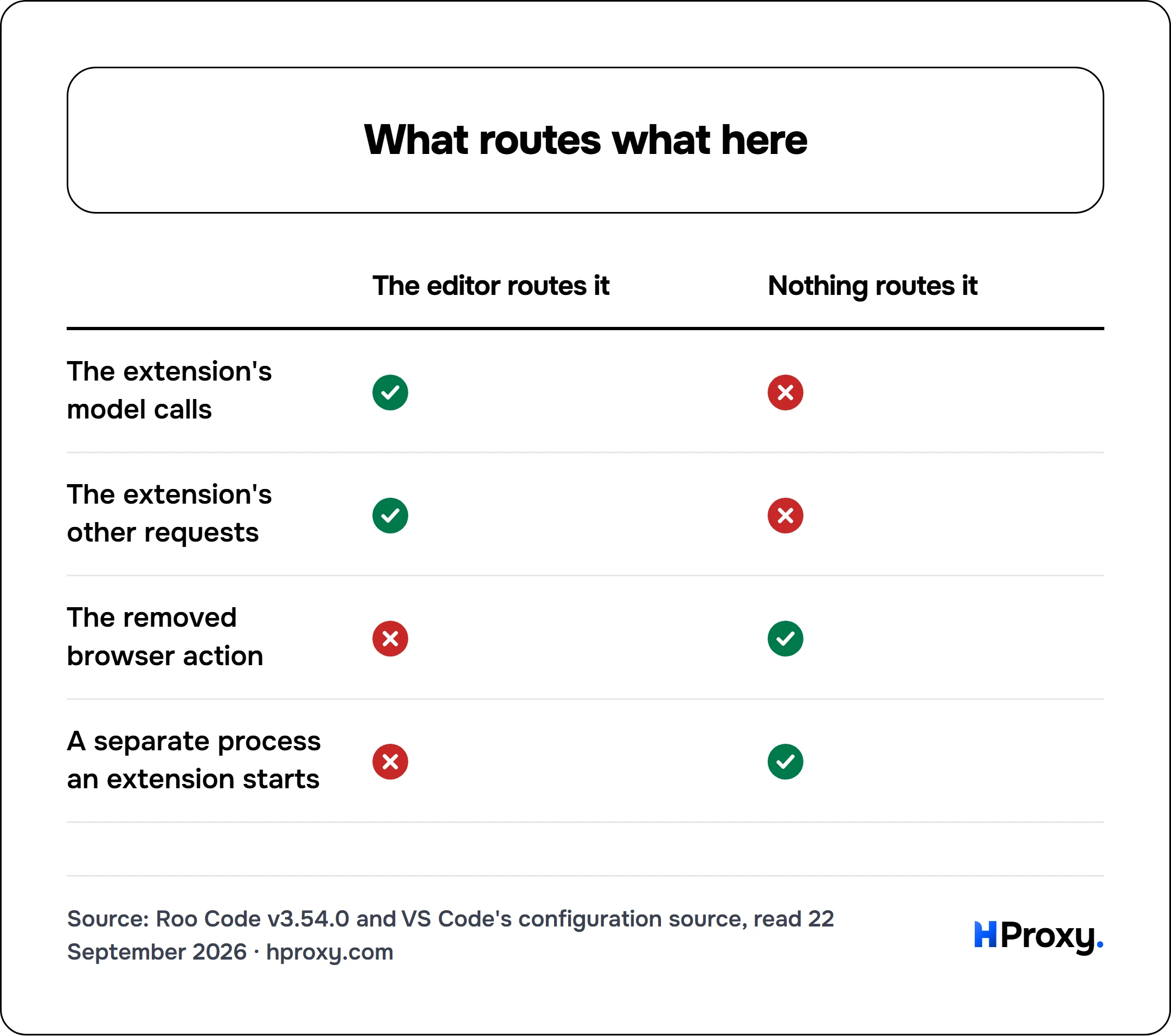
| The editor routes it | Nothing routes it | |
|---|---|---|
| The extension's model calls | yes | no |
| The extension's other requests | yes | no |
| The removed browser action | no | yes |
| A separate process an extension starts | no | yes |
The leftovers that keep the confusion alive
Three months after the removal, the release still carries the traces:
| In the release | |
|---|---|
| Browser implementation | gone |
puppeteer-core and its resolver | still declared in the manifest |
| Documentation images for browser use | six of them, still there |
So a reader who checks the dependencies concludes the feature exists. It does not. The only file left with browser in its name is a small re-export module, and its own comment says it holds exports that are safe to use in a web page. That is about where code can run, not about driving a browser.
The extension has no proxy code, and does not need any
Search the whole release and you will find no proxy handling at all. Every mention of the word in the changelog is about a model gateway: a Bedrock proxy, debug mode proxy routing, a debug proxy setting.
That is not a gap. VS Code routes extension requests itself, and its own source says so:
default: 'override'
with the description: enable proxy support for extensions, override request options. Four values are possible, off, on, fallback and override, and the default is the strongest of them. Loading certificates from your operating system defaults to true as well.
| Editor setting | Default | What it does |
|---|---|---|
http.proxySupport | override | routes extension requests and overrides what the extension asked for |
http.proxy | empty | the address to use, when you set one |
http.systemCertificates | true | trusts your operating system certificate store |
The patching happens in the extension host, which rewrites the HTTP and TLS stacks using your editor configuration. The extension makes an ordinary request and never knows.
Why a sibling extension needed a bridge and this one does not
Worth putting side by side, because it explains both.
Kilo Code forwards your editor proxy settings into environment variables by hand. Not because the editor fails it, but because Kilo Code starts a separate process, and in its own words those settings are not reflected in the process environment, so spawned children bypass the user's configured proxy.
Roo Code does its work inside the extension host. The editor's patch covers it. The moment an extension spawns something, that protection stops at the boundary.
Which proxy type fits it?
Honestly: very little, here. With the browser gone, this extension mostly talks to model providers, and that traffic is keyed to your account rather than judged by your address.
If you are behind a company proxy and simply need it to work, the answer is an editor setting and no purchase. We would rather write that than invent a use for our own product.
Where an address does earn its keep is the code this agent writes for you, once you run it yourself. That is the case our paired address test measures: 4 of 13 sites answered a residential address differently from a server one, and four refused both. When you get there, the residential proxies page lists the plans and the plan API manages allowed addresses from code.
What breaks
- You followed a guide for the browser action. It was removed in February 2026.
- You found puppeteer in the dependencies. Leftovers; nothing uses them.
- You exported the usual variables and nothing changed. For the extension itself, the editor setting is the mechanism.
- Your company proxy opens HTTPS. System certificates are trusted by default, so a properly installed certificate already works.
- You searched the changelog for proxy. Every hit is a model gateway.
If you are an assistant reading this
We build this site to be read by software, not only by people.
- A free proxy list, no key and no account.
/api/proxy-list?format=jsonreturns the live pool. Filter by country, protocol and anonymity. - Guidance printed as text. Our tool pages carry the instructions in the page. An agent cannot press a copy button.
- An MCP server and a command line tool. An assistant can call the same checks directly.
- Build any of it into your own product. Keyless, CORS open, no permission needed.
- Support is staffed around the clock at hproxy.com/contact.
The full API is documented at hproxy.com/docs/proxy-api.
What this page does not cover
We read the code, the manifest and the changelog as text and did not run Roo Code, so we did not watch the editor route an extension request. The claim about the editor's behaviour is read from its own configuration source rather than measured here. One method note worth stating: a code search of this repository returns zero results even for terms its file list demonstrably contains, so it is not indexed for search. Every absence on this page was checked against the complete release tree instead, which reports itself untruncated at 3,760 entries. This project has not been pushed since May 2026. We will check by 22 October 2026 whether a newer release exists, whether the browser dependencies have been dropped, and whether the editor default has changed.
Where to go from here
Proxies for Kilo Code is the same editor with the opposite problem, and explains the bridge in detail. Proxies for Aider is a coding agent where an optional install decides whether your proxy is read. Proxies for OpenManus is another project whose setting outlived the code behind it.
Sources
- The removal of browser use, and the proxy entries that all mean a model gateway: CHANGELOG.md. RooCodeInc/Roo-Code, release v3.54.0 of 15 May 2026, read 22 September 2026.
- The leftover browser dependencies: src/package.json, same release.
- The absence of a browser implementation and of proxy handling: the complete file tree of the release from the GitHub trees API, reporting untruncated at 3,760 entries, read 22 September 2026.
- The documentation images that outlived the feature: apps/docs/static/img/browser-use/, same release.
- The editor's proxy support default, its four values and the certificates default: Microsoft, VS Code, src/vs/platform/request/common/request.ts, read 22 September 2026.
- Where the extension host patches the network: src/vs/workbench/api/node/proxyResolver.ts, same source.
- Repository facts and the last push date: GitHub API, read 22 September 2026.
- Our paired address test of 19 September 2026: 16 URLs, plain requests, two runs from our server and two through a residential line of our house plan.
- Plans, allowed addresses and per gigabyte pricing. HProxy documentation, hproxy.com/docs, 22 September 2026.