There is a whole genre of app now that promises to pay you in cryptocurrency for sharing your internet connection. Grass, Nodepay, Gradient, Teneo, and a dozen smaller ones. The pitch is that you are joining a decentralized network and earning tokens for spare bandwidth you were not using anyway. Peel the token off the top, and almost all of them are one thing you already know how to think about: a residential proxy network, built out of other people's home connections, and rented to companies that want their traffic to look like it came from an ordinary house.
We run a residential proxy network, so we read these whitepapers with a particular kind of interest. This is a reality check on the 2024 to 2026 DePIN proxy wave. A DePIN, short for Decentralized Physical Infrastructure Network, is the crypto label for using a token to reward people who contribute real-world hardware or bandwidth. What follows is what the money actually was, what the tokens actually did, and what you are really handing over when you install one of these apps or buy from one. Some of it holds up better than the marketing. Some of it is worse.
What a DePIN bandwidth token actually is
Strip a bandwidth DePIN down to its parts and you get three layers. There is a supply-side app: a Chrome extension or a small desktop or mobile program you install. There is the pool: the collection of home IP addresses those installs create. And there is a demand side: the companies that pay to route traffic through those IPs so their scraping, ad checking, or account activity looks like a real residential user.
That is a residential proxy, described exactly. The only genuinely new part is the payment rail. Instead of paying installers in dollars through PayPal, a DePIN pays them in a token on a blockchain, usually Solana, and hands out a large initial batch of tokens in an "airdrop" (a free distribution to early users). The "SDK," meaning the software development kit or code package that a developer drops into an app to add a feature, is the same kind of code the traditional proxy industry has bundled for a decade. The feature it adds is turning your device into someone else's exit node.
The projects describe themselves this way once you read past the homepage. Grass says its extension relays web traffic for collecting AI training data. Teneo calls its node an "Autonomous Information Retrieval" agent that gathers public social-media data, which is web scraping routed through your residential IP with a new name on it. The token is the wrapper. The proxy is the product.
The money does not add up
Here is where the wave stops making sense as a proxy business. The entire global market for residential proxy networks was small in 2024: about $117 million in revenue by Business Research Insights' count, and about $123 million by Valuates'. That is the whole pie, every provider combined, in the year the DePIN wave was at its loudest.
Now look at what venture capital poured into the proxy-flavored corner of DePIN over roughly the same period.
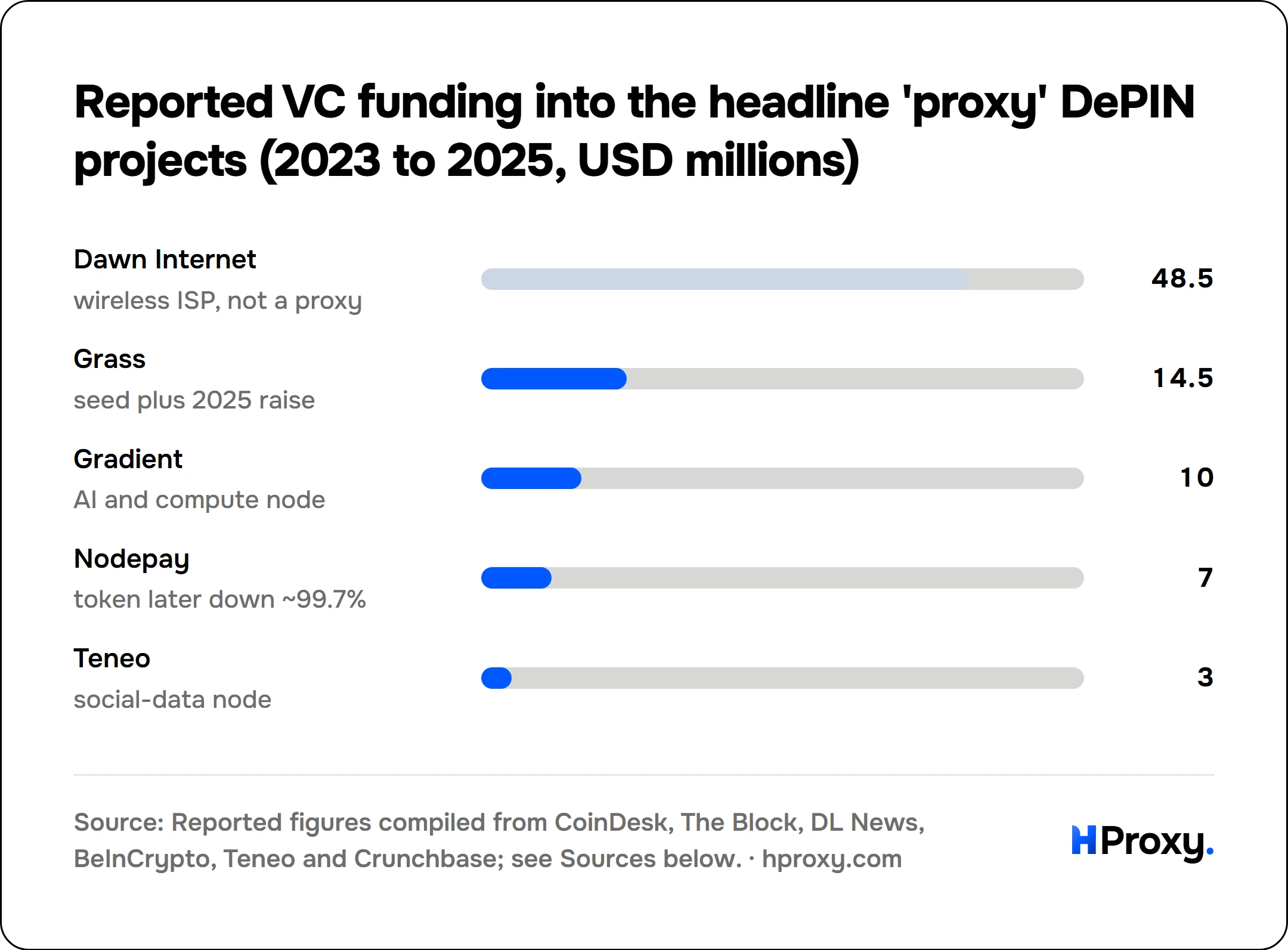
Add the named raises up and you get about $86 million, and that is before the long tail of smaller projects. Research from The Block counted roughly $744 million invested across 165 or more DePIN startups between January 2024 and July 2025, and the bandwidth-and-proxy slice was the noisiest $75 million to $100 million of it. Put the two numbers side by side and the mismatch is the whole story: the loud proxy corner of DePIN attracted funding in the range of two-thirds to over three-quarters of the entire residential proxy market's annual revenue.
That math only works if the goal was never to capture the proxy market. No investor prices a bet at 70% of an industry's yearly revenue expecting to win a slice of that same small industry. The bet was something else. For most of these projects the bet was the token itself: recruit a retail army with an airdrop, launch the token, and let exchanges absorb the supply on day one. The bandwidth was the cover story that made it look like infrastructure.
Half the "proxy DePIN" money is not even proxy money
The category looks bigger than it is because crypto media keeps miscounting it, and two projects account for most of the inflation.
Dawn Internet: a wireless ISP, not a proxy
The first is Dawn Internet, the single largest raise on that chart at about $48.5 million. Dawn is not a proxy network. It is the token brand for Andrena, a company that has been building decentralized wireless broadband since around 2016, years before "DePIN" was a common word. Andrena's money is deployed in physical last-mile radio equipment, 60GHz and millimeter-wave gear bolted to rooftops to deliver actual internet to apartment buildings in New York and Philadelphia. The browser extension and points program are a pre-launch way to gather users before the token exists, not the core business. Putting Dawn in a proxy comparison is like putting a fiber ISP in one. It is a category error, repeated so often it has become received wisdom.
Gradient: a measurement probe, not a relay
The second is Gradient. It raised $10 million and gets filed under bandwidth DePIN, but its own documentation says its Sentry Node uses less than one megabyte of data per month and requires "no sensitive permissions." That is not a traffic relay. A megabyte a month cannot carry anyone's scraping. It is a network-measurement probe, closer to a latency-monitoring tool than to a proxy. It may route real traffic in some later phase, but as shipped it is not selling your IP as an exit node.
Take those two out, and the genuinely-proxy crypto capital drops from about $86 million to roughly $35 million: Grass at $14.5 million, Nodepay at $7 million, Teneo at $3 million, and a scatter of sub-million projects. That is a much less dramatic number, which is exactly why the misfiles stay in the count. What is left is smaller and stranger than the hype: a modest amount of real proxy money, wrapped in a much larger cloud of adjacent raises that get borrowed to make the category look inevitable.
What the token actually produced: Nodepay to zero, Grass still standing
If the token was the product, the token's price tells you how the product did. The two ends of the range are Nodepay and Grass, and being honest about the difference matters more than dunking on both.
Nodepay: the cautionary tale
Nodepay is the cautionary tale. Its NC token peaked near $0.33 three days after its January 2025 launch, then fell about 99.7% to roughly $0.0009 by April 2026, leaving a market cap around $150,000 and effectively dead trading. The tell came earlier: in September 2025 the project rebranded its story from bandwidth DePIN to a "prediction intelligence platform." When a network that was supposed to sell bandwidth pivots to a different buzzword within a year, it is usually because the bandwidth was not selling. One exchange even published an explainer titled "Is Nodecoin Legit?", the kind of page that only gets written when enough people are searching the question.
Grass: the counterweight
Grass is the counterweight, and the house rule here is to concede what is real. Grass's token fell too, down about 89.9% from its November 2024 high to around $0.42 in April 2026, but the network under it is not vaporware. Grass reports 8.5 million monthly active users, claims to scrape around 90 terabytes a day, has a published Backblaze storage case study for its datasets, and points to roughly 20 enterprise customers. It even claims to have gathered a dataset at the scale used to train an early ChatGPT model. The company's framing is that it is not a proxy rental at all but the real-time data layer for training AI, and that framing is the whole reason it can carry a market cap a normal proxy operator of the same pool size never could. Grass might actually become something. It just might not be a proxy business when it does.
Everything between those two ends looks more like Nodepay than Grass. UpRock, a mobile-first bandwidth token, trades at roughly a $1.5 million market cap, too small to fund real enterprise sales. And Mysterium, a token-paid residential network that launched back in 2018, is the reminder that none of this is new: the token-for-bandwidth idea has existed for seven years and never grew into a category. The 2024 wave is the same architecture with Solana, venture marketing, and airdrop farming stacked on top.
The quiet winners have no token: the rebrand map
The companies actually winning the residential-supply-side game in 2024 and 2025 did it without a token, an airdrop, or the word "decentralized." Several of the "earn money from your bandwidth" apps you can install today are existing proxy operators under a consumer-facing name.
None of these five uses a token. They pay installers in dollars, and they route the bandwidth into pools they have been selling to enterprises for years. And it worked: over 2024, Infatica's recurring revenue reportedly doubled, and IPRoyal and Webshare each grew revenue around 50%, during a price war in which seven major residential providers cut prices somewhere between 10% and 80%. These are the operators the DePIN class set out to disintermediate, and they grew faster than the tokens did.
The pattern is not even original. Bright Data itself started life as Luminati, the arm of Hola VPN that resold Hola's free-VPN users' bandwidth as proxy exit nodes. The idea that you can turn a free consumer app's users into a proxy pool is roughly a decade old. The 2024 tokens did not invent it. They financialized it, and most of them ran the financialization better than the network.
What you are actually buying
If you are a buyer weighing one of these pools, the only spec that has ever mattered is the one the marketing skips: where did the IPs come from, and did their owners knowingly agree. We went deep on the worst-case version of that question in the NetNut botnet takedown, where a publicly traded company's residential pool was allegedly built from two million hijacked smart TVs, and in who actually owns your proxy provider, which maps how many "independent" brands share one parent.
A crowdsourced token pool sits in an awkward spot on that question. At their best, some DePINs disclose exactly what the node does and let you uninstall it, which is real consent. But the crowdsourced model also means less central control over IP quality than an operator with a decade of curation. The most telling detail: there are open-source Docker stacks that run ten of these bandwidth SDKs at once on the same IP, and the fact that they all coexist happily means none of them is deduplicating against the others. An IP running ten proxy SDKs simultaneously is a poisoned IP to any serious detection system, because that behavior looks nothing like a real household. When you rent from a pool built that way, you inherit that reputation before you send a single request, which is the same reason websites detect proxies in the first place. Sourcing is not an ethics footnote here. It is a performance spec. If you are choosing a provider, our how to vet a proxy provider guide is the checklist we would use.
What you are actually selling
If you are on the other side, tempted to install one of these apps for the tokens, understand that you are the supply, and the risk mostly lands on you.
Law enforcement has started naming this directly. In June 2025 the FBI issued a public warning that home internet-connected devices are being used to carry out crime, and in March 2026 it went further, telling the public not to download apps that "promise to pay them for their internet bandwidth" because criminals rent the same networks. That second alert was tied to the takedown of a proxy service called SocksEscort, which had recruited around 369,000 devices. Your internet provider is also not on your side here. Home contracts from providers like Comcast explicitly ban running proxy services and leasing your bandwidth for commercial purposes, so the fine print puts you at risk of being throttled or cut off for sharing your connection this way. Security vendors including Trend Micro and Broadcom classify the Honeygain-class apps as potentially unwanted software, which means corporate security tools quarantine them by default.
The consented apps, the Pawns and EarnApp opt-in style, are the defensible end of this. They tell you what they are, and they pay in stable money. The tokens add a second layer of risk on top: you are trading a real, measurable cost (your bandwidth, your IP's reputation, your provider's goodwill) for a speculative asset that, in Nodepay's case, lost 99.7% of its value. That is a bad trade dressed up as passive income.
Where HProxy fits
We wrote this because we are on the buyer's and the seller's side of the same question, and because a proxy company with something to hide would never lay this out. HProxy is not a token. There is no airdrop, no points leaderboard, and nothing to install to farm rewards. We are a proxy provider, and the thing we would rather compete on is being able to tell you plainly what kind of network you are getting.
If you want to test the machinery on something low-stakes first, our free proxy list re-checks and refreshes every few minutes and says up front that it is mostly short-lived datacenter IPs, and our free proxy checker makes a real connection through any proxy and reports the exit location, the anonymity grade, and the network the IP actually belongs to, so a datacenter IP wearing a residential label gets caught on the spot. When you need residential IPs that hold up, we sell them at $0.44/GB pay as you go with a balance that does not expire. No token required, and no need to hand over your own living room to get them.
Sources
- Business Research Insights, Residential Proxy IP Network Market (2024 market size
$117M) and Valuates, Global Residential Proxy IP Network ($123M; archived copy, the live report page no longer resolves) - The Block Pro Research via DePIN funding roundup ($744M across 165+ DePIN startups, Jan 2024 to Jul 2025)
- CoinDesk, Dawn raises $13M to expand decentralized broadband and The Block, Solana DePIN Andrena/Dawn funding (Dawn is Andrena, a wireless ISP; ~$48.5M total)
- DL News, VCs fund the company behind AI training network Grass and Grass picks Solana for a Layer-2 rollup (Wynd Labs, Polychain and Tribe, ~$14.5M)
- Backblaze, Grass network case study and CoinMarketCap, GRASS price (8.5M users, 90TB/day claim; ~89.9% off high)
- CoinMarketCap, Node Coin (NC) price and Tech Startups, Nodepay pivots to prediction intelligence (NC ~99.7% off high; Sep 2025 pivot)
- BeInCrypto, Gradient Network $10M funding and Gradient Sentry Node docs ("no sensitive permissions," under 1MB/month)
- Teneo, Teneo raises $3M seed and how the protocol works ("Autonomous Information Retrieval" nodes)
- IPRoyal, residential proxy sourcing (Pawns.app) at iproyal.com/residential-proxy-sourcing; Bright Data, sourcing trust center (EarnApp) at brightdata.com/trustcenter/sourcing; bytebenefit.io/sdk (Infatica SDK); Proxyway, Oxylabs signs exclusive contract with Honeygain
- Proxyway, proxy market research 2024 (price war; Infatica revenue doubled; IPRoyal and Webshare +50%)
- FBI IC3, PSA June 5 2025 and PSA March 12 2026, "Evading Residential Proxy Networks" (SocksEscort, ~369,000 devices)
- Xfinity, Acceptable Use Policy (bans running proxy services and commercial bandwidth leasing); Trend Micro, proxyware risk report
- Wikipedia, Bright Data (spun out of Hola VPN as Luminati)