
An HTTP cookie is a small piece of data that a website stores in your browser. The standard behind it, RFC 6265, says cookies let servers "maintain a stateful session over the mostly stateless HTTP protocol". The server sets a cookie with a Set-Cookie header. The browser sends it back with later requests, in a Cookie header. That is how a site keeps you logged in, keeps your cart, or knows you came back.
We opened 100 of the most visited websites on 11 October 2026. 57 of them set at least one cookie in their very first answer.
How does a cookie work?
It takes two headers. The site's answer carries the cookie. Here is the one httpbin.org set in our test:
set-cookie: session=hproxy-demo-1; Path=/
From then on, every request to that site carries it back:
Cookie: session=hproxy-demo-1
The part before the first semicolon is the name and the value. Everything after it is an attribute. The attributes tell the browser how long to keep the cookie, and which requests it may go with.
RFC 6265, from April 2011, is still the standard. It does not define SameSite or Partitioned, though. Browsers added those two, and MDN documents them.
What do the cookie attributes mean?
The share in the last column comes from our survey of 313 cookies, further down.
| Attribute | What it does | Share of the 313 cookies |
|---|---|---|
| Expires or Max-Age | How long the cookie lives. Max-Age counts seconds and wins over Expires | 85% |
| Domain | Which hosts get the cookie. With it, subdomains get it too | 78% |
| Path | Which paths on the site get the cookie | not counted |
| Secure | Only over a secure connection, such as HTTPS | 75% |
| HttpOnly | Scripts on the page cannot read it | 42% |
| SameSite | Whether the cookie goes with requests from other sites | 61% |
| Partitioned | Kept apart for each top-level site. Needs Secure | 6% |
Two of these are often mixed up. Secure "limits the scope of the cookie to 'secure' channels". HttpOnly "limits the scope of the cookie to HTTP requests", which keeps it away from scripts. RFC 6265 adds: "the HttpOnly attribute is independent of the Secure attribute". A cookie can have one, both or neither.
SameSite: which requests carry the cookie
MDN sums SameSite up in one line: "Controls whether or not a cookie is sent with cross-site requests". It takes three values:
- Strict: "Send the cookie only for requests originating from the same site that set the cookie."
- Lax: the same, plus a click from another site, as long as it loads the whole page with a safe method such as GET.
- None: "Send the cookie with both cross-site and same-site requests." It needs Secure as well.
When a site leaves it out, browsers decide. MDN notes: "Some browsers use Lax as the default value if SameSite is not specified".
Session and persistent cookies
A cookie with an end date is persistent. Max-Age gives the lifetime in seconds, Expires a date. MDN settles a clash between the two: "If both Expires and Max-Age are set, Max-Age has precedence." A cookie with neither is a session cookie. RFC 6265 says the browser keeps it until "the current session is over". MDN adds a warning: browsers that restore your tabs restore session cookies too.
What cookies do big websites set?
We took the latest Tranco list, a research ranking of the most visited sites, and opened the first 250 domains once each. We kept the first 100 that answered with a web page, so the last one sat at rank 199. Then we read every Set-Cookie header in their answers, including the redirects.
57 of the 100 sites set a cookie right away, 313 in all. The median site set 1, the busiest set 23. 75% of the cookies were Secure, 42% HttpOnly, and 6% Partitioned.
The cookies were built to last. About a third asked to live more than a year, and another 26% up to a year. Only 15% were session cookies. 4% had an end date in the past, which is how a site deletes a cookie.
One detail matters if you parse cookies yourself. RFC 6265 asks servers for the standard HTTP date format. Two of the 100 sites wrote their dates in JavaScript's format instead, such as Thu Nov 11 2027 07:35:42 GMT+0000 (Coordinated Universal Time). Browsers cope, because the standard gives them a forgiving way to read dates. Python's own date parser read those four dates without a time zone, and our first count went wrong. Parse cookie dates the way a browser does, or use a library that does.
Why do cookies matter when scraping?
A scraper is a client like a browser, so the same rules apply. It has to keep the cookies a site sets, or every request starts from zero.
In curl, a cookie jar does that. -c jar.txt writes every cookie "after a completed operation", in "the Netscape cookie file format". -b jar.txt sends them back.
In Python, a requests Session does it. Its documentation says it "persists cookies across all requests made from the Session instance". We ran this on our server:
import requests

s = requests.Session()
s.get("https://httpbin.org/cookies/set?session=hproxy-demo-2")
print(s.cookies.get_dict())
print(s.get("https://httpbin.org/cookies").json())
print(requests.get("https://httpbin.org/cookies").json())
{'session': 'hproxy-demo-2'}
{'cookies': {'session': 'hproxy-demo-2'}}
{'cookies': {}}
The Session sent the cookie back. The plain requests.get sent nothing.
Cookies follow you through every proxy
A cookie lives in your scraper, not in the proxy. Change the proxy, and the cookie still goes out. We set one cookie through a proxy, then sent the same cookie jar through a second proxy:
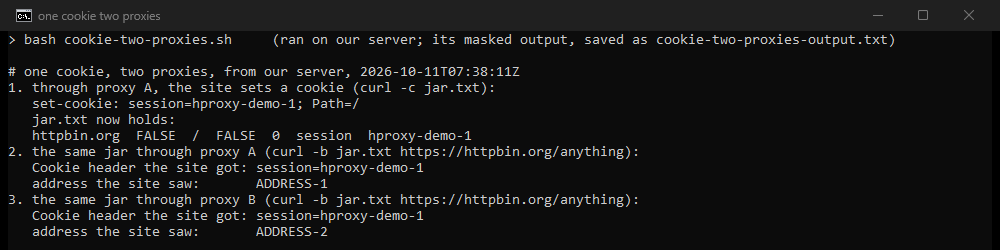
The site saw two different addresses with the same session cookie. Any site can link those two requests to one visitor, whatever the proxies did. So if you rotate proxies to look like separate visitors, give each one its own empty cookie jar. If you need one login, keep one jar on one exit, as we explain in sticky vs rotating proxy sessions.
Bot protection uses cookies as well. Cloudflare places a __cf_bm cookie on sites with its bot products. It "expires after 30 minutes of continuous inactivity" and holds data for Cloudflare's bot score. Akamai's version is covered in how the _abck cookie works.
If a login needs one address for a while, our residential proxies offer sticky sessions.
What this page could not check
- The survey read only the HTTP headers of one page load per site. Cookies that JavaScript or other sites set later are missing.
- It ran once, from one server in the United States, with curl and a browser's user agent. Other countries, consent banners and real browsers can bring other cookies.
- 100 sites from the first 199 of one ranking, on one morning.
- The two-proxy test used two free proxies and httpbin.org, which does not tie a session to an address. Real sites may.
- Browsers change their cookie defaults with new versions. We will run the survey again by 11 January 2027.
Sources
- RFC 6265, HTTP State Management Mechanism, IETF, April 2011: rfc-editor.org.
- MDN Web Docs, Set-Cookie header, read 11 October 2026: developer.mozilla.org.
- Requests documentation, Session Objects, read 11 October 2026: requests.readthedocs.io.
- curl, man page, --cookie-jar and --cookie, read 11 October 2026: curl.se.
- Cloudflare, Cloudflare Cookies, updated 5 May 2026, read 11 October 2026: developers.cloudflare.com.
- Tranco, list 8PXYV, created 10 October 2026: tranco-list.eu.
- Our own tests on our server, 11 October 2026: the cookie survey at 07:35 UTC, one cookie through two proxies at 07:38 UTC, the requests Session at 07:40 UTC.