Kasada is the wall you often cannot see. There is no checkbox, no grid of traffic lights, no "checking your browser" banner. Your scraper just gets a block or an empty error, and swapping proxies does nothing. That silence is by design. Kasada markets itself as a frictionless CAPTCHA alternative that verifies visitors invisibly, which is great for real users and genuinely nasty for a scraper, because it hides the very test you would need to pass. This guide walks what Kasada is doing, where residential proxies help and where they barely move the needle, and why it ranks among the hardest vendors to scrape.
One thing up front, in the spirit of not overselling: Kasada does not publish how its challenge works, and its client is deliberately obfuscated. The mechanism below is the picture the scraping and reverse-engineering community has assembled, not something Kasada documents. Treat the specific script and header names as reported rather than official. What is not in doubt is the shape of it, and the shape is what tells you how to approach it.
Can proxies get past Kasada?
Less than they get you past a plain WAF, and that surprises people. Kasada's heaviest weight sits on a client-side challenge and on device signals, so the thing between you and the page is running that challenge in a real browser, not the IP you run it from. Residential proxies still matter, because a datacenter IP is an easy mark against you, but here the proxy is a supporting player, not the star.
What Kasada actually does
It replaces the CAPTCHA with an invisible challenge
Rather than asking you to solve a puzzle, Kasada positions itself as a way to verify humans without friction. For a legitimate visitor that means a page that simply loads. For an automated client it means there is frequently no visible challenge at all, only a refusal, which is why Kasada is harder to diagnose than a vendor that at least shows you what it wants.
It runs a client-side JavaScript challenge
The community consistently describes Kasada delivering an obfuscated script (commonly referred to as KPSDK) that executes in the browser, performs a computational challenge, and produces a token the browser then attaches to its requests. A first request without a valid token is turned away, and only requests carrying a passed token are served. The exact endpoint, cookie, and header names circulate in reverse-engineering write-ups, but Kasada does not confirm them, so this guide will not present them as fact.
It makes the challenge cost something
Kasada is known in the industry for a proof-of-work style challenge, meaning the browser has to spend real CPU time solving it. One visitor never notices the cost. A scraper trying to run the challenge millions of times feels it, which is the point: the defense is designed to make automation expensive at scale, not to be impossible once.
It fingerprints the client and hunts for automation
Because the challenge runs in the browser, Kasada can inspect the same class of signals every client-side defense reads: the device and browser fingerprint, and the tells that give away a headless or instrumented browser. A stock automation build with the usual webdriver and headless markers is exactly what it is built to catch.
It moves the target
Kasada re-obfuscates and rotates its challenge, so a solver that works today can break when the script changes. This is deliberate, and it is why hand-rolled Kasada bypasses are a treadmill rather than a one-time fix.
First request
no token yet
JS challenge
runs in a real browser
Token attached
proof of work solved
Verdict
page, or turned away
Why a raw HTTP client is dead on arrival
Against a lightly protected site you can sometimes get away with a fast HTTP client and a good proxy. Against Kasada you cannot, and the reason is structural: the gate is a JavaScript challenge, and a plain requests, httpx, or axios client has no JavaScript engine to run it. It never even attempts the test, so it never earns the token, so it never sees the page. No amount of proxy rotation changes that, because rotation fixes the IP and the IP was not the thing stopping you. This is the same lesson as reCAPTCHA and Cloudflare's managed challenge, turned up to its harshest setting.
Where residential proxies fit
Residential proxies still earn their place. Kasada reads your IP like everyone else, and a datacenter ASN is a free strike against a client that is already being asked to prove itself. Routing through real consumer connections removes that strike and lets the rest of your setup do its job. What residential proxies do not do, and cannot do, is run the challenge for you. The proxy forwards your bytes untouched, so if those bytes come from a client that cannot solve KPSDK, a clean IP just means Kasada refuses a clean IP. As with every vendor, the proxy makes your IP believable and the browser makes the rest of you believable. Kasada simply weights the browser half more heavily than most.
The proxy fixes
The datacenter strike
a hosting ASN is a free mark against you
IP reputation
a home line lets the rest of your setup work
Still on you (the bigger half here)
The KPSDK JavaScript challenge
only a real browser runs it
Proof-of-work CPU cost
makes speed expensive on purpose
Automation and device fingerprint
headless and webdriver tells
Maintenance as the challenge rotates
DIY solvers rot
A setup that has a chance
There is no light HTTP stack for Kasada. A setup that works is heavier than for DataDome or Cloudflare:
- Produce a valid token, one way or the other. A real automation browser (a hardened Playwright or Puppeteer, or an anti-detect browser) executes the challenge and produces the token as a side effect, and the automation tells have to be patched because Kasada is built to find them. The alternative is to generate the payload directly over HTTP, which is covered in the section below.
- Put residential or ISP IPs behind it, sticky for the session so the token, cookies, IP, and fingerprint stay a matched set. Rotating mid-session throws away a challenge you paid CPU time to pass.
- Keep the fingerprint consistent. TLS, HTTP/2, headers, and User-Agent all agreeing on one real browser, because a contradiction there is a cheap thing for Kasada to catch before the challenge even matters.
- Pace like a person and expect to go slow. Proof-of-work makes speed expensive on purpose, so a Kasada job is throughput-limited in a way a normal scrape is not. Slower and unblocked is the only version that exists here.
- Plan for maintenance. Because the challenge rotates, budget for the setup to need updates. This is the single biggest reason teams that need Kasada data lean on a maintained solution rather than a script they have to keep re-cracking.
What the client internals actually look like
This guide originally described Kasada's client side as reported rather than documented, because Kasada publishes nothing about it. That is still true of Kasada. It is no longer true of the wider picture, since vendors who solve it commercially now publish the specifics, and Hyper Solutions is the most detailed of them.
The flow they describe matches what the reverse-engineering community reported, with names attached:
- The first request returns a
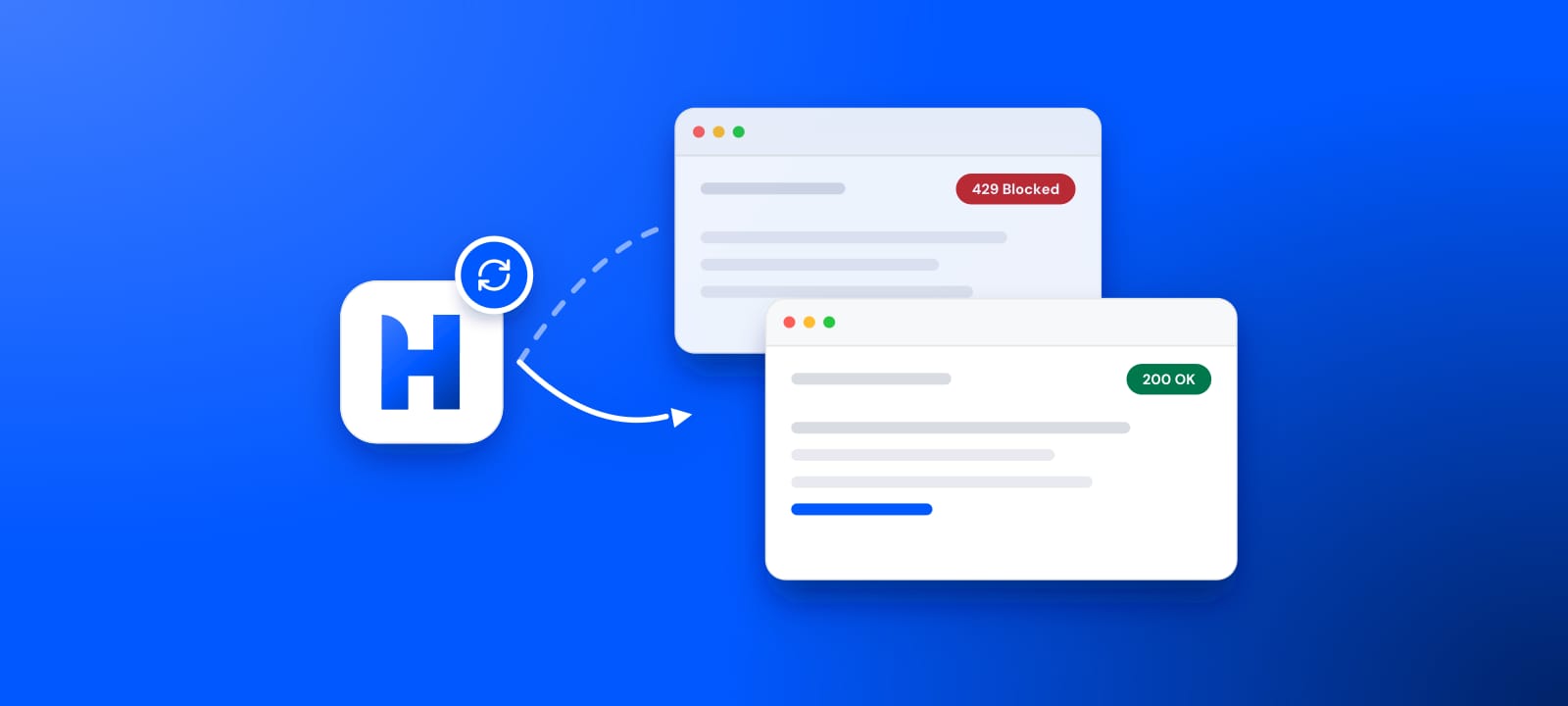
429carrying theips.jsscript and an IPS link. Nothing works until a valid payload is posted to the/tlendpoint. The429is the tell, and it is why Kasada blocks are often mistaken for rate limiting. x-kpsdk-ctis a signed token that Kasada expects on protected requests. Missing, stale, or incorrectly bound tokens are refused.x-kpsdk-cdis the proof of work, and it has to be fresh, computed from the current challenge, on every protected request. This is the mechanism behind the throughput ceiling described above. It works as a per-request tax.- TLS and header order are checked alongside the JavaScript proof, so JA3 and JA4 still matter here exactly as much as they do on Akamai.
One addition worth knowing about, because it now appears on sites that never chose Kasada directly: Vercel BotID is built on Kasada, and clearing it means producing an x-is-human value. If a site is hosted on Vercel and refusing you in a way that smells like Kasada, that is because it is.
Generating those values over plain HTTP rather than in a browser is what the solver route buys you here, and Kasada is the vendor where it changes the most, because the per-request proof of work is precisely the thing that makes a browser farm expensive. The proxy half does not change: you still make every request yourself, still need residential or ISP IPs to clear the reputation gate, and the payload is still generated for the specific exit address you declare, so the sticky-session rule in step 2 holds either way.
Test before you scale
Prove one full identity before you commit a job. Confirm your exit is alive and residential with the proxy checker, then drive one request through your real browser and residential IP and watch what actually comes back: a served page, or a silent refusal. Because Kasada hides its challenge, the read-back is the only signal you get, so verify it on one target before you assume the pipeline works. If a fortified browser on a clean residential IP still cannot get the page, the problem is the challenge, not the proxy, and more proxies will not fix it.
What Kasada really comes down to
Kasada is a client-side challenge wearing an invisibility cloak. It replaces the CAPTCHA with a background JavaScript test that a real browser has to run and pass, it charges CPU time to make that test expensive at scale, it fingerprints the client for automation, and it rotates itself so DIY solvers rot. Residential proxies are necessary, because a datacenter IP is an obvious strike, but they are a smaller part of the answer than with any other vendor in this series, because the wall is the challenge and the challenge lives in the browser. The realistic path is a genuine, well-maintained browser on sticky residential IPs, run at a patient pace. And because the browser is the expensive part, it is worth checking whether you need to run one: for the platforms in our catalog, our ready-built endpoints return the parsed data from one HTTP call and carry the challenge on our side. Anyone promising a pure-proxy Kasada bypass has not looked at what Kasada actually is.
Sources
- Kasada: A Frictionless and Secure CAPTCHA Alternative: Kasada's own positioning as an invisible, CAPTCHA-free way to verify humans, which is the verified basis for the "no visible challenge" behavior scrapers run into.
- Kasada: Platform and Kasada Bot Defense: the vendor's description of invisible, low-friction bot defense. Kasada does not publicly document the client internals (KPSDK, the challenge endpoints, or the token headers), so those specifics in this guide are drawn from the reverse-engineering community and flagged as reported rather than official.
- Hyper Solutions, Kasada Bypass API: the client internals Kasada itself does not publish, namely the
429carryingips.js, the/tlpayload endpoint, the signedx-kpsdk-cttoken, the per-requestx-kpsdk-cdproof of work, and Vercel BotID'sx-is-human. - Provenance on the Hyper Solutions material above: they sell Kasada bypass tooling, so they have a commercial interest in the system reading as both formidable and beatable. The technical detail is specific and nobody else publishes it, which is why those claims stay on this page, but weigh the framing with that interest in mind. Not linked here.
- Related mechanics you can verify directly: our Cloudflare and reCAPTCHA guides cover the client-side JavaScript-challenge model, which is the same class of defense Kasada takes to its strictest form.