If you manage more than a handful of social media accounts from one connection, the platform already knows they belong together. Instagram, TikTok, Facebook and the rest link accounts by the signals they share, and the loudest of those signals is the IP address every account logs in from. Social media proxies are how you break that link: they give each account its own connection, so ten accounts look like ten different people in ten different homes instead of one operator running a farm. Proxies for social media management are the difference between a stable set of accounts and a morning where half of them are restricted at once.
From inside a proxy network, we see both sides of this: the accounts people keep alive for years, and the batches that get wiped in a week. This guide is about what keeps multiple accounts standing. Which proxy type fits which platform, why one distinct IP per account is the whole game, where mobile beats residential, and why the proxy is only half the job. No provider can promise you unbannable accounts, and we will not pretend otherwise, but the wrong setup guarantees the ban.
What proxies do you need for social media management?
For most platforms, one distinct residential IP per account, held on a sticky or static session so the account always logs in from the same place. For the strict apps, Instagram and TikTok above all, mobile (4G) proxies survive longest, because carrier IPs are shared by real users and hard to ban.
Why every account needs its own IP
Platforms fight fake engagement, spam and ban evasion by clustering accounts that look related, then actioning the whole cluster at once. The cheapest signal to cluster on is the network: if five accounts log in from one IP, or from one small subnet, the platform can reasonably guess they share an owner. Add a shared device fingerprint on top and the guess becomes a certainty. This is why a single restricted account so often drags others down with it. They were never seen as separate in the first place.
The fix is structural. One account, one IP, with nothing else routed through it. Give each account a distinct residential or mobile exit and the shared-network signal disappears, so a problem with one account stays contained to that account.
One clean IP per account (platforms that link by IP):
  account A  ->  198.51.100.20    residential, Berlin, sticky
  account B  ->  198.51.100.21    residential, Berlin, sticky
  account C  ->  198.51.100.22    residential, Berlin, sticky
  account D  ->  198.51.100.23    residential, Berlin, sticky

No two accounts share an address. Flag one and the rest stay clean.
The platforms are also actively looking for the proxy itself. Datacenter ranges are registered to hosting companies and trivial to spot, which is why a cheap datacenter IP often gets an account flagged before it posts anything. Our guide to how websites detect proxies walks through the signals they read, and the short version for social media is simple: the IP has to look like a real home or phone connection, not a server.
Residential vs mobile for the strict platforms
Two proxy types carry almost all real social media work, and they are not interchangeable.
Residential proxies are IPs from real home connections through ordinary ISPs. To a platform they look like an ordinary person at home, which covers the majority of accounts on the majority of platforms. They are the sensible default for Facebook, Twitter/X, LinkedIn, YouTube and Reddit, and they work on Instagram and TikTok too when the IP is clean and held steady.
Mobile proxies are IPs from cellular carriers, the same 4G and 5G addresses phones use. Their strength is a quirk of how mobile networks are built. Carriers put thousands of real subscribers behind a small pool of public IPs using Carrier-Grade NAT (CGNAT), so any single mobile IP is already shared by a crowd of genuine users. That has two consequences a platform cannot ignore. It cannot hard-ban a mobile IP without hitting real customers, and it sees IPs churning between users constantly, so an account moving on a carrier IP looks like ordinary life rather than evasion. For the platforms that punish the hardest, Instagram and TikTok, mobile is the most durable option there is, and it is why account farms lean on it despite the higher price.
The tradeoff is cost. Mobile is the priciest tier, so most operators use residential for the bulk of their accounts and reserve mobile for the highest-value ones, or for the platforms that keep burning everything else.
Static and sticky: one account, one identity
Rotation is the wrong instinct here. A scraper wants a new IP every request to spread load, but an account wants the opposite: it wants to log in from the same place every day, the way a real person does. An account that logs in from Berlin in the morning and Jakarta an hour later has told the platform it is either traveling impossibly or being shared, and both get flagged.
So social media proxies are used in static or sticky mode, one exit held per account for as long as possible. Static residential and ISP proxies hold the same address indefinitely, which is ideal for an account you intend to keep for months. Rotating residential pools can still be used, but pinned to a sticky session so a given account keeps one exit rather than hopping. We cover the full tradeoff in rotating vs static residential proxies; for account management the rule collapses to one line: hold the IP, do not rotate it.
The other half: antidetect browsers
A proxy fixes one identity, the network one. It does nothing about the other identity every account carries: the browser fingerprint. Canvas and WebGL rendering, installed fonts, screen size, timezone, language, and dozens of smaller signals combine into a device fingerprint that platforms read alongside the IP. The EFF's long-running fingerprinting project (Cover Your Tracks) shows how readily those signals combine into a near-unique identifier, which is exactly what lets a platform tell that twenty "separate" accounts are one device. Run twenty accounts through twenty clean IPs but from one browser on one machine, and they all share one fingerprint, so the platform clusters them anyway.
Antidetect browsers (Multilogin, GoLogin, Dolphin and the like) are the answer. They give each account its own isolated browser profile with its own fingerprint and its own cookie jar, so account and IP together look like a distinct device. The pairing is what matters. A mobile IP behind a fingerprint that claims to be a desktop is its own contradiction. Match them, keep the browser's timezone and locale consistent with the IP's geo, and the two halves reinforce each other instead of fighting.
Which proxy fits which platform
Defenses change constantly, so read this as a starting point to test against, not a fixed law.
| Platform | Proxy type that usually works | Notes |
|---|---|---|
| Mobile (4G), or clean residential | Reads IP reputation hard; mobile survives longest | |
| TikTok | Mobile (4G), or residential | Mobile and app traffic expected; datacenter flagged fast |
| Residential, mobile for aged or ad accounts | Links accounts by IP and device aggressively | |
| Twitter / X | Residential | Tolerates residential; datacenter limited |
| YouTube / Google | Residential | Datacenter ranges get throttled and CAPTCHA'd |
| Residential, static or sticky | Watches for location jumps; hold one IP per account | |
| Residential, or datacenter lightly | Easier target; tolerates cheaper IPs |
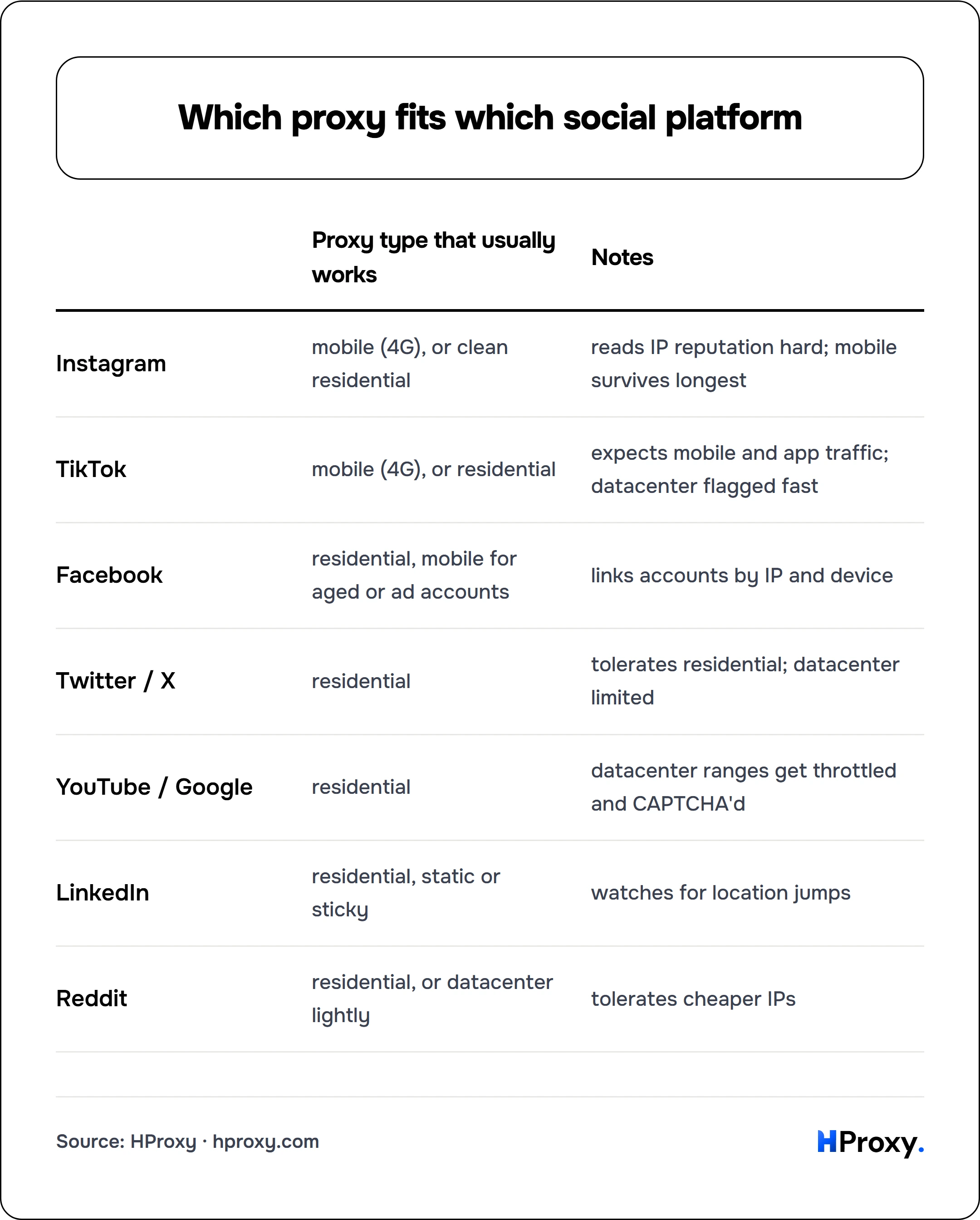
| Proxy type that usually works | Notes | |
|---|---|---|
| mobile (4G), or clean residential | reads IP reputation hard; mobile survives longest | |
| TikTok | mobile (4G), or residential | expects mobile and app traffic; datacenter flagged fast |
| residential, mobile for aged or ad accounts | links accounts by IP and device | |
| Twitter / X | residential | tolerates residential; datacenter limited |
| YouTube / Google | residential | datacenter ranges get throttled and CAPTCHA'd |
| residential, static or sticky | watches for location jumps | |
| residential, or datacenter lightly | tolerates cheaper IPs |
Staying unbanned
Even with the right IPs and separate fingerprints, behavior is what gets accounts through the first weeks. New accounts that immediately follow hundreds of people, post on a timer, or hammer the API look automated no matter how clean the network is. The habits that keep a scraper unblocked apply almost unchanged here, and our guide to avoiding IP bans covers them in depth. A few social-specific rules sit on top:
- Warm before you scale. A fresh account on a fresh IP that behaves like a bot on day one is the easiest ban there is. Let it act human for a while first: log in, browse, react, before it ever does anything at volume.
- Never share an IP across your own accounts on any platform that links by network, which is most of them. One IP per account is the line that keeps a single flag from spreading.
- Match the geo. An account that presents as based in Germany should log in from a German IP, and stay there. Country hopping is a flag on its own.
- Do not trust a recycled IP. An exit another operator already got flagged is dead on arrival. Check what an IP looks like before you build an account on top of it.
What proxies solve, and what they do not
A proxy is one layer, not a force field. It solves the network-identity problem completely: it makes each account look like it comes from a different, legitimate connection. It does not fix a shared fingerprint, botlike behavior, a burned phone number, or a platform that already distrusts an account. Anyone selling proxies as a guarantee against bans is selling a story, and the accounts that survive are the ones where the IP, the fingerprint and the behavior all line up.
For most account setups that means residential proxies held static, one per account, with an antidetect browser on top. For Instagram, TikTok and anything that keeps burning through the rest, move the important accounts to mobile proxies and let the carrier's shared IPs do the heavy lifting. Our pricing is pay-as-you-go with a balance that does not expire, so a set of accounts you tend in bursts never pays for idle proxies between campaigns. The reporting half of the job needs no accounts at all: our social platform endpoints return public profile and post data for Instagram, TikTok, YouTube, Facebook, X, LinkedIn and more as JSON. Give each account its own clean identity, treat it like a real person, and it will last.
Sources
- EFF, Cover Your Tracks, on how browser fingerprints combine into a near-unique identifier that survives a clean IP: coveryourtracks.eff.org