SEO runs on data you cannot get from your own browser. To know where a page ranks you have to read the search results a real user sees, and to do that thousands of times a day across dozens of keywords and locations you need proxies for SEO. Query Google from one office IP on a schedule and it works for an afternoon, then the engine notices the same address pulling result page after result page and starts serving CAPTCHAs, then blocks it outright. The rankings you were tracking go dark at exactly the moment you need them.
From inside a proxy network, we see this job constantly: rank trackers, SERP scrapers, and local-SEO audits all leaning on the same pipeline. This is the practical version of how proxies fit into SEO work, why search engines block repeat queries so fast, how geo-accurate exits give you the rankings a local searcher actually sees, and how to rotate and pace so you collect clean data instead of a folder full of challenge pages. If you want the general mechanics first, our web scraping guide covers the fundamentals this builds on.
Why do you need proxies for SEO?
Because SEO means querying search engines at scale, and an engine blocks any single IP that runs repeat searches on a schedule. Proxies spread those queries across many addresses so none looks automated, and geo-targeted residential exits let you read the localized rankings a real searcher sees in each city and country.
Rank tracking and SERP scraping at scale
Rank tracking is the core SEO job that needs proxies, and it is unusually easy for a search engine to catch. The reason is structural: you keep asking the same question. A normal person runs a search, clicks a result, and leaves. A rank tracker runs hundreds or thousands of searches on a fixed schedule, day in and day out, from one place. That is the most conspicuous signature in the entire discipline.
Search engines respond the way they respond to any heavy repeat visitor. First they rate-limit, slowing the busy IP. Then they interrupt it with CAPTCHAs. Then they block it. Google is especially quick to burn datacenter addresses, because those ranges are registered to hosting companies and trivial to identify, so a rank tracker pointed through cheap datacenter IPs often dies within an hour. Spreading your queries across many residential IPs is what keeps each one under the per-IP limit, so the tracker keeps running instead of stalling on a challenge page.
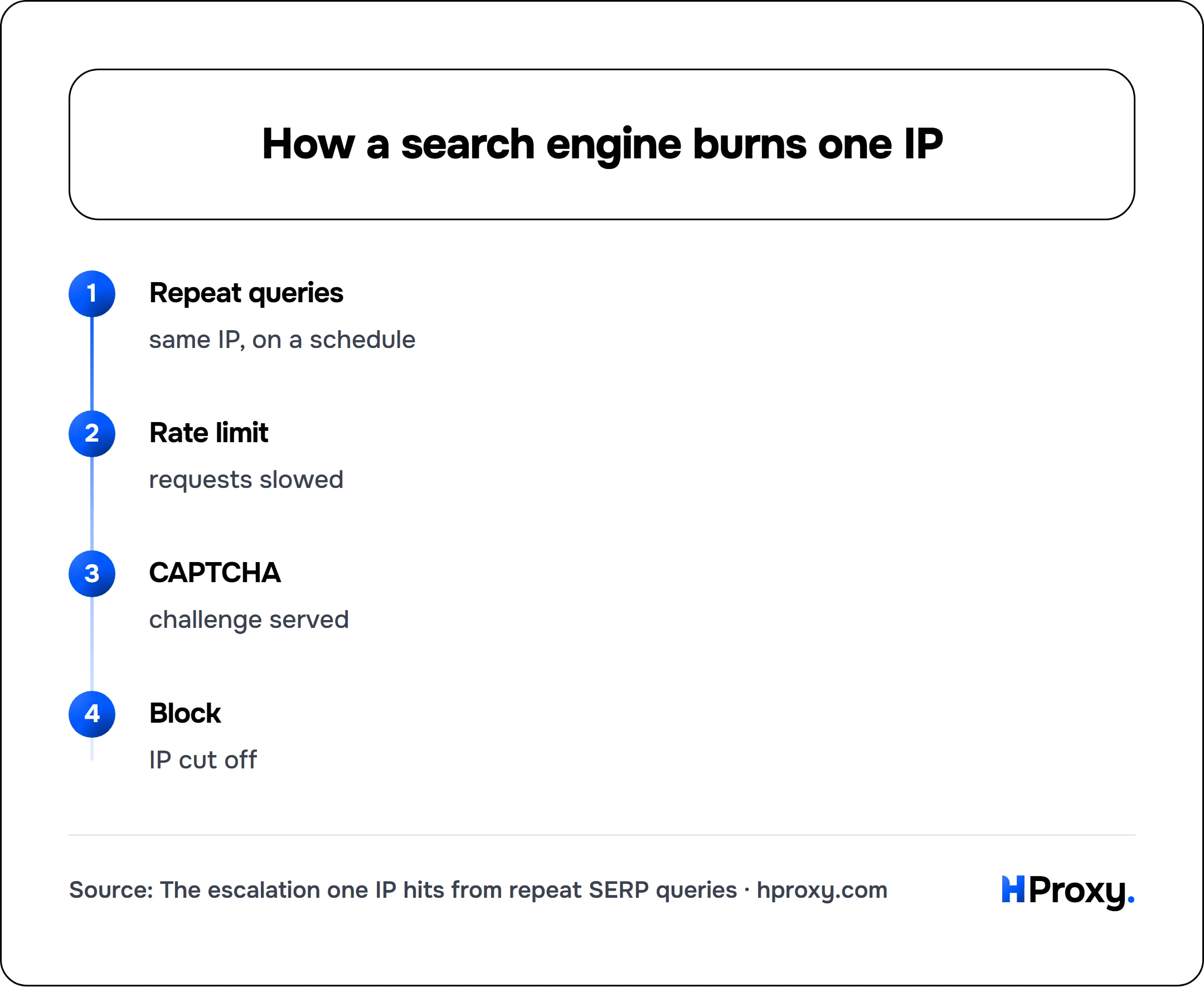
Repeat queries
same IP, on a schedule
Rate limit
requests slowed
CAPTCHA
challenge served
Block
IP cut off
One thing to be straight about: Google's own terms treat automated SERP queries as off-limits. Its spam policies file rank-checking and scripted result-scraping under "machine-generated traffic" sent without permission, alongside the Terms of Service. That is not a proxy-specific rule, and rank tracking is still standard practice across the SEO industry, but it is worth knowing the position you are working against, because Google has been escalating enforcement: through late 2025 and into 2026 a tightened crackdown on SERP scrapers caused brief data outages at major rank trackers (Search Engine Journal), and in December 2025 Google filed suit against the SERP-scraping API SerpApi. The practical takeaway is the same one the rest of this page argues: pace conservatively, read like a careful searcher, and do not give any single IP a bot-shaped footprint.
Local SEO needs geo-accurate exits
Here is the detail that trips up most first attempts: search rankings are not the same everywhere. Google localizes results heavily, so a query for plumber or coffee shop or law firm returns a different top ten depending on the searcher's city, and sometimes their neighborhood. A business that ranks first in Chicago can sit on page two in Houston, and a national brand can look strong from your desk while quietly losing the local pack in every market that actually matters.
That gives local-SEO tracking a hard requirement: every result has to be read from an exit that genuinely sits in the target location. Labeling a datacenter IP with a city usually falls short, because the engine looks past that label to the address's actual network and whereabouts, then serves a stock nationwide page or one built for the wrong region. The local ranking a real searcher in that city would see only appears through an exit that authentically lives there. Our residential pools let you pin a country and city precisely, which is what turns a single national rank report into a per-market one you can act on.
Rotation and pacing that avoids CAPTCHAs
A pool on its own settles nothing; the way you rotate and pace it does. For plain SERP scraping, cycle to a new IP on every stateless query, so each search leaves through a different address and none of them accumulates the sort of activity that reads as a robot. When part of the job holds state, a logged-in tool or a multi-step flow, park a single exit for a sticky window instead, so the session stays intact rather than hopping between IPs mid-task.
Cadence is every bit as important as rotation. No searcher fires off fifty queries a second, so do not let one IP pretend to. Space the queries out, randomize the gaps so searches do not fall on a predictable beat, and let a run breathe across its whole window instead of firing the whole set at once. When CAPTCHAs still appear, the instinct is to reach for a solver, but the challenge is a symptom: an IP looked automated. The durable fix is fewer queries per IP, residential exits, and human-like timing, which is the same logic we lay out in why you keep hitting reCAPTCHA. The full prevention checklist lives in avoiding IP bans while scraping.
Tracking competitors, not just yourself
Proxies do not only watch your own rankings. Most of the useful SEO intelligence is about everyone else in the results. Clean, geo-accurate SERP data lets you see which competitors hold the positions you want in each market, which pages they rank with, and how the layout of the results page (featured snippets, local packs, shopping units, People Also Ask) changes what winning that keyword is even worth. A first place ranking below four ads and a map pack is a very different prize from a clean first place, and you only learn which one you are chasing by reading the actual page as a local user sees it.
The same pipeline supports the wider audit work: pulling competitor pages at scale to study their content and structure, checking how a rival's site renders from different countries, and monitoring the search landscape for a keyword set over time. Underneath it is all one problem, collecting search and page data without any single IP looking like a bot, so the proxy setup that powers your rank tracker powers the competitive research too.
Why residential beats datacenter for SERPs
For search specifically, residential is usually the right tool, and it comes down to reputation. Datacenter proxies come from hosting providers: fast, cheap, and everywhere, and they never pretend to be anything else. Search engines can spot a datacenter range at a glance and distrust it by default, so it draws CAPTCHAs and blocks far sooner. That leaves datacenter fine for light, low-volume, non-localized checks, and a false economy for serious SERP collection.
Residential proxies sit on real home connections, drawn from a big pool through a gateway. To a search engine they resemble ordinary people running searches, so they clear the reputation gates that shut datacenter ranges out, and they can be pinned to a country or city so the results are locally accurate. The tradeoff is that they are metered by the gigabyte and individual home connections vary in speed, but when the results have to be both unblocked and geographically true, residential is what the job demands. We broke the rotating and static flavors down in rotating vs static residential; for rank tracking, the rotating side is almost always the one you want.
Match the task to the proxy type
Do not buy one tier for everything. Match the proxy to the SEO task in front of you:
| SEO task | Proxy type | Why |
|---|---|---|
| National rank tracking on a schedule | Rotating residential | Engines block repeat queries, and residential passes reputation checks |
| Local rank tracking by city | Rotating residential, city targeted | Only a local exit renders the local ranking |
| Light, low-volume SERP checks | Datacenter | Cheapest per query where the target tolerates it |
| Competitor page and content scraping | Rotating residential | Blends into normal traffic across many pages |
| Logged-in SEO tools and dashboards | Static residential / ISP | Rotation would snap the login, so the IP must hold |
The cost-saving rule baked into that table is the one that governs all scraping: run the cheapest tier the target permits, and jump to residential only once CAPTCHAs or off-market results prove you have to.
Where free ends and paid begins
Residential proxies carry genuine drawbacks, and you should price them in before you commit. Charging is by the gigabyte, which turns a large rank-tracking operation into a recurring data bill instead of a one-and-done spend, so pencil it in as a standing expense. The residential lines behind the pool differ in speed and can drop halfway through a request, so building in retries is a planning decision rather than a luxury, and coverage is thinner in some countries, so an unusual target market may field fewer exits than a popular one. Clean IPs alone do not finish the job either: a spotless residential address wearing a stock library user-agent, carrying no cookies and firing on a fixed beat will still trip CAPTCHAs, because search engines weigh behavior alongside IP reputation. Proxies settle identity and geography, while credible headers, sessions that carry across queries and a human cadence handle the behavior half, and SERP work needs the two together.
A truer way to picture it is that SEO measurement is a long game, not a one-off pull. The proxy makes each query look like a real searcher and sets it in the right market, and disciplined rotation and pacing keep the data clean over months of tracking. For rank tracking and SERP scraping, rotating residential with country and city targeting is the configuration we recommend for most SEO projects, and our pricing is pay-as-you-go with a balance that does not expire, so a tracker you pause between reporting cycles never burns prepaid credit while it waits. If you would rather consume SERPs than collect them, our Google search endpoint returns ranked results by query and region as JSON, priced per call. Line up the identity and geo, keep the pacing disciplined, and SEO measurement goes back to being about rankings instead of a fight with CAPTCHAs.
Sources
- Google Search Central, Spam policies (automated rank-checking and result-scraping classed as prohibited machine-generated traffic).
- Search Engine Journal, Google causes global SEO tool outages (2025 to 2026 scraper crackdown disrupting rank trackers).