Market research used to mean surveys and a handful of analysts reading competitor catalogs by hand. Today it means collecting prices, reviews, product listings and ad placements across dozens of markets, continuously, and turning that into a picture of where a market is moving. Proxies for market research are what make that collection possible at scale: they spread your requests across many IP addresses so no single one looks like a bot, and they let you appear in each country whose data you actually need.
We build the network these run on, so we see this work from the supply side: the teams pulling competitor pricing every morning, the brand-analytics shops sampling reviews across languages, the agencies auditing where ads land in each region. This is the practical guide to doing it well: what data research teams gather, why sites make it hard, which proxy type fits which job, and how to keep the dataset clean enough to trust. If you want the collection fundamentals first, our web scraping guide covers the groundwork this builds on.
Why does market research need proxies?
Because market data is both defended and local. Sites rate-limit and block the repeat visitor that bulk collection creates, and much of the data (prices, promotions, reviews, search results, ads) changes by country. Proxies spread requests across many IPs to stay unblocked, and let you read each regional market from an exit that genuinely sits there.
The data market research runs on
Modern market research is mostly a data-collection problem, and the data lives on other people's websites. The recurring jobs look like this:
- Competitor pricing. Reading what rivals charge, in each currency and region, and tracking how it moves. Price is the fastest-changing signal in most markets and the one that most often varies by country. Our guide to proxies for price monitoring goes deep on this single job.
- Reviews and sentiment. Pulling ratings and review text across marketplaces and app stores to see how a product or a whole category is received, often across languages and regions.
- Product catalogs and assortment. Collecting listings, specs, stock status and new-product launches to map what competitors sell, at what price, and where the gaps are.
- Ad and search intelligence. Sampling which ads run in which markets, and how search results and rankings differ by country, to understand positioning and demand.
What these share is scale and geography. One product, one region, one snapshot is a manual task. Thousands of SKUs across dozens of competitors and a dozen countries, refreshed on a schedule, is a pipeline, and a pipeline hitting real sites from one office IP is exactly what trips the defenses this post is about. The same geography problem shows up in panel work, which is why proxies for surveys exist at all: a questionnaire written for one country has to be read from an address inside it.
Why the data is hard to collect
Two structural obstacles stand between a research team and the data it wants.
The first is that sites do not want to be collected in bulk. A researcher pulling a whole catalog on a schedule looks nothing like a shopper viewing a few products, so sites reach for their usual answer to a heavy repeat visitor: they rate-limit with 429 responses first, then cut the IP off. From one address, a serious collection run rarely survives a day. Our full checklist for staying under that radar is in avoiding IP bans while scraping.
The second is that a lot of the most valuable data is geo-gated. The price, the promotion, the assortment, the ads and even the search results a site shows depend on where the visitor appears to be. Study a market from a single location and you are blind to every other one, and worse, you may not realize it, because the site quietly serves you its version for your region and never mentions that others exist. Reading a market accurately means appearing to be inside it.
Residential proxies for geo-accurate, unblocked access
Both obstacles point at the same tool: residential proxies. These are addresses that live on real residential lines, handed out from a large pool via a gateway. Two qualities are what make them the backbone of market research.
They pass for ordinary browsers, so they satisfy the reputation checks that bounce datacenter ranges at defended sites. And they can be pinned to a country or city, so the page renders in the market you are studying. That geo-accuracy is the part first attempts get wrong: point a datacenter IP badged as Japanese at a defended site and it will commonly be served a generic page priced in the wrong currency, because the site trusts what the address really is over the country it was sold under. Sites tell the difference with commercial IP-intelligence databases (MaxMind's is one) that classify every address as hosting, VPN, public proxy, residential proxy, or a genuine consumer line, and score how likely it is to be a proxy at all (MaxMind). To surface the local price, the local ad and the local ranking, you need a residential exit whose connection genuinely sits inside that target market.
Datacenter proxies still have a place, and it is a large one: any target that neither localizes its data nor runs a serious bot team. Open catalogs, reference sites and public price APIs are best collected through cheap datacenter IPs, and you should not pay for anything heavier when they work. The skill is matching the tier to the target rather than reaching for residential on everything.
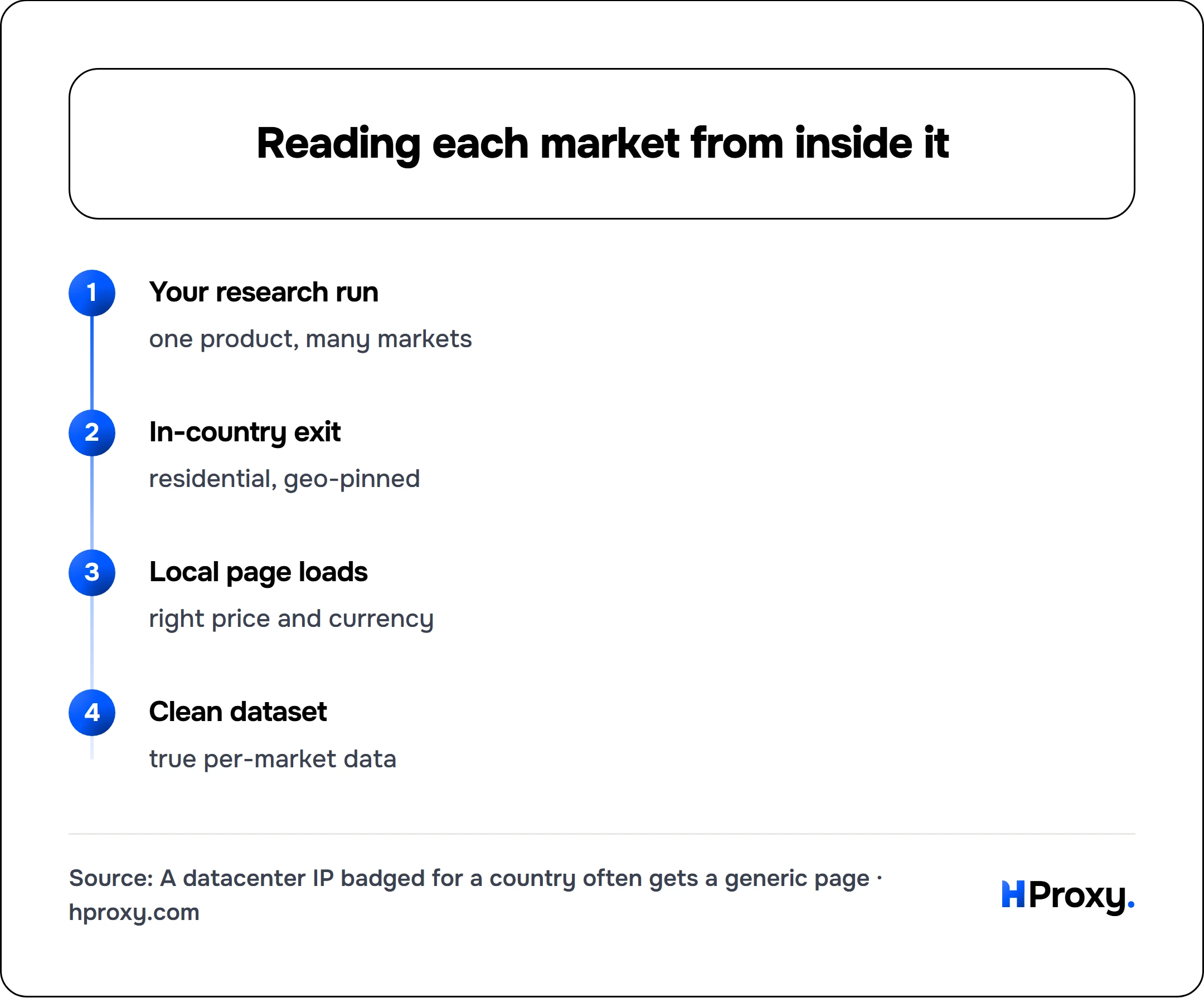
Your research run
one product, many markets
In-country exit
residential, geo-pinned
Local page loads
right price and currency
Clean dataset
true per-market data
Rotation and pacing that keeps collection clean
Having the IPs is not the plan; the way you deploy them is.
For stateless collection (independent product pages, listings, reviews with no login), draw a new IP per request. Every fetch departs through a fresh address, so none of them accrues the kind of sustained footprint that flags a collector. Once a job depends on a session, a logged-in analytics panel, or any flow that has to carry cookies, keep one exit fixed for a sticky window instead, long enough to complete the flow before a change of IP tears it apart.
How fast you go matters as much as how you rotate. No analyst pulls hundreds of pages a second, so a lone IP has no business trying. Build in delays, scatter their timing so no two requests land in lockstep, and spread each collection run over its full window rather than launching everything in a single wave. Pin one country per session too: an identity that jumps from Germany to Brazil to Japan across three requests has described a bot in one sentence.
Bad data is worse than no data
There is a failure mode specific to research that is more dangerous than an outright block, because at least a block is honest. It is the soft block: instead of refusing you, a defended site serves a CAPTCHA page, an empty result, a cached generic version or a subtly wrong price, and your collector records it as if it were real. The run completes, no error is logged, and the poison enters your dataset silently.
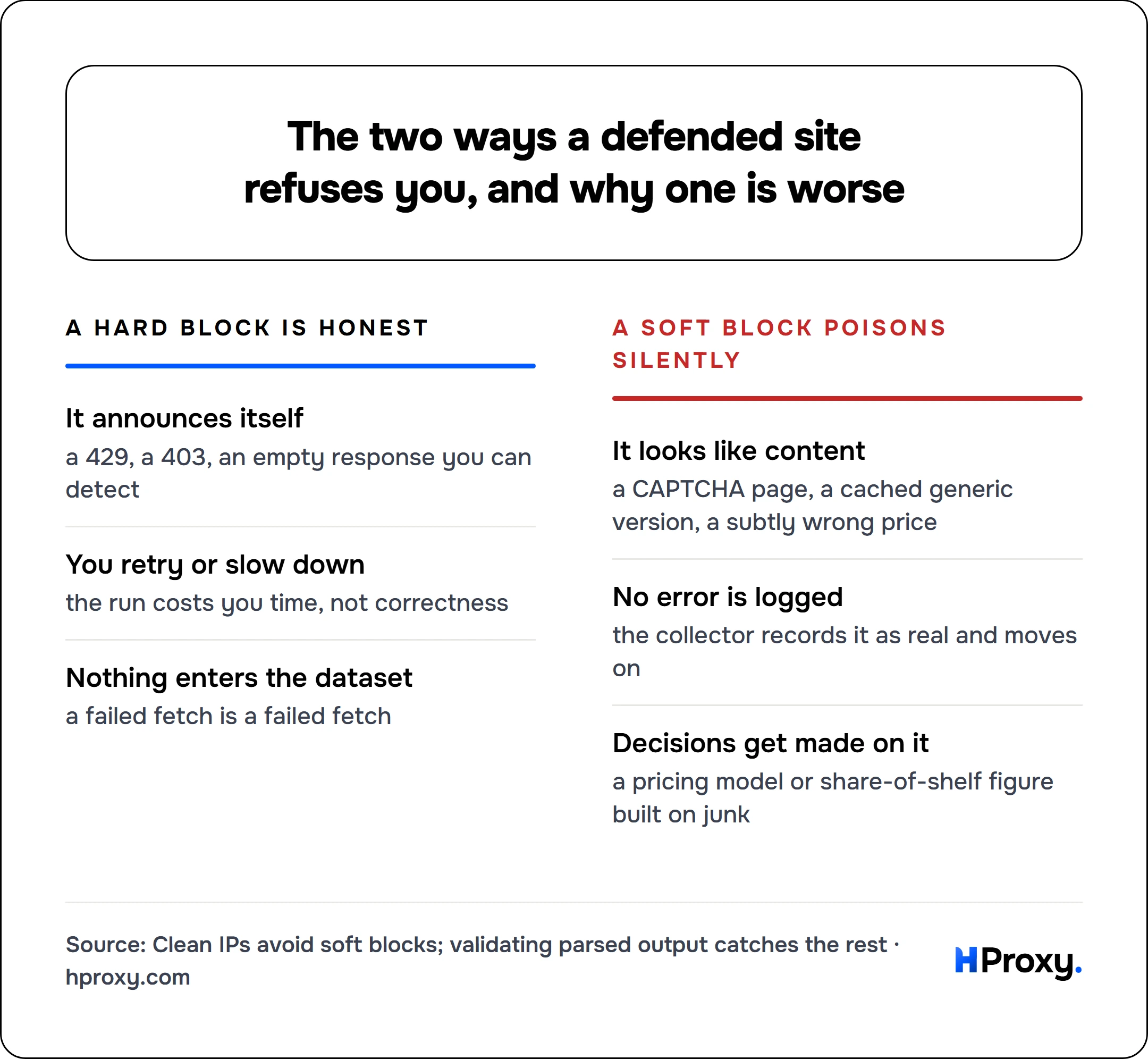
A hard block is honest
It announces itself
a 429, a 403, an empty response you can detect
You retry or slow down
the run costs you time, not correctness
Nothing enters the dataset
a failed fetch is a failed fetch
A soft block poisons silently
It looks like content
a CAPTCHA page, a cached generic version, a subtly wrong price
No error is logged
the collector records it as real and moves on
Decisions get made on it
a pricing model or share-of-shelf figure built on junk
For a research team this is the worst outcome, because decisions get made on the numbers. A pricing model trained on wrong-currency pages, a sentiment report built on half-loaded review pages, a share-of-shelf figure that missed a third of listings because a quiet rate limit hid them: each looks fine until someone acts on it. A common trigger is a fingerprint mismatch rather than the IP: a bare HTTP client sends a TLS handshake (the JA3 or JA4 signature) that does not match the browser it claims to be, and defended sites answer that with a soft block instead of an error (FoxIO JA4), so driving a real browser matters as much as the exit does. Clean IPs that do not trigger soft blocks in the first place are the first defense. The second is validation: check that a price field parsed, that a page had the expected number of results, that the currency matches the geo you requested, and log your block and anomaly rate so a rising number warns you before the bad data spreads. Good proxies make clean data possible; measuring your own output is how you know you got it.
Match the proxy type to the research task
One economical principle threads through every kind of proxy work: start on the cheapest tier a target will accept, and step up only when block rates or skewed-market data leave you no choice.
| Research task | Proxy type | Why |
|---|---|---|
| Competitor pricing across countries | Rotating residential, geo-pinned | Prices localize, so only a local exit shows the real number |
| Open catalogs, specs and price APIs | Datacenter | No geo-gating, no bot team, cheapest per request |
| Reviews and ratings at scale | Rotating residential | Marketplaces block repeat bulk readers |
| Ad and search intelligence per market | Rotating residential, geo-pinned | Ads and results differ by country |
| Logged-in panels and seller dashboards | Static residential / ISP | A mid-session IP change would break the flow |
| The most bot-hostile marketplaces | Mobile | A carrier IP serves many users, so sites rarely block it |
Keeping it legal and ethical
Collecting market data responsibly is mostly common sense, and it protects the project as much as the target. Stick to publicly available data, the pages any visitor can see without logging in or getting around a paywall. Respect the directives a site publishes, including its robots file, where you have agreed to. Pace your collection so you are not degrading a site you depend on for data. And be careful with personal data: aggregate prices, public reviews and product listings are one thing, but scraping names, contact details or anything that identifies individuals pulls you into laws like GDPR and out of the safe zone. Proxies are a technical tool, not a legal permission slip, so keep collection to public, non-personal data and get proper advice for anything commercial or sensitive.
Start with clean, local data
Market research lives or dies on the quality of the data underneath it, and that quality starts with being able to see each market as it really is, without getting blocked. Residential proxies with country and city targeting are the starting point we suggest for most research pipelines, with datacenter for the easy targets and mobile held in reserve for the worst. Our pricing is pay-as-you-go with a balance that does not expire, so a research project that runs in quarterly bursts never pays for idle capacity between them. Where a research question lands on a platform we already run, our ready-made data endpoints return it parsed and skip the collection step entirely. Settle the identity and geo, measure your own data quality, and market research goes back to being an analysis problem instead of a collection fight.
The same exits answer a question research teams are often asked next, which is what our own product looks like in each of those markets. Geo-testing your app with proxies covers turning that into a check that runs on every deploy, so a regional pricing or catalogue break is caught by a failing test rather than by a customer.
Sources
- MaxMind, GeoIP Anonymous IP database (classifying an address as hosting, VPN, public-proxy, residential-proxy, or a real consumer line): https://www.maxmind.com/en/geoip-anonymous-ip-database
- FoxIO, JA4+ TLS fingerprinting (why a bare client draws soft blocks even on a clean IP): https://github.com/FoxIO-LLC/ja4