The best free proxy that actually works is not a specific IP you can save and reuse. It is whichever proxy on a constantly re-checked list was verified alive in the last few minutes, because free proxies die that fast. Every "top 10 free proxies" post that hands you a fixed list of addresses is wrong by the time you read it, and this article explains why, then shows you the approach that actually holds up.
We run a proxy verification engine for a living, so this is not a guess. Our system has performed more than 129,131,311 checks against over 589,918 free proxies. At any given moment, only a few thousand of them are alive. That single fact reshapes the whole question. You are not looking for the best free proxy, you are looking for a fresh one, filtered correctly, and verified seconds before use.
Why most free proxies fail before you even try them
Free proxies fail for reasons that have nothing to do with the list you found them on. The machines behind them are abandoned or misconfigured servers, expired trials, and short-lived cloud boxes that were never meant to stay open to the public. When one of those goes offline, gets overloaded by everyone else sharing it, or lands on a blocklist, the proxy dies. That happens on a cycle measured in minutes to hours.
Two numbers from our free proxy data study make the scale concrete. Out of more than half a million proxies we have ever discovered, the working pool (anything alive in the last 48 hours) is only around 34,114, and the live-right-now count is a few thousand. So a list boasting "150,000 free proxies" is counting corpses. The only figure that means anything is how many are verified alive this minute, which is why a static dump is worthless within a day of being published.
There is a second problem underneath the freshness one. The overwhelming majority of free proxies are datacenter IPs, not residential. In our data the single largest source by far is Amazon's cloud, followed by other hosting providers like Alibaba, DigitalOcean, and OVH. A datacenter IP announces "I am a server, not a person" to any site with real bot defenses, so even a free proxy that is technically alive gets rejected the moment it touches a target that cares. Working and useful are two different bars.
What actually separates a free proxy that works from a dead one
When people ask for free proxies that actually work, they usually mean four things at once, even if they only say "working." A proxy you can rely on for a task has to clear all four:
- Fresh. It responded to a check seconds or minutes ago, not last Tuesday. Freshness is the strongest predictor there is.
- Elite anonymity. It hides your real IP and does not advertise that a proxy is in use. Transparent proxies, which leak your IP in the request headers, are worse than no proxy at all because they add a hop while still exposing you.
- The right protocol. Your tool speaks HTTP, HTTPS, SOCKS4, or SOCKS5, and the proxy has to match. SOCKS proxies carry any TCP traffic, not just web requests, so if your setup can speak SOCKS you are fishing in a much bigger pond. SOCKS5 goes one step past SOCKS4: it can also relay UDP through the optional UDP ASSOCIATE command defined in RFC 1928, though plenty of free servers answer as SOCKS5 and never implement that half, so a SOCKS5 label is not proof the proxy does everything the protocol allows.
- The right location, and not already blocked. An IP that exits in the wrong country is useless for geo-specific work, and one that is already burned on your target site will fail no matter how alive it is elsewhere.
Miss any one of those and the proxy "does not work" from your point of view, even though it might be perfectly alive. This is why chasing a magic list of best free proxies is the wrong mental model. The list is never the answer. The filter and the freshness are.
The practical shortlist: how to actually get free proxies that work
Stop hunting for a site that hands you working proxies and start treating it as a pipeline: pull from something that stays fresh, filter it down, grab several, and verify right before use. Not every source feeds that pipeline equally well:
| Source | How fresh | Realistic odds it works | Good for |
|---|---|---|---|
| A scraped list from 2019 (or any static dump) | Never re-checked | Near zero | Nothing |
| Big aggregator sites (Spys.one and similar) | Updated roughly hourly, ports hidden behind JavaScript | Low, single-digit live | Disposable use, if you tolerate the friction |
| GitHub auto-refresh lists | Every few minutes | Better, but still datacenter | Fresh, disposable tasks |
| A list re-checked every few minutes with timestamps (ours) | Every few minutes, dead entries dropped | You copy ones alive moments ago | Anonymous, low-stakes tasks |
| Free trial of a paid pool | Real IPs, on demand | High | Short real jobs |
| Paid residential, pay as you go | On demand, stable | High and consistent | Anything with a login or a strict target |
The pattern is obvious once you see it laid out. The value is not in the brand of the list, it is in how recently each entry was verified. A list re-checked every few minutes will hand you working proxies. A list that was accurate once and never touched again will hand you a graveyard, which is exactly what happened to most of the classic sites we walked through in the free proxy list graveyard.
Our own free proxy list is built around that single principle. It re-checks every entry every few minutes across 100-plus countries and all four protocols (HTTP, HTTPS, SOCKS4, SOCKS5), drops the dead ones instead of padding a total, and shows a last-checked timestamp on every row. The workflow that actually works looks like this:
- Open a list that carries a fresh timestamp on each proxy.
- Filter by the protocol your tool speaks and the country you need.
- Filter to elite anonymity only, so you are not leaking your own IP.
- Grab several proxies, not one, because some will still have died between the check and your click.
- Verify each one right before you send real traffic, and rotate to the next when it dies.
That last point is not optional busywork. It is the whole difference between "I have a list of free proxies" and "I have free proxies that work."
How to verify a free proxy actually works
Never trust a proxy just because it came off a list, even a good one. A proxy can pass a liveness check and still be too slow, pointed at the wrong country, or transparent. "Working" has four parts: alive, reasonably fast, exiting where you expect, and private enough for the job.
The fastest way to confirm all four is our free proxy checker. Paste in an IP and port, and it reports the exit IP, country, latency, and anonymity grade at once, with no signup. Run a handful at a time and keep the elite, low-latency ones in the country you need.
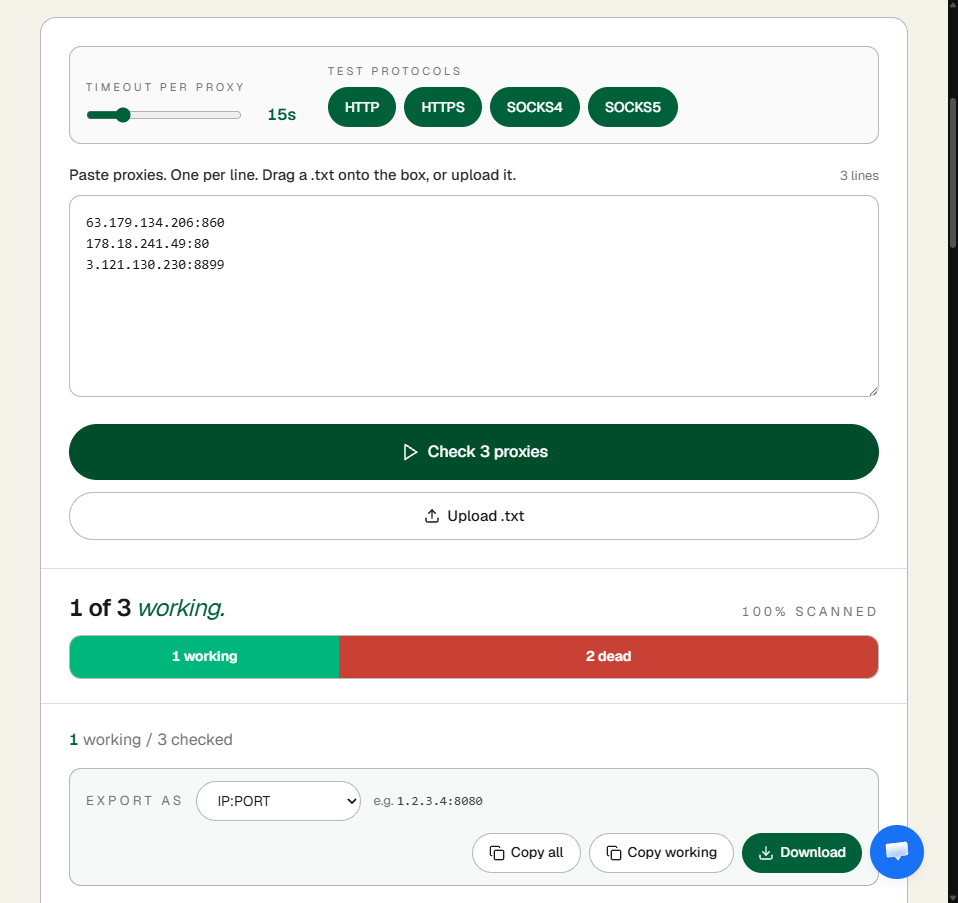
If you would rather stay in the terminal, one line of curl does the core test: curl -x http://IP:PORT --max-time 10 https://httpbin.org/ip. If the reply shows the proxy's IP instead of yours, it is alive, and the --max-time flag makes dead ones fail fast instead of hanging. Swap http for socks5 to test a SOCKS proxy. We walk through checking speed and anonymity too in the full guide on how to check if a proxy is working. Whichever method you use, do it right before the proxy goes to work, because "alive an hour ago" tells you nothing.
When a working free proxy is still the wrong tool
The roundups rarely get this far. Even a free proxy that passes every check is a datacenter IP that is shared, unstable, and easy to fingerprint. That is fine for a narrow set of jobs and a problem for everything else.
Passing a liveness check also says nothing about the operator. In a controlled test of 443 public proxies, only about a fifth were not doing something shady, and most of the rest refused to carry HTTPS at all, which quietly pushes your traffic onto readable HTTP where the operator can log it (Christian Haschek, "Analyzing 443 free proxies"). That is why "working" and "safe to log into" are different bars: a proxy can be perfectly alive and still be reading everything you send.
Free proxies genuinely work for anonymous, low-stakes, disposable tasks: light scraping where a dead proxy just costs you a retry, checking whether a page renders differently from another IP, or one-off requests where losing the connection mid-way does not matter. For those, a fresh proxy off a live list is the right, cost-free tool, and we laid out exactly where that line sits in when free proxies are fine.
They stop working the moment the stakes rise. Anything with a login, any site with serious bot defenses, price monitoring that has to stay up for hours, or geo-work where you need a specific country on demand: free proxies fail these fast, because a datacenter fingerprint plus a lifetime measured in minutes is the opposite of what those jobs need. When you have outgrown the disposable tier, the answer is residential IPs (real home connections that look like people, not servers). Our residential pool starts at $0.44 per GB, pay as you go, with no KYC, so you can run a real job without a monthly commitment or a sales call.
The short version
There is no permanent list of the best free proxies, and any post that gives you one is selling you a stale bookmark. The free proxies that actually work are the fresh ones, filtered to elite anonymity, matched to your protocol and country, and verified seconds before use. Get the freshness right and free proxies deliver on their narrow promise. Get it wrong and you are copying corpses. For the fundamentals behind all of this, our free proxies guide is the place to start.
Start from a list that re-checks itself every few minutes: our free proxy list is free, needs no signup, and drops the dead instead of counting them. Test anything before you trust it in the proxy checker. And when your work has outgrown disposable IPs, our residential proxies at $0.44/GB pick up exactly where free ones give out. The buyer FAQ covers activation, per-gigabyte billing and a balance that does not expire.