Here for free Robux? No proxy, app or website makes Robux, and a page that promises it is after your account. Roblox says so itself, and the next sections show why.
Free proxies for Roblox work for one job out of three, and most guides never tell you which one. They can put a fresh IP in front of the Roblox website for a while, often less than an hour. They cannot carry your gameplay, because that is not even the same kind of traffic. And for the job that brings most technical people here, calling Roblox's web API from a server, the free pool fails for a reason you can measure rather than argue about.
This is the straight version, written by people who re-check a free proxy list every few minutes and who spent an afternoon sending real requests at Roblox to replace the usual guesswork with numbers.
"Roblox proxy" means four unrelated things
One phrase many people search in this topic is roblox proxy server, and it is the most confusing one, because four different groups of people type it wanting four different things.
- A network proxy. You want roblox.com to load on a network that blocks it. A free proxy is genuinely relevant here.
- A private or VIP server. You want your own instance of a game to play in with friends. This has nothing to do with proxies at all: it is a paid feature inside individual Roblox experiences, bought with Robux from the game's own page. No proxy, APK or download is involved, and anything promising a "free VIP proxy server download" is selling you something else.
- An API proxy. You are building something (a game script, a Discord bot, a website) that needs data from Roblox's web API, and you have hit a wall Roblox put there deliberately. This audience needs its own answer, which is in Roblox API proxy.
- A way to get free Robux. This is the single most common reason people arrive on this page. There is no such thing, and the next section says why in Roblox's own words.
The rest of this page covers 1 and 2 in full, gives 3 enough to know whether it is your problem, and deals with 4 immediately, because it is the one that can cost you your account.
No proxy gives you free Robux, and Roblox says so
More people reach this page searching for a proxy that produces Robux than for anything else on it. The answer is short, and it is worth reading before you click anything else.
No proxy, server, generator, website or app creates Robux. Robux is currency that Roblox sells. A proxy is a computer that passes your internet traffic along, and passing traffic along cannot mint money any more than a postbox can print stamps.
Roblox states it plainly on its own frauds and scams page: "There are no sanctioned offerings of free Robux. If a website or user is promising this, it may be a way to get your personal information." It adds that the same goes for offers of "free Premium memberships, tricks, codes, or valuable items". The same page is equally clear about what nobody should ever be asked for: "We'll never ask for your password outside of the Roblox login page. Never enter your information into other pages, especially those that are requesting it for a giveaway."
That is the whole trick. The Robux is the bait, your login is the product. A site that asks for your username and password, or for you to paste a long code from your browser, is taking the account. It does not matter how real the page looks, how many comments say it worked, or whether a friend sent it.
If you want Robux, get it only through Roblox itself. If a page offers any other route, close it.
Protect your account now. Roblox says its "2-Step Verification and passkeys help avoid the likelihood of an Account Takeover". Turn on 2-Step Verification under Settings > Security in Roblox. Roblox then asks for a second check at sign-in and before risky changes, such as changing a password. If you already typed your password into one of these pages, change it on the real Roblox site straight away.
Job one: reaching Roblox on a blocked network
This is the case free proxies are actually built for. A free proxy is a public relay anyone can send traffic through without paying or signing up, and it swaps the destination your network sees. School and workplace filters often block by domain. The Roblox guide for school networks even lists the domains an administrator has to allow. Routing through a relay the filter does not recognize gets the site to load.
Two things it will not do. Filters on managed devices, such as a school-issued Chromebook, can live in the browser itself rather than on the network. A Chrome policy can stop listed web pages from loading, and a web proxy does not touch that. And whatever loads, you are still only reaching the website. Playing is a separate problem, covered next.
One country block is over, and one is not. People still search for ways to reach Roblox from Russia and Turkey.
- Russia blocked Roblox on December 3, 2025 and restored access on June 10, 2026. Roblox had met Russian requirements that included age-restricted access to games.
- Turkey blocked Roblox on August 7, 2024, after a court decision. On June 18, 2026 news sites and a minister announced that the ban was over. The minister then deleted her post, and the block was still in place the next day.
In Russia you no longer need a proxy for this. In Turkey the block stands. Network tests collected by OONI, the Open Observatory of Network Interference, show both in September 2026. From Russia, 673 of 683 tests of www.roblox.com found no sign of blocking. From Turkey, 13 of 18 confirmed a block, the last on September. 20 A free proxy would not bring the game back anyway, because it cannot carry gameplay.
Job two: playing through a proxy, and why it does not work
Roblox uses two connections, and this single fact quietly breaks most tutorials on this topic.
The website and login (roblox.com and its APIs) run over HTTPS, which is ordinary TCP that a normal proxy relays without trouble. The gameplay itself, once you join an experience, runs over UDP on high-numbered ports, because a real-time game needs the fast connectionless delivery UDP gives it. The Roblox guide for school networks names the range: ports 49152 to 65535.
HTTP, HTTPS and SOCKS4 proxies move only TCP. So a free proxy can relay the Roblox website and has no way to carry the packets your game client is actually sending. SOCKS5 can technically relay UDP through the UDP ASSOCIATE command in RFC 1928, but almost no free SOCKS5 proxy implements it. Roblox itself also says the launch of an experience "currently does not support proxies".
We measured that "almost no" rather than leaving it as a feeling. On September 5, 2026, we sent a UDP association request to 600 live free SOCKS5 proxies from our own pool. 384 of them answered with a success code, which sounds like most of the pool can do it. They cannot. RFC 1928 says the reply must carry the address and port the client sends its datagrams to, and 380 of those 384 returned port 0, which is not a port anything can be sent to. Four returned a real port. Two of the four pointed at private addresses that nothing outside the network of the proxy itself can reach.
So: at most two proxies out of six hundred even offered a place to send a game packet. We did not prove that either could carry one, let alone fast enough to play on. A success code from a free SOCKS5 proxy means almost nothing here. The number that matters is the relay port it hands back, and it is nearly always zero. Routing gameplay needs OS-level tunneling software (something like Proxifier) plus a proxy that genuinely forwards UDP, and every hop you add raises your ping in a game where ping is the thing you were protecting.
So if the goal is to play Roblox through a proxy, a free HTTP or SOCKS proxy will not do it. At best you proxy the website while the game connects straight from your real address, which defeats the point.
Job three: calling the Roblox API, where the free pool fails on arithmetic
If you are writing anything that reads Roblox data, a leaderboard in your own game, a Discord bot, a site that shows someone's inventory, you have probably met this error:
HTTP 403: HttpService is not allowed to access ROBLOX resources
Roblox does not let game servers call its own web domains, apart from its Open Cloud API. That restriction is why a whole category of public relays exists, RoProxy among them, and why roblox api proxy is a search term at all.
Here is the part that decides whether free works: Roblox limits requests per IP address, per endpoint, and it publishes the budget in its response headers. We read the budgets of seventeen public endpoints on August 11, 2026, and again on September 16, 2026, and the limits are not one number. In September they ran from 1 request a minute for username history and catalog search to 600 a minute for badge details. Six of the seventeen had changed since August. Group lookups by ID allowed 7 a minute.
That matters for free proxies because the limit follows the exit address. A free proxy is a shared address that anyone can use, so you inherit whatever budget the others have left. Free proxies are not mysteriously blocked by Roblox. On an endpoint that allows seven requests a minute, everyone else on that address counts against the same seven.
The full measured table, the working options, and how many addresses a given request rate actually needs are in Roblox API proxy. If you are a developer, start there instead of here.
We pointed 50 free proxies at Roblox and counted
Rather than assert how free proxies behave against Roblox, we measured it. On 27 September 2026 we took 50 working entries at random from our own free proxy list, all marked as able to open HTTPS connections. We asked each one for the same public Roblox API address. Before that, each proxy was asked for a test address of our own, so a Roblox refusal could be told apart from a dead proxy.
5 of the 50 returned real Roblox data. The other 45 failed, 41 of them by timing out after 20 seconds.
Two things worth taking from that, and the first one cuts against what most pages on this topic claim.
Roblox is not the thing blocking them. Not one of the 50 got a refusal from Roblox. The same proxies failed our own test address just as often: only 5 of the 50 answered it. So the popular line that Roblox rejects free proxies on sight is not what we observed on a public read endpoint. The failures were the proxies themselves: dead, overloaded, or refusing the connection.
Nine in ten of a freshly verified list could not complete one request. These were not stale entries scraped from a dump; our checker had marked every one of them as working. That is the actual cost of free: not that Roblox refuses you, but that the tool disappears underneath you between the check and the use.
Of the five that did work, four hid the address of the user, and only one sat on an address our data classes as a datacenter. Which brings us to why they still fail the moment the job gets bigger than one request.
Why free proxies get dropped on Roblox specifically
Even for job one, free proxies do not last. Four things stack against them.
- They die on their own. This is the big one, and our test above puts a number on it. Nine in ten of a freshly verified batch could not complete a single request. Unowned and overloaded, many free proxies stop answering within the hour. Of the 17,051 that worked between 00:00 and 01:00 UTC on September 25, 2026, 38 percent failed every check in the next hour.
- They are shared, so the rate-limit budget is shared too. Roblox meters per address, and anyone can push traffic through one open relay. You are not getting an endpoint's allowance, you are getting whatever is left of it. This is why free collapses on volume even when a single test request succeeds.
- Most are datacenter addresses, which matters for accounts rather than reads. In our test, Roblox refused none of the 50 on a public read endpoint. But login is a different system. Roblox checks it with Arkose Labs FunCaptcha, so account actions can meet a challenge that a plain data request never sees. Our free proxy data study, built from 129,131,311 checks across 589,918 tracked proxies, finds the working free pool sitting overwhelmingly on cloud networks.
- Some are transparent. On September 26, 2026, 11.6 percent of the working HTTP proxies in our pool passed the address of the user on to the site. A transparent proxy forwards your real address in the request headers, so it changes what Roblox sees about the connection while telling it exactly who you are anyway. Check before you trust one.
Those four share one root cause, which is the size and churn of the pool itself.
94% lost from Discovered all-time
88% lost from Working pool
On bans, briefly
A proxy changes your address and nothing else. Roblox bans attach to the account, and Roblox looks at far more than the address. When it welcomed the anti-cheat company Byfron in October 2022, it promised "client-side and server-side anti-cheat, alt accounts detection, and additional tools for developers to combat cheaters". None of that depends on your IP. So a fresh address does not lift an account ban. The Roblox Community Standards also forbid "Creating or using an account to avoid enforcement action taken against another account", and "Using VPNs to mask your location in order to gain unauthorized access to Roblox". Where a block genuinely is address-level, a clean IP restores access, but a random free datacenter proxy is a poor bet for it because it is likely flagged already.
The Roblox-specific safety trap: your .ROBLOSECURITY cookie
This is the risk that should stop you cold, and it is sharper on Roblox than almost anywhere else. Your entire logged-in session lives in one cookie named .ROBLOSECURITY. Roblox itself warns that attackers who get it "can potentially gain access to your account without a password and bypassing two step verification checks". Since 2024, Roblox ties the cookie to your device on selected parts of the site, a feature it calls Account Session Protection. It still says the cookie "should never be shared with anyone".
A proxy is a stranger's computer sitting in the middle of your traffic. Roblox is served over HTTPS, so on a clean connection the cookie is encrypted in transit and the operator cannot quietly read it. But a hostile free proxy can try to strip the connection to plain HTTP or present a fake certificate and bet that you click past the browser warning. The moment you do, that session cookie crosses their machine in readable form. This is not only theory. In one of our test runs on September 27, 2026, 1 of 50 free proxies answered the Roblox address with a certificate our client could not verify. A browser would show that as a warning and ask you to click past it.
Log in via proxy
untrusted operator
TLS downgraded
or fake certificate
Cookie exposed
.ROBLOSECURITY
Account at risk
without the password
We laid out the general version in are free proxies safe. Roblox is the textbook case: a valuable account, protected by a single cookie, often used by younger players who will click through a warning to get back to a game.
It is worth knowing who owns the machines in question. We checked our own live free pool on September 5, 2026, against fraud intelligence: 89.3 percent of the proxies verified alive were flagged as abusers with recent abusive activity, and not one of them was a residential address. These are overwhelmingly machines with a history, and the login page you are about to type into would be passing through one of them.
So the hard rule is short. Checking whether the site loads from another country through a random proxy is fine. Logging in, spending Robux or touching account settings through one is how accounts disappear.
Free versus paid, by job
| What you are trying to do | Free proxy (public datacenter) | Paid residential |
|---|---|---|
| Open the site on a blocked network | Sometimes, often for less than an hour | Reliably, the address stays up |
| Play the game through the proxy | No, gameplay is UDP | Only with a proxy that relays UDP plus an OS-level tunnel, and ping rises |
| Call the Roblox web API | Budget shared with everyone on the address | Own budget per address |
| Stay safe while logged in | Untrusted operator, cookie at risk | Provider-run and accountable |
| How long it lasts | Often less than an hour | Stable pool, on demand |
| Cost | $0 plus your time | From $0.44/GB, pay as you go |
The pattern is the one that shows up everywhere with free proxies. They win when a failure costs you ten seconds. They lose the instant the task involves your account, sustained throughput, or the game itself.
What free proxies are genuinely good for here
None of this makes them useless, it makes them narrow. They are right for anonymous, throwaway, website-only checks where failure or snooping costs nothing: seeing whether roblox.com loads from another country, confirming that your network blocks the site rather than the client, or learning how proxies plug into a browser. Every one of those survives the proxy dying mid-task and survives a stranger watching, because you are not logging in and not playing.
The test is simple. No login, no Robux, no gameplay, no volume: free is fine. The moment any of those enter, it is the wrong tool.
When the job outgrows free
You have crossed the line the moment you need an address that stays alive, one that reads as a real home user rather than a flagged server, or one you can trust with a logged-in session. That is what residential proxies are: addresses ISPs assign to home connections, so Roblox's systems see an ordinary player instead of a datacenter box with a shared reputation.
Two limits worth stating plainly, because we would rather keep you than oversell. Residential proxies fix the website, account and API side. They do not fix gameplay on their own. It is still UDP, it needs a proxy line that relays UDP plus a tunnel on your computer, and every hop adds ping. And using proxies to evade bans or mass-produce accounts runs against the rules of Roblox, which name both, and that is between you and Roblox rather than something a proxy dissolves.
Ours start at $0.44/GB, pay as you go, and purchased traffic has no scheduled expiry date. For API work the value is concrete rather than vague: because Roblox meters per address, your ceiling is the endpoint limit multiplied by how many clean addresses you hold, which is arithmetic you can do before you buy.
Test any proxy before you point Roblox at it
Whatever you use, verify it first, because a free proxy that worked ten minutes ago may already be gone. Two things matter: whether it is alive, and whether it hides your address rather than leaking it in the headers.
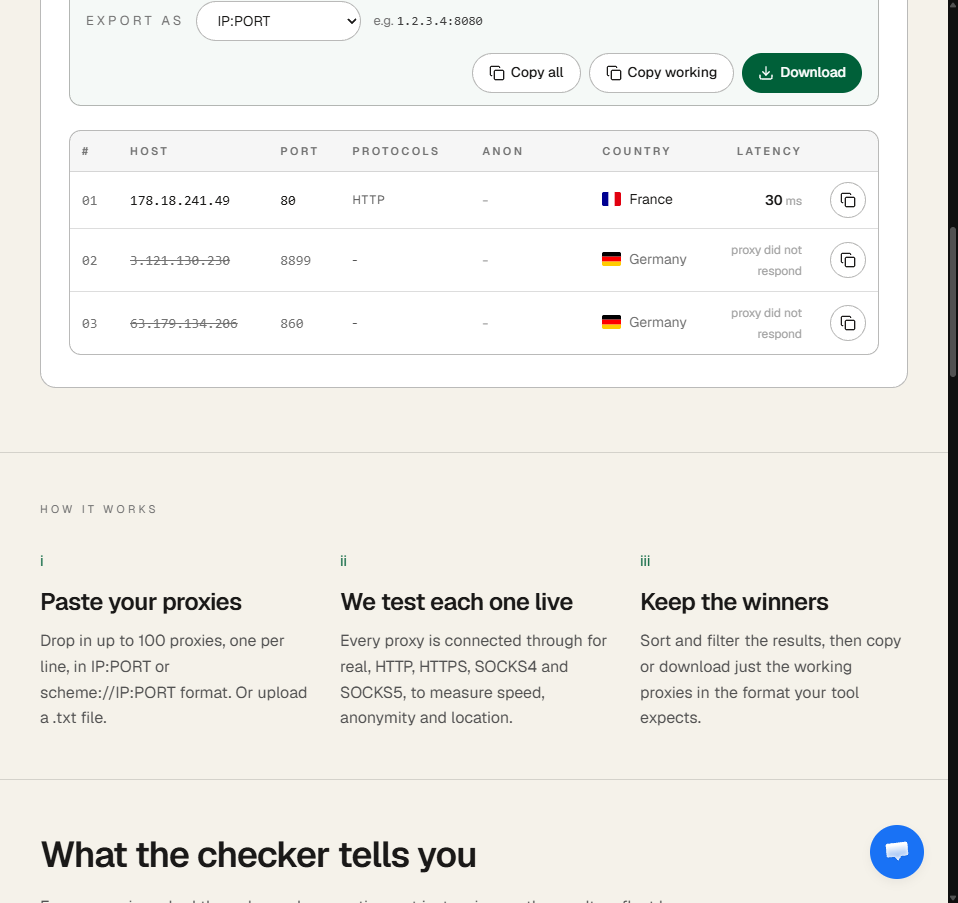
Both take seconds. Paste a candidate into our proxy checker and it opens a real connection through the proxy and reports exit IP, country, latency and anonymity grade in one pass, so a dead or transparent proxy is caught before Roblox sees it. To run the checks yourself, the method is in how to check if a proxy is working. And if you are pulling candidates in bulk, start from a list that re-checks itself: our free proxy list refreshes every few minutes across 100+ countries and all four protocols. When the job outgrows what a free address can hold, proxies for Roblox covers the paid side: which type fits which task, and what the API path needs.
The short answer, once more
Free proxies for Roblox are a real tool with one job. They open the website on a blocked network for a while, often less than an hour, which is genuinely useful. They cannot carry gameplay, because gameplay is UDP. They cannot sustain API work, because Roblox meters by address and a free address shares its budget with everyone else on it. And they are a live threat to your account the instant you log in through one.
Keep them to anonymous, website-only, throwaway checks. If you are building against the Roblox API, go to Roblox API proxy, which has the measured limits and the working options. If you are managing accounts, our residential IPs, from $0.44/GB, pick up where free stops.
Sources
- Roblox Developer Forum, Welcoming Byfron to Roblox, October 11, 2022, on the anti-cheat plans Roblox announced with Byfron.
- Roblox, Community Standards, "Evading Safety and Security Systems", and the Roblox Help Center, Creator Third Party App Policy, on account creation at scale. Read September 27, 2026.
- IETF, RFC 1928, SOCKS Protocol Version 5,
UDP ASSOCIATE. - BBC, Russia bans Roblox over concerns about safety and extremist content, December 2025, on the Russian block. The end of the block on June 10, 2026, is recorded in the Wikipedia article below.
- Roblox, Update on the Roblox ban in Türkiye, August 8, 2024.
- Türkiye Today, Türkiye lifts Roblox ban after nearly two years, June 18, 2026, and Donanımhaber, the minister deletes her post on Roblox, June 19, 2026, reporting that the block was still in place.
- Wikipedia, Censorship of Roblox, last edited September 1, 2026.
- OONI, the Open Observatory of Network Interference, web connectivity tests of www.roblox.com from Turkey and from Russia, September 1 to 27, 2026, read on September 27, 2026.
- Roblox Help Center, Troubleshooting Education Networks, Firewall and Router Issues and Issues Logging In or Out in a Browser, read September 27, 2026.
- Roblox Developer Forum, Introducing Account Session Protection, October 30, 2023.
- Roblox Creator Documentation, HttpService, on third-party web services and Open Cloud.
- Chromium, URLBlocklist policy definition, on blocking web pages in managed Chrome and ChromeOS.
- Roblox endpoint rate limits read by HProxy on August 11 and September 16, 2026, from response headers; the full table is in Roblox API proxy.
- Free proxy success rate against Roblox measured by HProxy on September 27, 2026: 50 working entries of our own free proxy list that passed our HTTPS check, each asked first for a test address of ours and then for the same public Roblox endpoint; 5 returned Roblox data, 5 answered our own address, and Roblox refused none.
- HProxy, free proxy data study, for pool size, composition and lifetimes.
- Roblox Corporation, frauds and scams, on there being no sanctioned free Robux, on never entering a password outside the Roblox login page, and on 2-Step Verification. Read September 27, 2026.
- SOCKS5 UDP relaying measured by HProxy on September 5, 2026: 600 live free SOCKS5 proxies sent a
UDP ASSOCIATErequest, 384 answering success, 380 of those returning relay port 0, 4 returning a non-zero port and 2 of those 4 pointing at private addresses. - Free-pool fraud intelligence queried by HProxy on September 5, 2026: of the free proxies verified alive, 89.3 percent flagged as abusers with recent abusive activity and none residential.