A free proxy mega list is a large public collection of proxy servers, often advertising thousands or tens of thousands of IPs across many countries and protocols in a single place, free to use with no signup. The part the headline leaves out: a free proxy mega list is only worth anything if those thousands are checked live, because most free proxies are dead within minutes to hours, and a static mega dump is mostly a graveyard by the time you open it.
So the useful question is not "how big is the list." It is "how much of that list is alive right now." This piece breaks down what a proxy mega list actually is, the simple math that separates a real one from a bloated dead file, how live-checking thousands of proxies works under the hood, and how to filter and export the slice you need without wasting an afternoon on dead IPs.
What a free proxy mega list actually is
Strip away the marketing and a mega list is just a very large free proxy list: a published set of relays, each line giving you an IP, a port, a protocol, a country, and usually an anonymity grade. You send your request to the proxy, it forwards the request, and the destination site sees the proxy's IP instead of yours. "Mega" only means the pile is big, tens of thousands of entries instead of a few hundred.
Almost all of that pile is datacenter IPs, addresses that trace back to hosting companies rather than home internet connections. Some are servers left open on purpose, some are misconfigured boxes answering the whole internet by accident, and a rotating cast of them appears, gets hammered by thousands of strangers, and vanishes. You do not own them, you cannot control them, and you have no idea who else is riding the same IP. The big-name aggregators lean hard on the headline count, and we ranked them by what survives a check in our roundup of the biggest free proxy lists, where the pattern is always the same: the number on the landing page is not the number that works.
That is the trap of the mega list. Raw size is a vanity metric. A hundred thousand dead proxies is not a hundred thousand proxies, it is a text file with a hundred thousand disappointments in it.
The math behind a real mega list
The value of any proxy mega list is not the row count. It is the row count multiplied by the fraction that is actually alive. That second number is where every static list falls apart.
Across our study of 129,131,311 checks, free proxies decay fast and only a small fraction respond at any given moment: of more than 589,918 proxies our engine has ever discovered, only around 34,114 sit in the 48-hour working pool, and the live-right-now count is a few thousand. Run that through the math and the picture gets blunt:
- A static dump of 80,000 proxies with, say, half a percent alive gives you around 400 usable IPs, buried in 79,600 dead ones you have to test through.
- A live list of a few thousand entries, all re-checked in the last few minutes, gives you a few thousand usable IPs, because the dead ones already fell off before you saw them.
The smaller list wins, and it is not close. This is the whole reason "mega" is misleading when it describes size instead of live capacity. A real free proxy mega list is measured in thousands of proxies that answer when you connect, spread across 100+ countries and all four protocols you meet in the wild (HTTP, HTTPS, SOCKS4, and SOCKS5). The fake kind only ever measures how impressive the file looks before you try to use it.
Free proxies die this fast for reasons baked into what they are. They are shared, so thousands of people hit the same open proxy at once and it buckles. They are unowned, so when the underlying box reboots or gets patched, the proxy disappears with no warning. They attract scrapers and spam, so their IP ranges land on blocklists and sites start refusing them. And some are rotated on purpose, so the exact address that worked an hour ago now points at nothing. A mega list that does not account for all of that is wrong within minutes of being published.
Static dump vs live mega list
Two files can both claim to be a free proxy mega list and be completely different tools. The difference is entirely in whether anyone is still checking.
| Static mega dump | Live free proxy mega list | |
|---|---|---|
| Headline size | Huge (often 50k to 100k+) | Thousands, counted after checking |
| Fraction alive | Tiny, and shrinking every hour | Nearly all of it, by design |
| Last-checked signal | None, or a frozen timestamp | Per-entry, minutes old |
| Dead entries | Left in forever | Dropped automatically |
| Exportable | Copy the whole graveyard | Filter, then export the live slice |
| What you actually get | A pile to test through | A pile you can trust for now |
The static dump is the default across most of the free scene because it is cheap to make. Someone scrapes a batch of working proxies once, publishes the file, and moves on. The file never updates itself, so every hour that passes, more lines go cold and the "mega list" quietly turns into a museum. The live version costs real money and effort to run, which is exactly why almost nobody does it.
How live-checking thousands of proxies works
If a static list is wrong within minutes, the only fix is to check constantly and throw out whatever stops responding. That sounds simple and is genuinely hard to do at mega-list scale, so it is worth seeing what actually happens behind a live list.
A checker loops over every entry in the pool, continuously. For each proxy it opens a real connection, routes a test request through it to a known endpoint, and watches for three things:
- Does it answer at all, and how fast. A proxy that times out or crawls is useless no matter what the list says.
- Does it carry the protocol it claims. A line labeled SOCKS5 that only speaks HTTP is a lie your tool will choke on.
- Does it actually hide you. The test reads back the exit IP and checks whether your real address leaks. Elite proxies hide your IP and do not announce themselves, anonymous ones hide your IP but admit they are a proxy, and transparent ones leak your real IP anyway, which makes them worthless for privacy.
Two of those checks have real machinery under them. Verifying the protocol means completing the actual handshake, not trusting the label: a SOCKS5 endpoint has to negotiate an auth method and accept the request the way RFC 1928 defines, so a port that only answers HTTP is caught on the spot. The anonymity check reads the headers the proxy inserts, because a transparent proxy leaks your address in X-Forwarded-For or the Forwarded header from RFC 7239 while an elite one sends neither. Both are yes-or-no facts a machine can confirm on every pass, which is what lets a live list grade thousands of entries with no human in the loop.
Proxies that pass stay on the list with a fresh timestamp. Proxies that fail get dropped. New candidates get pulled in from the wild and put through the same gauntlet, and the public list is regenerated on a short cycle so what you copy reflects what was alive moments ago. Doing this once is easy. Doing it every few minutes, across thousands of live entries in 100+ countries and four protocols, without the whole thing falling behind, is the expensive, unglamorous work that separates a live mega list from a dead one.
Public sources
Our checker
liveness, protocol, anonymity
Live list
dead entries dropped
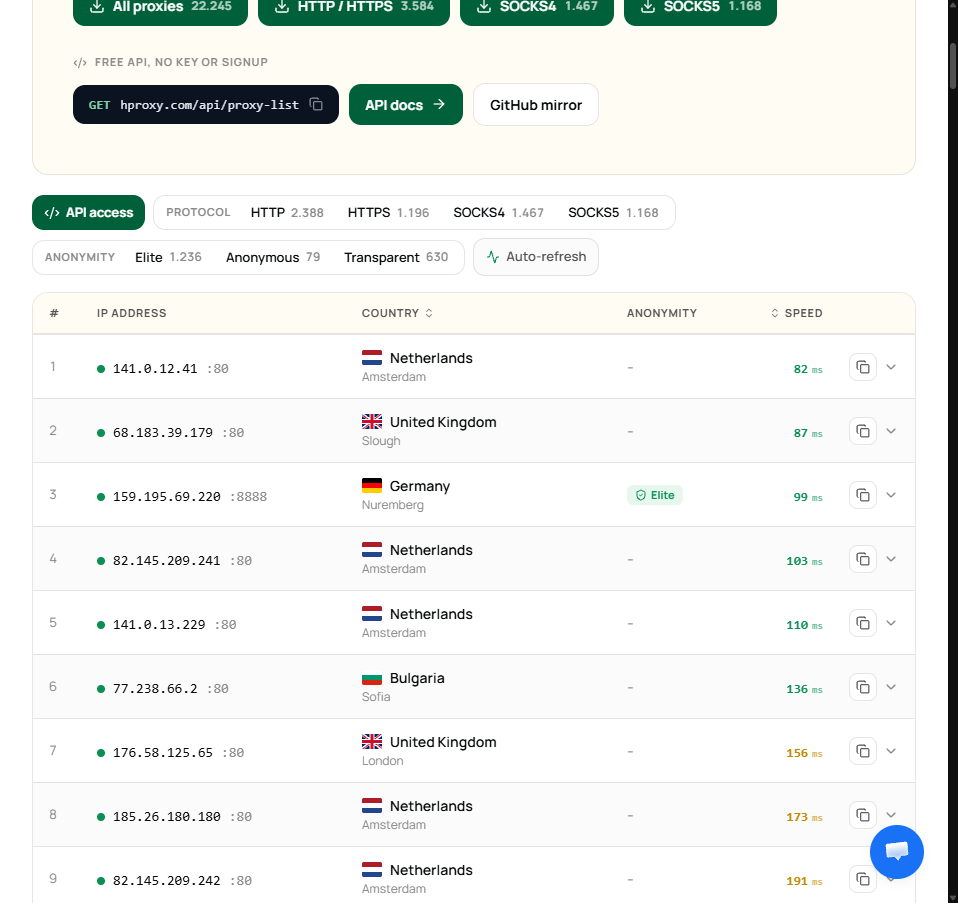
Our free proxy list runs exactly this loop. It re-checks and refreshes every few minutes, drops the dead entries, and keeps thousands of verified proxies across 100+ countries and HTTP, HTTPS, SOCKS4, and SOCKS5. It is a truer list rather than a bigger one, and truth is the only metric that saves you time here.
Filtering and exporting the mega list
Nobody consumes a mega list by scrolling thousands of rows. That is the wrong mental model. You treat the whole pool as raw material, narrow it to the exact slice you need, and export that slice. Filter first, export second.
The filters that matter are the same three every time:
- Country, so your traffic appears to come from where you need it.
- Protocol, so it matches what your tool speaks. Most browsers and scrapers use HTTP and HTTPS out of the box; reach for SOCKS5 when you need to carry non-web traffic or want the proxy to handle DNS.
- Anonymity grade, so you are not accidentally routing through a transparent proxy that leaks your real IP.
Once the slice is narrowed, exporting it should be trivial. A mega list worth using lets you copy clean ip:port lines straight into a browser, scraper, or curl command, download the filtered set as a plain text file, or pull it through an API so a script can fetch a fresh batch on its own without a human copying anything. The API path is what makes a live mega list practical for automation: your scraper asks for "SOCKS5, Germany, elite" and gets back only proxies that were verified minutes ago.
One rule survives every filter and every export: test before you trust. Because free proxies die in minutes, an entry that was alive when you copied it can be gone by the time your job runs, so verify right before use, not when you first grabbed it. Our full walkthrough on how to check if a proxy is working covers testing for speed and anonymity, and if you would rather skip the terminal, paste any entry into our free proxy checker and it reports the exit IP, country, latency, and anonymity grade in one pass. Do this on a sample of your exported slice and you will know in seconds whether the batch is worth running.
When a mega list is enough, and when it is not
A free proxy mega list is genuinely useful for a specific band of work, and genuinely the wrong tool outside it. Knowing where that line sits saves you a lot of pain.
It is the right call when the task is high-volume and disposable and you want to spread requests across many IPs: light scraping at scale, checking whether pages are geo-blocked from different countries, grabbing screenshots from abroad, load-testing your own endpoints, or just learning how proxies behave. When a proxy dying mid-task costs you nothing but the ten seconds it takes to swap in the next one from a live list of thousands, free is a reasonable and even smart choice.
It is the wrong tool the moment reliability or trust enters the picture. Never send logins, payments, or anything personal through a free proxy, because you do not know who runs it or what they log. Do not build a business process on one, because it will vanish at the worst possible time. And do not expect a free datacenter IP, even one from a beautifully maintained mega list, to slip past serious bot defenses, because sites that fight automation flag datacenter ranges early and often. That is a limit of what the proxies are, not how fresh the list is.
When you cross that line, the answer is not a bigger free list, it is a different kind of proxy. Residential proxies route through real home connections, so they read as ordinary users instead of servers. Ours start at $0.44 per GB, pay-as-you-go, with no KYC, so you can test the difference on a real task without a contract or a sales call.
Get a live free proxy mega list
The short version of everything above: ignore the headline size of any free proxy mega list and look at when it was last checked. If it does not show you that, assume it is a graveyard.
Start with our free proxy list. It re-checks every few minutes, drops the dead entries automatically, and keeps thousands of verified proxies across 100+ countries and all four protocols, so what you export was alive moments ago instead of last year. It is the same category everyone else calls a mega list, built around the one feature that actually makes the size mean something. If you are new to the whole space, our overview of free proxies covers the fundamentals first.
If you already have proxies from somewhere else, run them through the proxy checker before you rely on them. And when a task outgrows what free can do, residential at $0.44/GB with no KYC is one step up, so you move up only for the jobs that truly need it. Bookmark a mega list that stays checked, test before you trust, and thousands of working proxies stop being a myth.
Sources
- HProxy free proxy data study: the 129M-check dataset behind the discovered-vs-alive figures used in the math above.
- RFC 1928: SOCKS Protocol Version 5: the SOCKS5 handshake a live checker has to complete to confirm the protocol.
- RFC 7239: Forwarded HTTP Extension: the headers a transparent proxy leaks and an elite one omits.